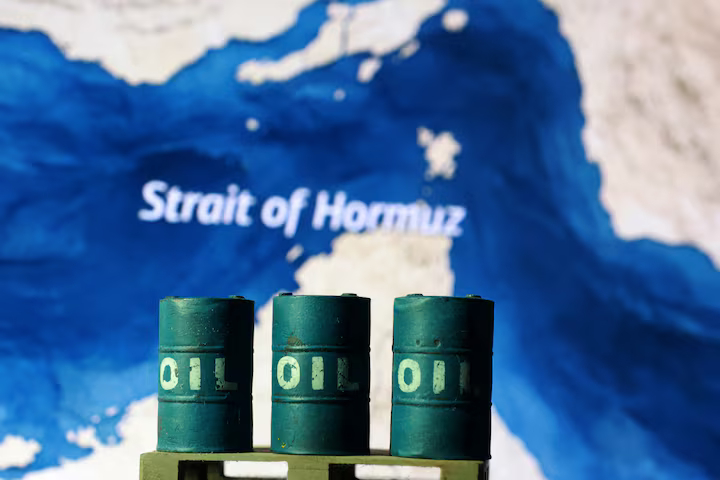
Something significant is happening in the derivatives market, and it is not subtle. Over the past month, bets on Brent crude hitting $150 a barrel by the end of April have increased tenfold. Open interest in $150 call options has jumped from roughly 3,400 lots to nearly 29,000 — each lot representing 1,000 barrels of oil. At current prices, that position is worth close to $3 billion. Traders are not necessarily predicting $150 oil; they are paying to be covered if it happens. The scale of the hedging activity tells a stark story about how professional markets are reading the Hormuz crisis.
Brent is currently trading around $107 a barrel, up nearly 50% since February 28, when U.S. and Israeli forces launched Operation Epic Fury and Iran effectively blockaded the strait. That move alone — from roughly $72 to $107 — has already generated an energy shock that typically takes years to develop. What the options market is signaling now is that traders see a meaningful probability of a second, larger move. The all-time Brent record is $147.50, set in 2008. That ceiling is now within range if the strait remains closed into May.
What the Options Positions Actually Show
The architecture of the current positioning reveals a market that sees extreme outcomes in both directions but assigns a higher probability to further price spikes.
Extreme Upside: Open interest in $160 call options has gone from zero to nearly 15,000 lots. There are even active positions on $200 to $240 oil.
The Anchor: The largest single position remains the $100 call, with over 61,000 lots of open interest. This is where professional money is “anchored,” pricing in an environment where oil stays elevated rather than collapsing.
The Downside: Put options are concentrated between $45 and $70 a barrel. This suggests traders believe a return to pre-war prices is a “tail scenario” (unlikely) rather than the base case.
“These calls are clear signs that investors see tail risk outcomes to the current conflict,” one senior derivatives analyst told Reuters. As long as oil cannot flow out of the Gulf, the risk of outright physical shortages remains.
The Physical Reality Behind the Financial Signal
Roughly one-fifth of the world’s daily oil supply is currently trapped in the Gulf. War-risk insurance has been repriced or withdrawn on many routes, and shipping costs have surged. The impact is compounding: storage capacity near the strait is filling, and the logistical architecture for rerouting supply around the Cape of Good Hope is approaching its limits.
The tentative diplomatic signals — talks through Pakistani intermediaries and Trump’s claims of “productive” conversations — have introduced enough uncertainty to keep markets volatile without resolving the supply problem. A deal struck in the next week would look very different to oil markets than one struck in late May, by which point seasonal demand picks up and storage buffers thin further.
The Federal Reserve is watching this with limited options. Raising rates to combat oil-driven inflation risks accelerating a slowdown in an economy already absorbing equity market losses. Holding rates risks entrenching inflationary expectations. The traders positioning for $150 oil are acknowledging that the military and policy decisions required to prevent it have not yet been made.
Original analysis inspired by Amanda Cooper and Robert Harvey from Reuters. Additional research and verification conducted through multiple sources.