The transformation of global energy systems represents far more than technological progression in response to environmental imperatives. Throughout the Middle East particularly, this process constitutes fundamental geopolitical restructuring that redefines power relationships, alliance configurations and diplomatic practices. The essential inquiry concerns not whether regional actors confront energy system transformation, but rather whether this evolution actually redistributes influence across the international system.
Persistent Hydrocarbon Relevance Despite Renewable Investment
Energy long functioned as foundational element undergirding Western-dominated international order across Middle Eastern regions. Petroleum and natural gas flows sustained strategic partnerships, security commitments and political sway, especially between American interests and Gulf producing states. Current conditions subject this framework to intensifying pressures as Asian consumption patterns shift, Chinese strategic presence expands, Russian energy influence persists and regional diversification strategies advance.
Despite substantial renewable energy investment, hydrocarbons retain geopolitical significance according to both International Energy Agency and OPEC assessments. IEA’s 2025 World Energy Outlook Current Policies Scenario projects oil and gas demand continuing through 2050 without peaking, particularly across geopolitically sensitive regions including Middle Eastern territories. Recent global disruptions have reinforced rather than diminished this reality.
Ukraine conflict provided acute demonstration of energy’s rapid repoliticization capacity. IEA characterized Russia’s February 2022 invasion as sparking “the first truly global energy crisis” with effects persisting years afterward. European energy policy assessments documented how supply disruptions translated directly into geopolitical leverage, with energy reverting to strategic instrument status rather than neutral commodity designation. This development exposed vulnerabilities in global markets and political alignments.
Autonomous Energy Diplomacy Emergence
What transformed involves not energy’s importance but rather who exercises leverage and through which mechanisms. Middle Eastern producers no longer function as passive suppliers embedded within fixed security arrangements. These actors increasingly deploy autonomous strategies utilizing energy as diplomatic instrument rather than mere export commodity.
Saudi Arabia’s energy diplomacy recalibration, United Arab Emirates’ parallel hydrocarbon and renewable investments, and Qatar’s long-term liquefied natural gas contracting reflect strategic, interest-driven positioning. Analysis from Columbia University’s Center on Global Energy Policy and Middle East Institute pointed to Qatar’s extended LNG agreements with Asian and European purchasers as deliberate movement away from short-term market exposure toward geopolitical risk hedging and strategic predictability.
Russia’s 2022 Ukraine invasion upended LNG markets, causing European buyers to purchase record volumes compensating for pipeline gas interruption. This dynamic prompted renewed focus on supply security and long-term contractual arrangements. Qatar has actively pursued extended supply contracts with both new European buyers and existing Asian partners, though negotiations face complications regarding duration, destination restrictions and pricing mechanisms.
Energy Transition Technologies as Geopolitical Assets
Simultaneously, technologies associated with energy system transformation themselves constitute emerging geopolitical assets. Control over critical mineral resources, renewable manufacturing capabilities, hydrogen infrastructure networks and energy-related information systems generates novel dependency forms and influence vectors.
Studies by International Renewable Energy Agency emphasize how critical minerals access and clean-energy supply chains emerge as new strategic power sources. IRENA analysis warns that mining and processing of critical materials exhibits geographic concentration, with few countries and major companies playing dominant roles. External shocks, resource nationalism, export restrictions, mineral cartels, instability and market manipulation could therefore increase supply shortage risks.
World Bank assessments similarly underline emerging strategic power from critical minerals access, though no universally accepted criticality definition exists. IEA analysis emphasizes that Democratic Republic of Congo and China controlled approximately 70 percent and 60 percent respectively of global cobalt and rare earth element production in 2019, with concentration levels even higher for processing operations where Chinese share approaches 90 percent for rare earths.
Multipolar System Dynamics
These transformations unfold within rapidly multipolarizing international architecture. American actors remain key players in Middle Eastern energy security yet no longer function as uncontested arbiters. Chinese expanding footprint introduces novel diplomatic dynamics.
Data from US Energy Information Administration confirms China’s status as world’s largest crude oil importer since 2013, surpassing United States. China imported 11.1 million barrels daily in 2024, with Middle Eastern sources including Saudi Arabia, Iraq, Oman and UAE providing substantial volumes. This development reshapes regional energy alignments while reducing Western influence exclusivity.
Russia persists as energy actor despite sanctions and political isolation, maintaining influence through coordination mechanisms and strategic partnerships. This multipolar environment provides Middle Eastern states greater maneuvering capacity, enabling strategic balancing and external relations diversification. Simultaneously, it exposes them to intensified great-power competition where energy intersects sanctions regimes, technological rivalry and security dilemmas.
Energy Repoliticization Through Transition
Contrary to optimistic assumptions, energy transition processes do not depoliticize energy but rather repoliticize it through novel mechanisms. Renewable projects embed within financing structures, technology transfers and geopolitical alignments. Energy corridors intersect maritime security concerns, regional conflicts and diplomatic competition. Climate diplomacy itself has become contested terrain.
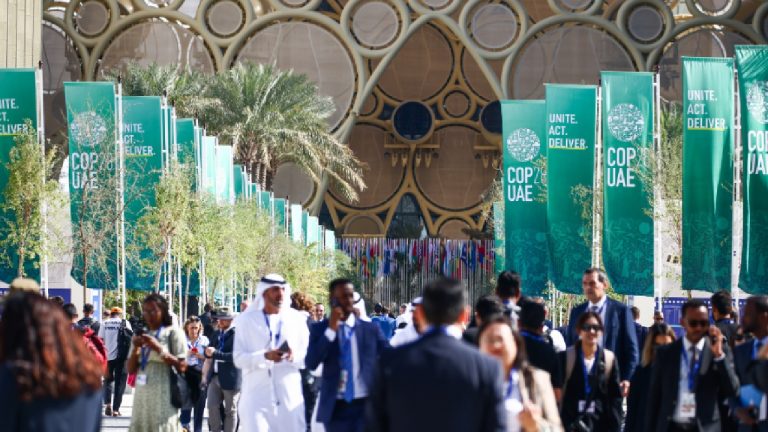
Just transition concepts illustrate this tension clearly, with UN climate frameworks revealing deep disagreements between developed and developing economies over responsibility attribution, timing parameters and cost-sharing arrangements. Discussions at COP29 and COP30 demonstrated continuing fault lines, with developed countries focusing primarily on workforce dimensions while developing countries sought broader scope reflecting comprehensive societal transformation.
Developing countries led by Like-Minded Developing Countries, Arab Group and African Group articulated concerns about cross-border impacts of unilateral trade measures on just transition pathways. For numerous Middle Eastern states, rapid decarbonization absent economic diversification risks social instability and political backlash. Consequently, energy diplomacy increasingly emphasizes managing transition pace, securing investment flows and preserving state capacity rather than embracing abrupt transformation.
Sanctions and Alternative Partnerships
This dynamic proves particularly salient for states confronting sanctions or sustained geopolitical pressure. For such actors, energy remains among few viable international engagement channels. UN monitoring reports and international think tank policy analyses demonstrate energy’s continued function as diplomatic interface through which states negotiate relief, build alternative partnerships and maintain strategic relevance outside traditional Western frameworks.
UNDP Climate Promise analysis notes that transition to low-carbon economies can produce undesired consequences including elevated living costs, employment displacement, income loss and increased energy and food insecurity. Moreover, it risks widening socioeconomic divides between developed and developing nations.
Distributed Power and Strategic Adaptation
The outcome constitutes a Middle East where energy no longer guarantees dominance yet still enables influence exercise. Power distribution no longer concentrates solely in resource endowments but disperses across infrastructure, technology, finance and diplomatic agility dimensions. States recognizing this shift actively reposition themselves, while those failing adaptation risk strategic marginalization.
Ultimately, regional futures will not be determined by energy transition success or failure alone, but rather by how effectively Middle Eastern actors navigate its geopolitical consequences. This transition does not represent linear progression toward post-energy political order. Instead, it constitutes contested process shaped by power struggles, strategic calculations and uneven global governance.
Viewed through this analytical lens, Middle Eastern energy transition involves less about abandoning conventional fuels and more about rewriting influence rules. This represents not merely technological shift but rather power redistribution throughout a region where energy has consistently remained political.
Original analysis by Dr. Kamran Yeganegi for Middle East Monitor. Republished with additional research and verification by ThinkTanksMonitor.