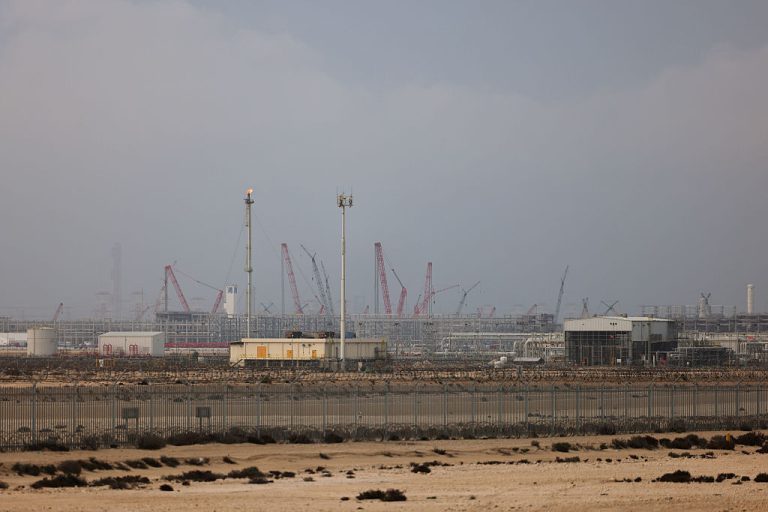
On Wednesday, Israeli warplanes struck the onshore processing hub for South Pars — the world’s largest natural gas field, shared between Iran and Qatar beneath the floor of the Persian Gulf. Within hours, Iran retaliated by firing missiles at Qatar’s Ras Laffan Industrial City, the world’s largest LNG production facility, causing extensive damage and igniting massive fires. By Thursday morning, European gas prices had surged 35%, Qatar had expelled Iran’s military attachés, Saudi Arabia had intercepted missiles aimed at Riyadh refineries, and Trump had threatened to massively blow up the entirety of South Pars if Iran struck Qatar again.
The exchange marks the most dangerous escalation of the three-week war — one that transforms the conflict from a military campaign into an energy war with consequences that will outlast the fighting by years. A sustained Gulf energy crisis could trigger stagflation — a simultaneous supply shock, inflation spike, and financial instability — reminiscent of the 1973 Arab oil embargo but amplified by today’s tightly integrated global supply chains.
One Field, Two Countries, Total Destruction
The geology is what makes the escalation so reckless. South Pars and Qatar’s North Dome are not merely adjacent — they are geologically continuous. Reservoir pressure, extraction dynamics, and environmental consequences are shared. The entire field contains an estimated 1,800 trillion cubic feet of usable gas — enough to supply the world’s needs for 13 years.
On the Iranian side, South Pars produces 730 million cubic meters of gas per day — a record achieved only weeks ago. That production supplies 70% of Iran’s domestic gas consumption, feeding power plants, heating systems, and the petrochemical complexes that sustain what remains of the country’s sanctioned economy. The Israeli strike took offline processing capacity for approximately 100 million cubic meters per day — roughly 14% of South Pars output.
The Iraqi News Agency quoted its Electricity Ministry spokesperson as saying Iranian gas supplies to Iraq had been halted, sharply curbing power production. Iran supplies roughly one-third of Iraq’s gas and power needs — meaning the strike on South Pars immediately plunged millions of Iraqis into darkness.
On the Qatari side, the damage may prove even more consequential. Ras Laffan produces about 20% of the world’s LNG supply, playing a major role in balancing Asian and European markets. Iran’s strike will cut an estimated 17% of Qatar’s LNG export capacity for up to five years, officials say. Analysts at Wood Mackenzie said the attacks fundamentally reshape the global LNG outlook, with disruption now likely to last longer than two months.
The Coordination Question
Trump insisted the US had no prior knowledge of Israel’s strike. The United States knew nothing about this particular attack, he wrote on Truth Social. But a US defense official confirmed to Axios that Israel’s strike on South Pars was coordinated with and approved by the Trump administration. An Israeli official separately told CNN the same thing.
The contradiction is politically explosive. Qatar — which had been one of Washington’s most important mediators with Iran and had hosted the nuclear talks that preceded the war — condemned Israel’s strike as a dangerous and irresponsible step, with its spokesman saying targeting energy infrastructure constitutes a threat to global energy security. Hours later, Iranian missiles hit Ras Laffan. Qatar’s prime minister rejected Tehran’s justification outright: There were persistent Iranian claims that these attacks are against American interests… and this claim is rejected and cannot be accepted. The clear proof of this is the attack that took place yesterday that targeted a natural gas facility in the State of Qatar.
The Gulf Erupts
Iran made good on its threat to widen the energy war. Tasnim news agency listed five specific facilities that would be targeted: Saudi Arabia’s SAMREF refinery and Jubail petrochemical complex, the UAE’s Al Hosn gas field, and Qatar’s Ras Laffan refinery and Mesaieed petrochemical complex. Iran attacked Qatar’s LNG complex, targeted a gas field and facility in the UAE, fired missiles and launched drones on a Saudi Arabian oil refinery and on two Kuwaiti gas units on Thursday.
Saudi Arabia then said it reserved the right to take military actions against Iran if deemed necessary — the most aggressive statement Riyadh has made since the war began. Saudi Arabia’s Defense Ministry said it had intercepted an Iranian missile targeting the port of Yanbu, which has become a backup route for Saudi oil exports given the Hormuz blockade. Saudi Foreign Minister Prince Faisal bin Farhan reportedly said what little trust there was before with Iran has completely been shattered.
The UAE called the South Pars strike a serious escalation posing a direct threat to global energy security, and labeled Iran’s targeting of its Habshan gas facility and Bab field a terrorist attack.
The “No Man’s Land” Fear
The Gulf states’ dilemma is captured in a single contradiction. They argued against this war, correctly predicting they would bear the brunt of Iran’s retaliation for a conflict they neither started nor endorsed. But now that Iran is widening its assault on their infrastructure, they also fear what comes next from an emboldened Tehran if America and Israel don’t finish the job.
A source familiar with Saudi thinking told the Financial Times that Riyadh did not want regime change in Iran but did want a weakened Tehran. There is a cost to what’s happening, but to what extent do you want to say: ‘Let’s not stop now. Just give it another push,’ the source said. You don’t want to end up in no man’s land. A senior Gulf official told the Wall Street Journal that the only acceptable outcome would be an Iran so defanged and enfeebled that it could never imperil its neighbors again.
The calculation has shifted from “end this war” to “if you’re going to do this, do it properly.” That is a dangerous evolution — not because the Gulf states are wrong about the threat Iran poses, but because it aligns their interests with an open-ended American military campaign that has no defined objectives, no congressional authorization, and no exit strategy.
Trump’s Threat — and Its Contradictions
Trump’s response was his most extreme of the war. He threatened Iran to halt its attacks on Qatar’s facilities or face severe US strikes: The United States of America, with or without the help or consent of Israel, will massively blow up the entire South Pars Gas Field at an amount and strength and power that Iran has never seen or witnessed before.
The threat is staggering in its implications. Destroying South Pars entirely would eliminate 70% of Iran’s domestic energy supply, plunge the country into a humanitarian catastrophe, and simultaneously devastate the shared reservoir that underpins Qatar’s entire economy. Economist Mohit Kumar of Jefferies noted the US had been trying to avoid hitting energy infrastructure to keep a lid on oil prices, but Israel’s attack on Iran’s gas field showed that as the war drags on, any red lines are likely to get blurred.
French President Macron called for an immediate moratorium on strikes targeting civilian infrastructure: It is in our common interest to implement, without delay, a moratorium on strikes targeting civilian infrastructure, particularly energy and water supply facilities. Germany’s foreign minister warned of a crisis of the gravest order if global supply chains continued to be disrupted.
The war has now entered the phase that energy analysts feared most: an energy-for-energy escalation dynamic in which critical infrastructure on both sides of the Gulf becomes the primary target. Rachel Ziemba of the Center for a New American Security noted that Ras Laffan’s pre-existing production shutdown meant there would be no immediate new supply shock — but the physical damage could delay restart for years. Twenty days in, the war is no longer just destroying military targets. It is destroying the energy infrastructure that heats European homes, powers Asian factories, and keeps the lights on in Baghdad. The damage being done this week will still be felt in 2030.
The Media Tells the Story
As Kareem Shaheen of New Lines Magazine notes, the shift is visible not just in official statements but in what Gulf media outlets do and don’t cover. Saudi columnist Abdulrahman al-Rashed, writing in Asharq Al-Awsat, argued that Trump appears committed to carrying on the war and that Gulf states have no desire to join as long as they do not have to. The qualifier is doing enormous work in that sentence. Two weeks ago, the emphasis was on “no desire to join.” Now it has shifted to “as long as they do not have to” — leaving the door open for exactly the kind of participation that Gargash signaled from Abu Dhabi.
The Gulf International Forum warned before the war that Iran’s attacks would force Gulf states to choose between restraining Washington and protecting their own infrastructure — and that every Iranian escalation would push them closer to active participation. That prediction is now playing out in real time.
The question is whether the Gulf’s anger translates into military action or remains confined to diplomatic gestures and UN resolutions. The Security Council adopted a Bahrain-sponsored resolution condemning Iran’s attacks on Gulf states last week, with Russia and China abstaining. But resolutions don’t intercept missiles. And as Iranian drones continue to strike refineries, airports, and gas processing facilities across the Gulf, the political space for neutrality shrinks with every explosion.
Iran’s strategy of punishing American allies to pressure Washington is producing the opposite of its intended effect. Rather than driving a wedge between the US and the Gulf, it is welding them together — reluctantly, angrily, and with full awareness of the irony that the countries most opposed to this war may end up joining it because the country they tried to protect from it is now attacking them.
Original analysis inspired by Kareem Shaheen from New Lines Magazine. Additional research and verification conducted through multiple sources.