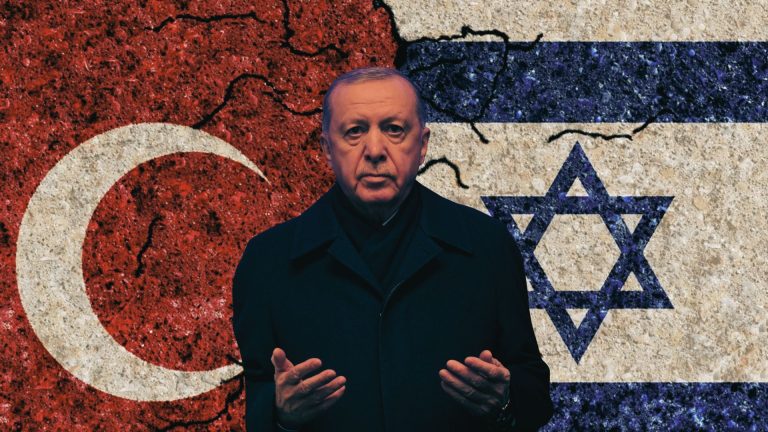
Turkey has moved well beyond angry press conferences and recalled ambassadors. Since October 7, 2023, Ankara has waged a systematic campaign using courts, trade restrictions, airspace closures, and international institutions to isolate Israel diplomatically and legally. What distinguishes this effort from earlier episodes of Turkish-Israeli friction — including the 2010 Mavi Marmara crisis — is the deliberate shift from protest to prosecution, turning political grievances into formal proceedings designed to outlast any single war.
The breadth of Ankara’s actions suggests something bigger than a reaction to the Gaza conflict. Turkey is using the confrontation with Israel as a vehicle for a larger ambition: positioning itself as a leading voice in reshaping international norms, while simultaneously securing a seat at the table in post-war Gaza governance.
From Rhetoric to Courtrooms
Turkey’s engagement with international courts has been aggressive and multifaceted. In August 2024, Ankara filed a declaration of intervention at the International Court of Justice, joining South Africa’s case accusing Israel of violating the Genocide Convention. That step transformed Turkey from a vocal critic into an active legal party in a state-versus-state proceeding. Ankara also participated in ICJ advisory opinion hearings on Israel’s presence in Palestinian territories, treating the court’s non-binding recommendations as if they carried the weight of settled law.
At the International Criminal Court, Turkey pushed for personal criminal liability against Israeli decision-makers, despite not being a party to the Rome Statute. This involved feeding materials to the Office of the Prosecutor, lobbying for expedited warrants, and publicly framing delays as proof of institutional bias. Then in November 2025, the Istanbul Chief Public Prosecutor’s Office issued arrest warrants against 37 Israeli figures, including Prime Minister Benjamin Netanyahu, invoking universal jurisdiction. The warrants carry no realistic enforcement power, but they restrict the travel of senior Israeli officials and signal to third countries that engagement with Israel carries reputational risk.
This three-pronged approach — the ICJ, the ICC, and domestic courts — is designed to keep Israel in a state of permanent legal exposure, regardless of whether any single proceeding produces a binding ruling.
Economic and Physical Walls
Ankara backed its courtroom strategy with tangible punitive measures. In May 2024, Turkey suspended all trade with Israel, initially targeting 54 categories of goods before expanding the ban to cover imports and exports worth billions of dollars. When indirect trade through third parties continued, Turkey cracked down on its own exporters. By August 2025, the restrictions went further: Ankara closed its airspace to Israeli government aircraft and flights carrying weapons, and barred Israeli-linked ships from Turkish ports.
Turkey also blocked NATO cooperation with Israel, vetoing joint exercises, meetings, and coordination mechanisms. At the July 2024 NATO summit, Erdogan declared that no country could feel safe while Israel operated outside international law — an extraordinary statement from a member of the alliance that has maintained a partnership with Israel for decades.
The Turkish parliament added its own weight, passing resolutions calling for Israel’s suspension from the UN and urging parliaments worldwide to sever military and commercial ties. A separate bill proposed stripping citizenship from Turkish nationals who served in the IDF during the Gaza conflict. Even if not all measures become law, their advancement normalizes the idea of collective punishment as policy.
The Gaza Endgame
Turkey’s confrontation with Israel is not only backward-looking. Ankara has secured a direct role in the governance discussions for post-war Gaza. Foreign Minister Hakan Fidan holds a seat on the Gaza Executive Board, part of the U.S.-proposed Board of Peace overseeing Trump’s 20-point plan for the territory. Turkey also positioned itself as a guarantor of the ceasefire, alongside Egypt and Qatar.
This creates a pointed contradiction. The same government issuing arrest warrants against Israeli leaders now sits across from Israel in a reconstruction framework. For Jerusalem, a Turkish military or administrative presence in Gaza — even under international cover — amounts to a red line, given Ankara’s ideological proximity to Hamas and the depth of the bilateral rupture since October 2023.
Istanbul also hosted the unofficial Gaza Tribunal in October 2025, a four-day quasi-judicial event that heard testimony and issued a verdict accusing Israel of genocide. The tribunal carries no legal authority, but its evidentiary record was explicitly designed to feed into formal proceedings at The Hague.
Turkey’s motivations are layered. The Palestinian cause resonates deeply with Erdogan’s domestic base, and the PKK’s decision to disarm in May 2025 has reduced one source of international criticism that previously complicated Ankara’s moral positioning. Strong personal ties between Erdogan and Trump have given Turkey diplomatic cover, while the broader erosion of the post-1945 order has lowered the cost of challenging Western norms. The net effect is a relationship between Turkey and Israel that has moved from managed tension to what amounts to strategic severance — a break that legal precedents and institutional resentments will make exceptionally hard to reverse.
Original analysis inspired by Tammy Caner and Gallia Lindenstrauss from INSS. Additional research and verification conducted through multiple sources.