While Donald Trump demands that China send warships to the Strait of Hormuz, Beijing is sending something else entirely: humanitarian aid to the countries being hit by the war Trump started. On Tuesday, China announced emergency assistance to Iran, Lebanon, Iraq, and Jordan — its first material response to the conflict — in a move that simultaneously positions Beijing as the region’s responsible partner and delivers a quiet rebuke to Washington’s request for military cooperation.
The timing was exquisite. Hours before the aid announcement, Trump confirmed he was postponing his planned March 31 visit to Beijing. Hours after it, China’s foreign ministry spokesman declined to say whether Beijing had received any formal request for naval assistance in the strait. The message required no translation: China will help the Middle East on its own terms, not Washington’s.
Four Countries, Four Crises
The aid package covers countries facing vastly different pressures from the same war. Iran has absorbed more than 1,400 deaths from US and Israeli strikes, with 3.2 million people internally displaced. Lebanon has suffered over 900 killed and more than a million displaced since Israel launched its campaign against Hezbollah on March 2. Jordan has been struck by Iranian drones and missiles — collateral damage from a war it explicitly warned Washington not to start. Iraq has seen fighting between Iran-backed militias and US forces in Baghdad and Erbil, with its last functioning oil export terminal shut down after tanker attacks in Basra’s waters.
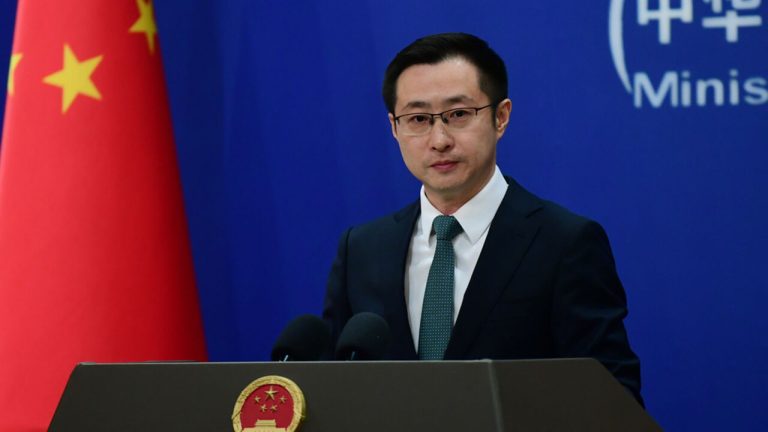
Chinese Foreign Ministry spokesperson Lin Jian offered no details on the scale or composition of the aid, writing only that “we hope this will help ease the difficult humanitarian situation facing the people there.” The vagueness is characteristic of Beijing’s approach to the crisis: signal concern, avoid commitment, and let Washington’s isolation speak for itself.
Beijing had already dispatched its special Middle East envoy, Zhai Jun, to the region less than two weeks ago. He met with the foreign ministers of Saudi Arabia, the UAE, and Bahrain last week, and with his Kuwaiti counterpart on Sunday — a diplomatic tour that mirrors the one Turkey’s Erdogan conducted in early February but with a different purpose. Where Ankara was building a Sunni coalition, Beijing is building a reputation as the power that shows up with food and medicine while America shows up with bombs.
The Summit That Wasn’t
Trump’s postponement of the Beijing visit removes what was supposed to be the centerpiece of his spring diplomatic calendar. The original March 31-April 2 trip was designed to produce a spectacle: a grand deal on trade, a reset in US-China relations, and photographs of the two leaders that would project stability to rattled global markets. The war made all of that impossible.
Treasury Secretary Scott Bessent insisted the delay “would have nothing to do with the Chinese making a commitment to the Strait of Hormuz.” Trump said there were “no tricks.” China rejected any connection between the visit and the strait. None of these denials were persuasive. Multiple Americans with contacts in the Chinese government told Foreign Policy that Chinese officials were having difficulty reaching their US counterparts to coordinate arrangements — a sign that the war has consumed Washington’s bandwidth so thoroughly that basic diplomatic logistics are breaking down.
Trump told reporters in the Oval Office that he would travel in five or six weeks instead. But the conditions that made the summit difficult this week — the Hormuz crisis, the oil shock, the war’s expansion into Lebanon — are unlikely to improve on that timeline. The Pentagon is planning for contingencies lasting at least 100 days. Israel’s defense minister says operations will continue “without any time limit.” A delayed summit risks becoming a cancelled one.
The Oil Arithmetic
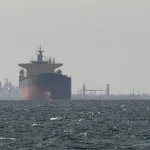
China’s immediate vulnerability is real but manageable — for now. Before the war, China received 5.35 million barrels per day through the Strait of Hormuz. That figure has collapsed to roughly 1.22 million, coming exclusively from Iranian tankers that Tehran still guarantees safe passage. CNBC reported that Iran shipped 11.7 million barrels of crude through the strait since the war began, all bound for China — though it is uncertain whether those shipments have continued as traffic has slowed further.
China held an estimated 1.2 billion barrels of onshore crude stockpiles as of January, according to data analytics firm Kpler. Beijing also increased its oil purchases by roughly 16% in January and February compared with the same period in 2025 — suggesting that Chinese intelligence may have anticipated the conflict, or at least hedged against the possibility. At current consumption rates, those reserves provide approximately six to eight weeks of buffer before supply constraints force industrial output cuts.
Tehran has reportedly offered to allow tankers carrying yuan-denominated cargo to transit the strait — a gesture designed to cultivate goodwill in Beijing and advance Tehran’s long-standing goal of de-dollarizing oil trade. The practical obstacles are enormous: wartime insurance is unavailable, GPS interference is widespread, and sailors are understandably reluctant to enter a combat zone. But the symbolism matters. Every barrel of Iranian oil that reaches China in yuan is a small crack in the dollar-denominated energy system that has underpinned American financial hegemony for fifty years.
The Leverage Beijing Won’t Use — Yet
Trump’s demand that China send warships to help reopen the strait was never realistic. Even long-term US allies like Japan and Australia have refused. China maintains a small anti-piracy task force in the Gulf of Aden, but deploying it alongside American forces against a strategic partner would violate every principle of Chinese foreign policy articulated over the past two decades.
What Beijing possesses is not military leverage but economic leverage — and it is choosing, for now, not to deploy it. China holds approximately $760 billion in US Treasury securities. It controls over 90% of the world’s rare earth magnet production. It is the largest trading partner of every Gulf state. Any of these could be weaponized in a crisis. None have been — yet.
Instead, Beijing is playing a longer game. The humanitarian aid positions China as a constructive actor at minimal cost. The envoy’s regional tour builds diplomatic relationships that will outlast the war. The continued purchase of Iranian oil — sanctions or no sanctions — deepens Tehran’s dependence on Chinese markets. And the summit postponement denies Trump the photo opportunity he wanted while preserving the option for engagement when conditions improve.
The war Trump launched to demonstrate American power is instead demonstrating its limits — and every country in the world is drawing lessons. China’s lesson appears to be that the best response to American overreach is not confrontation but patience. Let Washington exhaust itself. Send aid to the countries it bombed. Buy the oil it can’t block. And wait for the call that always comes — not for warships, but for someone to help clean up the mess.
Original analysis inspired by Rosaleen Carroll from Al-Monitor. Additional research and verification conducted through multiple sources.