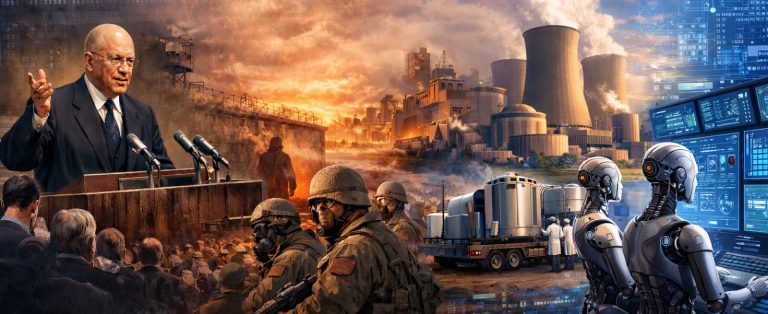
In December 1953, Dwight Eisenhower stood before the United Nations and urged the world to strip the atom of its military casing and harness it for peace. Seven decades later, that vision is being reborn — not by governments or generals, but by Mark Zuckerberg, Satya Nadella, and a generation of tech executives who need electricity on a scale that no wind farm or solar array can reliably deliver. The artificial intelligence revolution is forcing the United States into a shotgun marriage with nuclear power, and the ceremony is already underway.
The numbers are staggering. The Federal Energy Regulatory Commission reported that US data center electricity demand is expected to climb to 35 gigawatts by 2030, up from 19 GW in 2023. By that point, the US economy may consume more electricity for processing data than for manufacturing all energy-intensive goods combined — including aluminum, steel, cement, and chemicals. A medium-sized data center consumes as much electricity as 100,000 households. Data centers, AI, and cryptocurrencies accounted for 2% of global electricity consumption in 2022, a figure the IEA says may double by 2026 — and the combined consumption of Amazon, Microsoft, Google, and Meta alone more than doubled between 2017 and 2021.
Big Tech Goes Nuclear
The corporate stampede toward atomic energy has been breathtaking. Meta cut a trio of deals in January to power its AI data centers, securing enough energy to light the equivalent of about five million homes through agreements with TerraPower, Oklo, and Vistra. Its Prometheus facility in New Albany, Ohio — a 1-gigawatt cluster spanning multiple buildings — is anticipated to come online this year and is expected to be the world’s first gigawatt-capable data center. Combined with an earlier deal with Constellation Energy, Meta’s agreements make it “one of the most significant corporate purchasers of nuclear energy in American history.”
Microsoft has taken a different route with similar ambitions. In late 2024, it entered a 20-year agreement with Constellation Energy to revive Three Mile Island’s Unit 1 in Pennsylvania, a $1.6 billion investment to restart a reactor dormant since 2019. Google and Amazon have both invested in startups developing small modular reactors. In the US alone, big tech companies have signed contracts for more than 10 GW of possible new nuclear capacity in the last year.
The appeal is simple: nuclear runs around the clock. IAEA Director General Manuel Grossi declared that “only nuclear energy can meet the five needs of low-carbon power generation, round-the-clock reliability, ultra-high power density, grid stability, and true scalability.” Solar panels produce power six hours a day on average; wind turbines run about nine. Goldman Sachs Research conversations with renewable developers indicate that “wind and solar could serve roughly 80% of a data center’s power demand if paired with storage, but some sort of baseload generation is needed to meet the 24/7 demand.”
The Waste Problem Nobody Solved
Yet enthusiasm has outpaced infrastructure in one critical area: what to do with the radioactive leftovers. The United States has no permanent plan for storage of nuclear waste; spent fuel rods sit in temporary storage at nuclear power plants, awaiting a solution. The country spent nearly $7 billion studying Yucca Mountain in Nevada as a permanent repository before the Obama administration shelved the project in 2010 without citing any technical or safety issues. The inventory of used fuel has now grown to more than 96,000 metric tons while the taxpayer liability for government inaction continues to increase. Congress has yet to approve an alternative, and the Nuclear Waste Fund — paid into by utilities for decades — remains frozen.
This gap poses a direct challenge to the buildout. The Department of Energy has pledged to quadruple America’s nuclear output from 100 GW to 400 GW by 2050. Trump has issued four executive orders aimed at modernizing regulatory frameworks, expediting reactor approvals, leveraging nuclear technology for national security, and expanding the domestic nuclear industrial base. But any rapid increase in reactors demands a commensurate increase in disposal capacity — and at the moment, there is none. The constraint in scaling nuclear capacity isn’t uranium availability — it’s enrichment capacity, specifically domestic enrichment that doesn’t rely on Russian or Chinese supply sources. The Department of Energy awarded $2.7 billion in January 2026 to strengthen domestic enrichment services over the next ten years.
China Isn’t Waiting
While Washington debates regulations and waste storage, Beijing is building. China currently operates 58 nuclear reactors and is building 44 more, totaling 102 facilities — and at this pace, it will surpass all other nations to become the world’s top nuclear operator by 2030, with a combined generating capacity of approximately 113 gigawatts. China and Russia now control nearly 90% of new nuclear power construction worldwide.
China’s Linglong One small modular reactor is scheduled to begin commercial operations in the first half of 2026 — which would make it the world’s first commercial onshore SMR. The US approved its first SMR design in 2022 but won’t have one operational until at least 2029. China is racing to build 150 new reactors by 2035, targeting 200 gigawatts — more than the rest of the world combined.
The geopolitical dimension is hard to overstate. Nuclear power has re-emerged as a strategic instrument for long-term geopolitical influence, rather than merely a source of electricity or a decarbonization tool. Countries that buy Chinese or Russian reactors enter dependencies lasting 60 to 100 years — covering fuel supply, maintenance, training, and technology upgrades. Nuclear exports function as high-value extensions of overseas strategic influence.
BloombergNEF expects about 15 reactors to come online globally in 2026, adding close to 12 gigawatts of new capacity — a meaningful rebound after one of the industry’s weakest years. The Palisades plant in Michigan, if successfully restarted, would become the first US nuclear facility to return to service after entering decommissioning. The question is no longer whether nuclear power will be part of the AI future — it’s whether the United States can build fast enough to remain in the race. Eisenhower’s dream of atoms for peace has returned, dressed in server racks and cooling towers. Whether America seizes it or cedes it to Beijing will shape both the energy grid and the geopolitical order for the rest of the century.
Original analysis inspired by Michael Ferguson from Global Security Review. Additional research and verification conducted through multiple sources.
Tags:
Categories: USA | China | Economics & Energy | War, Defense & Security