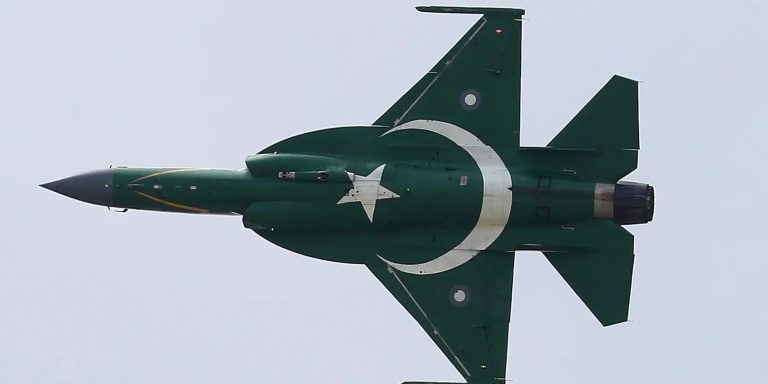
While Europe’s defense establishment was trading anxieties at the Munich Security Conference in February, a quieter revolution was unfolding thousands of miles away. Inside Pakistan’s National Aerospace Science and Technology Park in Rawalpindi, engineers guided startups through prototype development and students trained on flight simulators — the human infrastructure behind a fighter jet that is reshaping who gets to control the skies.
The JF-17 Thunder, co-developed with China and now assembled entirely at Pakistan’s Kamra facility, has gone from a budget alternative to a combat-proven platform. The aerial battle over Kashmir in May 2025 involved more than 114 aircraft — 72 Indian and 42 Pakistani — in what was described as the largest beyond-visual-range engagement on the India-Pakistan border. There is substantiating evidence that Pakistan brought down up to four planes, with a Washington Post visual investigation finding compelling evidence of three crash sites in India, identifying two of the crashed airplanes as types not operated by Pakistan — the French Rafale and Mirage-2000.+1
The effect on sales has been immediate. As of early 2026, Pakistan has confirmed defense export discussions with 13 countries across Africa, the Middle East, and Asia, with the JF-17 positioned as the core offering. Pakistan signed a $4.6 billion agreement with Azerbaijan for 40 JF-17 Thunder fighters — its largest-ever defense export. A $4–4.6 billion deal with Libya’s National Army followed in December 2025. Talks are active with Indonesia for roughly 40 jets, Bangladesh for up to 48, and Saudi Arabia over a potential $2–4 billion loan-conversion package. The JF-17’s unit cost is estimated between $25 million and $30 million, far cheaper than Western rivals like the F-16 or Rafale.+2
Turkey’s Drone Empire
Pakistan is not alone in this shift. Turkey now controls 65% of the global UAV export market, with Baykar alone contributing 60% of that share. Baykar generated $2.2 billion in exports in 2025, accounting for 88% of its total revenue. The Bayraktar TB2 — priced at roughly $5 million per unit versus $20 million for America’s MQ-9 Reaper — has been exported to 36 countries and battle-tested from Nagorno-Karabakh to Ukraine to Libya.+1
In five years, Turkish arms exports went from $2 billion to over $10.5 billion in 2025. SIPRI data shows Turkey’s arms exports surged by 103 percent from 2015–2019 to 2020–2024, making it the 11th top exporter worldwide. Turkey’s defense industry is attractive to countries desiring to develop their armed forces away from direct US or EU influence, as Turkish weapons sales usually come with fewer strings attached.+1
Together, these two countries are dismantling the financial and political barriers that long restricted credible aerial capability to a handful of wealthy states.
Washington Pushes Back
The U.S. is not watching passively. When Turkey purchased Russia’s S-400 air defense system, Washington blocked Ankara from acquiring advanced F-16 upgrades — a move that only accelerated Turkey’s indigenous programs. Washington has actively intervened to secure assurances from Saudi Arabia that it would not proceed with acquiring the JF-17, aligning with broader U.S. efforts to maintain dominance in Gulf arms sales by offering F-35s instead.
But the genie is out of the bottle. The prominent role of Chinese equipment in the India-Pakistan conflict has elevated China’s status in the global arms market, with analysts noting interest from Egypt, Saudi Arabia, and others. The conflict exposed the cost-performance gap between Chinese and Western systems, challenging the “brand premium” of European and U.S. platforms.
For decades, advanced airpower demanded massive budgets, deep technological ecosystems, and alignment with Western security networks that controlled access to cutting-edge aircraft, avionics, and precision weapons. Export controls and political conditionalities ensured the skies stayed guarded. That era is ending. Where Pakistan hopes for an edge is in offering a quality jet at a reasonable price, with the prospect of licensed assembly or even technology transfer — precisely the arrangement Western suppliers have historically withheld.
The result is a genuinely multipolar arms market where technological capability is no longer the exclusive domain of a few privileged states. Whether that redistribution of leverage produces stability or accelerates regional arms races is the question nobody in Munich thought to ask.
Original analysis inspired by Tanya Goudsouzian and Ibrahim Al-Marashi from Responsible Statecraft. Additional research and verification conducted through multiple sources.