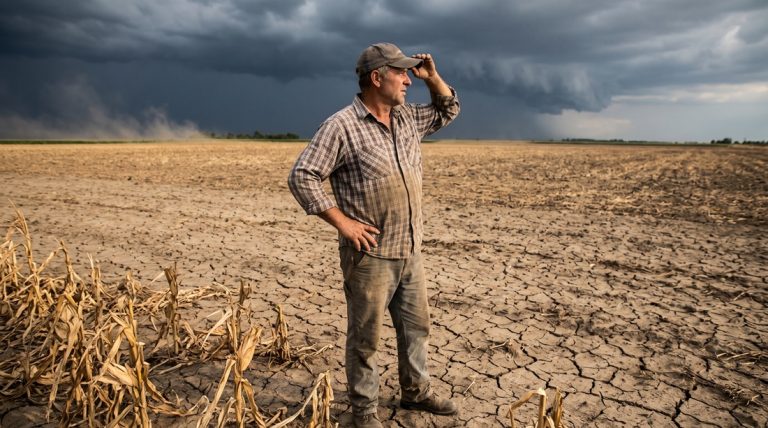
The most expensive part of El Niño may arrive after the floodwaters retreat and the weather maps return to normal. A failed harvest can leave a farmer without money for the next planting season, while damaged roads interrupt commerce long after a storm. With the Pacific warming sharply, governments face an economic challenge that extends beyond emergency relief. Their decisions before the worst weather arrives will help determine how long the damage lasts.
The World Meteorological Organization projects that the current warming will peak around December 2026, with unusually high temperatures across the central equatorial Pacific. Separately, the US Climate Prediction Center expects strong to very strong El Niño conditions to persist into early 2027. These are forecasts of an evolving climate system, not guarantees about the weather in any particular village. National rainfall outlooks and local agricultural calendars still matter when deciding where to intervene.
The distinction between immediate destruction and lasting income losses is crucial. Research published in Science estimated that the 1982 to 1983 and 1997 to 1998 El Niño events reduced global income by $4.1 trillion and $5.7 trillion respectively, with effects extending beyond the events themselves. Those historical estimates do not establish the eventual bill for 2026. They do show why counting damaged buildings and lost crops can miss a much larger economic burden.
The cost of waiting
Hunger is another delayed consequence that short emergency cycles can overlook. In 2016, the Food and Agriculture Organization warned that the effects of that El Niño would outlast its meteorological peak, threatening nutrition, livelihoods and water supplies. The implications for public spending are straightforward: assistance may still be needed when the disaster has disappeared from the headlines. Ending support too early can leave households selling productive assets or reducing essential consumption to survive.
There is already a concrete proposal for acting sooner. FAO and the World Food Programme requested $202 million to protect nearly nine million people across 22 priority countries. Planned measures include cash assistance, seeds suited to difficult conditions, livestock protection and water storage. Each addresses a different point at which a weather shock can turn into the loss of a livelihood.
Early spending also changes what assistance can purchase. WFP reports that buying animal feed before flooding in Bangladesh costs less than procuring it during a flood, illustrating how crisis conditions can erode aid budgets. Forecasts therefore create a purchasing window as well as a warning. Governments and donors can use it to secure supplies and support households before shortages intensify.
The next test is whether financing moves as quickly as the science. Uncertainty about the precise location or scale of damage is a reason to adapt assistance as forecasts improve, rather than postpone every decision. El Niño cannot be prevented, but some of its economic consequences can be reduced. Protecting productive capacity now offers a better prospect of recovery than waiting to replace what families have already lost.
Original analysis inspired by Christina Lu from Foreign Policy. Additional research and verification conducted through multiple sources.