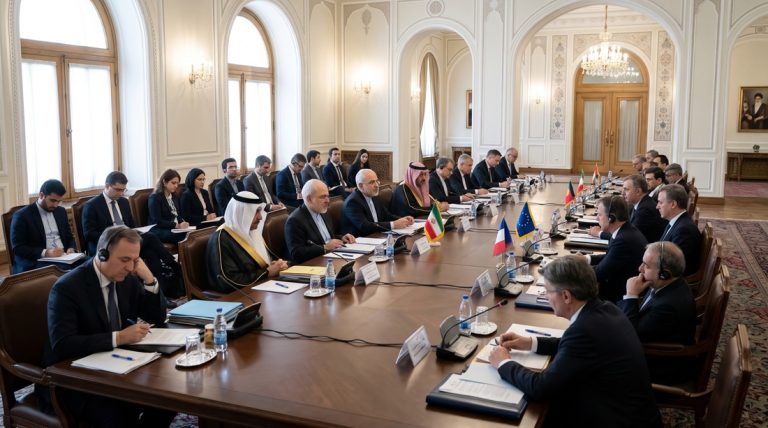
Regional diplomacy across the Middle East is shifting rapidly as neighboring capitals work to prevent another military confrontation with Tehran. While Washington threatens blockades and hints at fresh military strikes after the American midterm elections, regional leaders are building independent channels of communication. Security chiefs from Saudi Arabia, Turkey, and Pakistan recently traveled to the Iranian capital to open direct talks with senior decision makers. By hosting these delegations in Tehran, the Islamic Republic demonstrated that it remains central to any durable regional settlement.
This outreach reflects a broader realization that American and Israeli military campaigns have failed to bring stability. Over the past eight months, Tehran and its regional allies have proven their capacity to impose severe costs across vital maritime corridors. In Yemen, Ansarallah forces struck targets inside Saudi territory and disrupted commercial shipping moving through the Red Sea. Coordinated action by Iranian and Yemeni forces around the Strait of Hormuz and Bab el Mandeb could paralyze global energy transit, prompting neighboring states to favor dialogue over escalation.
European and Regional States Bypass Washington
Parallel diplomatic tracks are now taking shape without American participation. On October 23, foreign ministers from Britain, France, Germany, and Italy met in Istanbul with counterparts from Egypt, Pakistan, Turkey, and Saudi Arabia to establish a new consultative framework. Adding Rome to the European group strengthens diplomacy because Italy avoided the earlier sanctions snapback push and maintained working channels with Tehran. Together, these eight nations aim to reopen the Strait of Hormuz, end the conflict, and preserve prospects for Palestinian statehood.
Middle Eastern capitals have lost confidence in the assumption that Washington guarantees their protection. Although the August defense pact signed in Mecca created a collective security mechanism among key regional states, recent hostilities exposed the limits of purely military deterrence. Neighboring governments recognize that pushing a nation of ninety million people toward instability would trigger an unmanageable crisis across their own borders. Engaging Iranian military and political leaders directly offers a more realistic path to protecting regional infrastructure and commerce.
Incentives for a Durable Regional Architecture
Economic and nuclear diplomacy could anchor this emerging partnership between European and Middle Eastern middle powers. European governments urged compliance with international nuclear safeguards while exploring how targeted sanctions relief might encourage long term deescalation. Gulf and regional states could reinforce such an arrangement by leading initial investments into the Iranian economy once restrictions lift. Simultaneously, the eight partner states hope to press Beijing to use its commercial influence to guarantee safe maritime passage through Persian Gulf waters.
Iranian defense planners are unlikely to surrender their missile and drone capabilities after those systems proved decisive in recent deterrence operations. However, combining regional economic integration with European diplomatic backing creates opportunities to restrain Israeli military actions in Lebanon and Syria while stabilizing Gulf waterways. Even if zero sum impulses in Washington risk another round of fighting, middle powers are laying the groundwork for a multipolar security order. By placing diplomacy ahead of coercion, regional capitals are charting a future that no longer depends on American hegemony.
Original analysis inspired by Ellie Geranmayeh from Responsible Statecraft. Additional research and verification conducted through multiple sources.