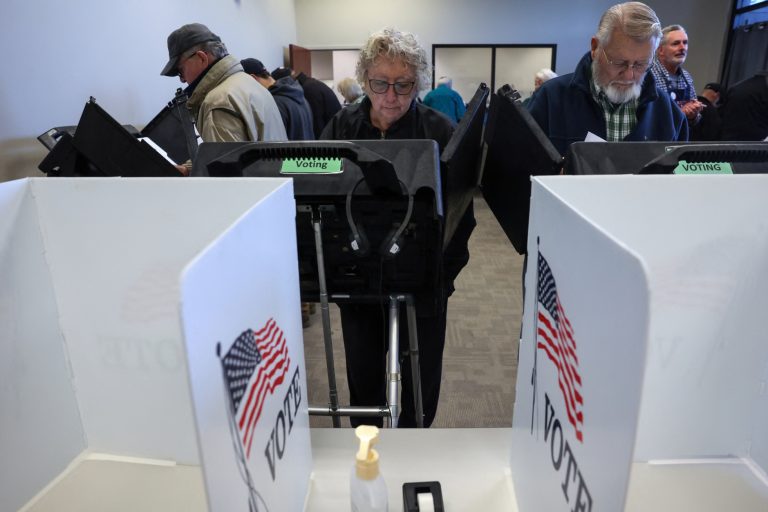
The 2026 midterm elections are developing into a test of whether Republicans can survive an increasingly hostile national mood while defending extremely narrow congressional majorities. Official House figures show Republicans holding 218 seats against 214 Democrats, with one independent and two vacancies. Control of Congress could therefore turn on a small number of districts even if the national vote shifts much more sharply. Two weeks before Election Day, that possibility is making what would normally be local congressional races into a referendum on Donald Trump’s second presidency.
The clearest warning for Republicans comes from public opinion. A Reuters Ipsos survey found Trump’s approval at 31 percent, its lowest point across his presidencies, while Democrats led Republicans by 12 percentage points among registered voters asked which party they would support for Congress. National polling does not translate directly into individual House districts, but such a wide gap gives Democrats room to compete in seats that would normally remain safely Republican.
Affordability is reshaping the election
Economic anxiety is strengthening that advantage. The national average price of gasoline stood near $4.28 per gallon on October 20, according to AAA, which reports that fuel prices remain at record levels for this time of year. Rising energy costs following the war with Iran have turned foreign policy into a domestic pocketbook issue, particularly for commuters, rural households, and lower income voters.
That connection matters because voters rarely separate economic conditions neatly from presidential responsibility. Trump returned to office promising lower prices and stronger household finances, yet current polling shows deep dissatisfaction with his economic management. Republicans are therefore campaigning not only against Democratic candidates but against voter frustration over fuel, food, housing, and other routine expenses.
History adds another problem. House records document substantial losses for the president’s party in several recent midterms, including 64 Republican gains during Barack Obama’s presidency in 2010 and 41 Democratic gains during Trump’s first term in 2018. Joe Biden’s Democrats limited their losses to nine seats in 2022, showing that the pattern is not automatic, but the president’s party usually enters a midterm fighting political gravity.
Redistricting may not provide the expected protection
Republicans tried to improve their position through unusual midcycle redistricting in several states. Those efforts initially appeared capable of shifting numerous districts toward the party, but weakening support for Trump has made some newly drawn seats unexpectedly competitive. A Reuters analysis found that nine of 16 districts designed to improve Republican prospects were now at risk, while another had been invalidated by a court.
The danger is dilution. Drawing Republican voters out of very safe districts can strengthen nearby seats, but only as long as the national environment remains reasonably balanced. A sufficiently large Democratic swing can turn that strategy against its designers by exposing several districts at once.
Turnout will determine whether national dissatisfaction becomes congressional change. Census data shows that participation reached 53.4 percent in the 2018 midterms and 52.2 percent in 2022, both unusually high levels for elections without a presidential contest. Trump’s presence at rallies may help Republicans mobilize voters who participate mainly when he is politically central, but his unpopularity can motivate Democratic and independent voters at the same time.
Campaigns are spending heavily to influence that final decision. AdImpact projects political advertising during the 2025 and 2026 cycle will reach a record $11.6 billion, exceeding even spending during the previous presidential cycle. Yet advertising cannot easily reverse public judgments about prices, war, or presidential performance when voters experience those issues directly.
The result is an election shaped by a striking mismatch. Republicans still possess the institutional advantages of incumbency, favorable districts, and control of both chambers, but Democrats currently hold the stronger national political environment. If that advantage survives through Election Day, even a modest shift in a handful of competitive districts could transform the final two years of Trump’s presidency by giving Democrats control of investigations, committee agendas, legislation, and potentially the confirmation process in the Senate.
Original analysis inspired by James M. Lindsay from the Council on Foreign Relations. Additional research and verification conducted through multiple sources.