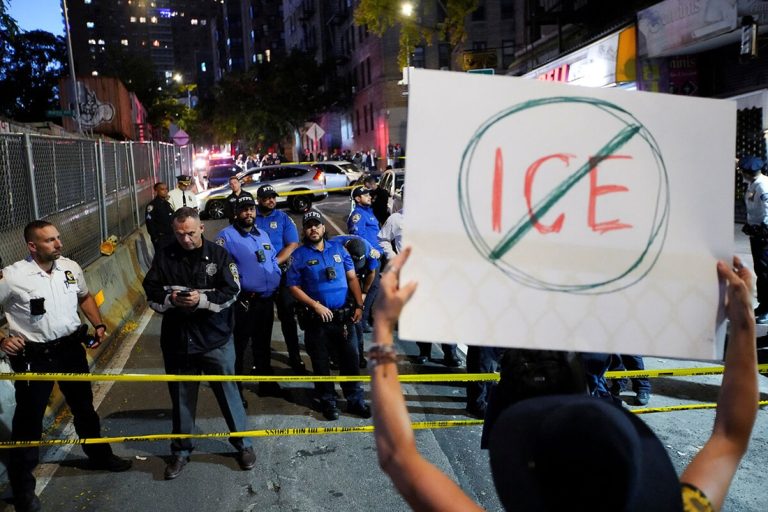
An Immigration and Customs Enforcement operation in the Bronx ended with an officer firing seven shots at a driver who had a five-year-old child in the back seat. The man, identified as Oscar Belgal, survived a neck wound. Federal officials say he refused orders and accelerated into ICE vehicles after agents blocked his car. City police recovered shell casings and released body camera footage of the aftermath. The child was not physically injured, and agents later said they did not know he was present.
Mayor Zohran Mamdani described the incident as evidence that ICE undermines public safety and has called for the agency to end operations in the city. Department of Homeland Security Secretary Markwayne Mullin countered that sanctuary policies create space for criminal activity. He stated that New York authorities had ignored nearly 15,000 detainers since early 2025 for people the administration labels as criminals. Belgal has a prior conviction for grand larceny and gang associations, according to DHS, though some details remain unconfirmed in public records.
New York law limits formal cooperation. The state prohibits 287(g) agreements that would deputize local officers for immigration duties. A 2018 appellate court ruled that holding someone past their ordinary release date solely on the basis of an ICE detainer constitutes an unlawful arrest under state law unless a judicial warrant is presented. ICE detainers themselves are administrative requests, not court orders, and lack the force of criminal warrants. Local agencies may notify federal officials of an impending release, but they cannot extend detention on that basis alone.
Despite the restrictions, ICE continues street arrests across the state. Operation Rotten Apple this summer produced more than 2,100 arrests, which the department described as including individuals with serious criminal records. Federal officials argue that the absence of local holds forces them into higher-risk field operations. City and state leaders maintain that their limited role protects community trust and complies with existing court rulings.
A federal judge has temporarily blocked Belgal’s removal while his detention is challenged. Advocacy groups have asked for his release pending further review. The Bronx district attorney’s office is examining the agents’ use of force. The episode illustrates a persistent national tension: federal immigration priorities clash with state and local rules that restrict how far police may assist in civil enforcement. Outcomes depend less on political rhetoric than on the precise legal boundaries that govern each jurisdiction.
Original analysis inspired by Sarah Matusek from The Christian Science Monitor. Additional research and verification conducted through multiple sources.