How Sanctions Have Amplified the Strategic Impact of Ukraine’s Drone Campaign
Moscow’s Kapotnya refinery, fifteen kilometres from the Kremlin, burned for the third time in a month on June 18, after roughly two hundred Ukrainian drones reached the capital and Russia’s Defence Ministry claimed nearly a thousand were intercepted nationwide. Seventeen people were hurt. Four airports shut, more than fifty flights were cancelled or delayed, and residents reported oily black rain falling across southern districts. The facility supplies about forty percent of Moscow’s petrol and roughly half its diesel. None of that is incidental. It is the latest data point in a pattern that now has enough scale, and enough repetition, to support actual analysis rather than just description.
Saudi Arabia faced a near-identical attack in 2019 and recovered in a month. Russia, hit by a smaller share of capacity, is struggling to recover at all — and the difference reveals what actually determines whether cheap drones can defeat a state’s depth
THE SCALE OF THE CAMPAIGN
A Quarter of Russia’s Refining Base, Verified
That pattern looks like this. Reuters reported in May that Ukrainian strikes had knocked out or curtailed nearly every major refinery in central Russia — Kirishi, Ryazan, Nizhny Novgorod, Yaroslavl, and Moscow among them — taking offline a combined capacity exceeding 83 million tons a year, roughly a quarter of Russia’s total refining base. The International Energy Agency’s May 2026 Oil Market Report projected Russian refinery throughput would fall by 4.5 million barrels a day in the second quarter as a direct result. Russia responded by extending a gasoline export ban through the end of July, the second such measure in two years.
THE COMPARATIVE CASE
Abqaiq, 2019: The Same Attack, A Different Outcome
The closer comparison is not Ukraine’s own history but Saudi Arabia’s. In September 2019, a swarm of roughly twenty-five drones and cruise missiles, reportedly costing as little as fifteen thousand dollars apiece, knocked out half of Saudi Arabia’s oil production in a single strike on the Abqaiq and Khurais facilities — despite Patriot batteries, Shahine missiles, and a defence budget among the largest in the world. The asymmetry was total: billions of dollars in air defence failed to stop weapons cheaper than a used car. But the comparison is instructive precisely because of what happened next. Saudi Aramco restored full production within about a month, drawing on stored reserves, spare capacity, and replacement parts sourced openly from the United States and Europe.
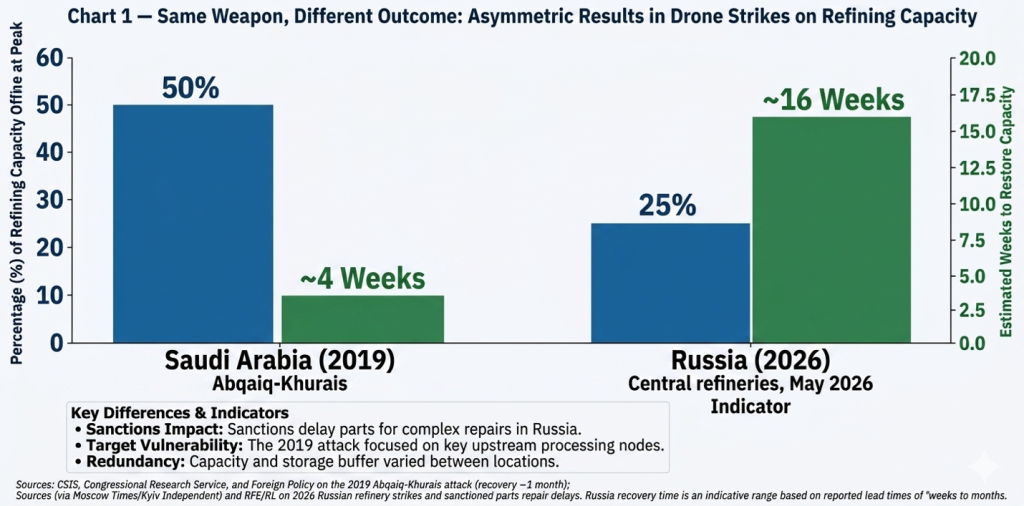
Chart 1 — Same weapon class, different recovery curve. Sources: CSIS, Congressional Research Service, and Foreign Policy on the 2019 Abqaiq-Khurais attack; Reuters (via Moscow Times/Kyiv Independent) and RFE/RL on 2026 Russian refinery strikes. Russia recovery time is indicative, based on reported sanctioned-parts lead times of weeks to months.
Russia does not have that option. Specialised refinery components — hydrocrackers, crude-distillation units — are subject to Western export controls, and Radio Free Europe has reported that repair lead times now stretch into months rather than weeks, with sanctions on parts compounding the delay. The same kind of attack that cost Saudi Arabia roughly a month of reduced output is, in Russia’s case, producing damage that accumulates faster than it can be repaired. That is the analytical core of what is happening: it is not that drones are inherently more destructive than missiles, but that the combination of repeated drone strikes and an already-sanctioned economy denies Russia the recovery speed that allowed Saudi Arabia to treat 2019 as a single bad month rather than a structural problem.
A SECOND COMPARISON
The Iron Dome Problem, Applied to a Continent
There is a second asymmetry worth naming directly, because it is the same one Israel has faced for over a decade defending against Hamas and Hezbollah rocket fire. Iron Dome interceptors cost on the order of forty to a hundred thousand dollars each; the rockets they intercept cost a few hundred. Multiply that gap by a sufficient volume of incoming fire, and even a 90-percent-effective defence system becomes financially unsustainable to operate indefinitely. Russia’s strategic-depth problem is the same arithmetic applied to geography instead of a single border: every refinery, terminal, and storage depot across eleven time zones would need its own air defence to be genuinely protected, and that is not a militarily serious proposition.
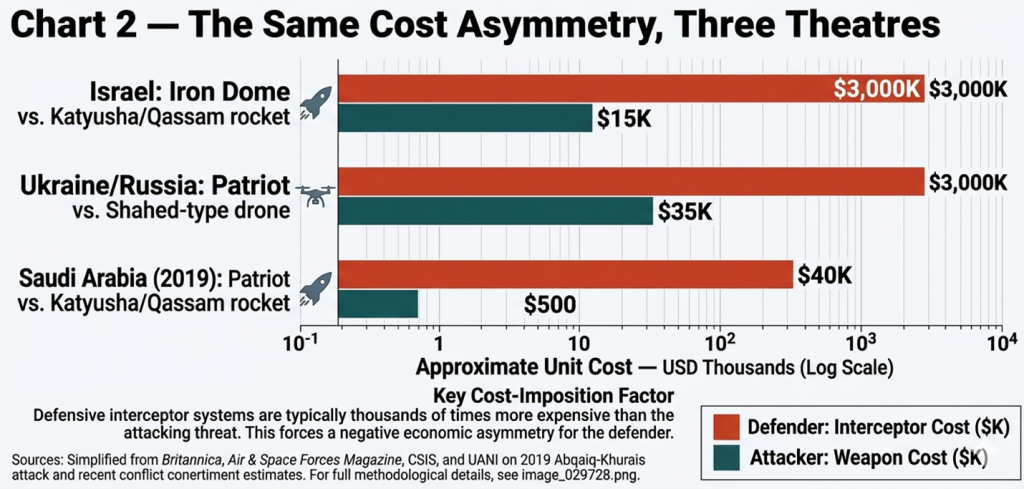
Chart 2 — The same cost asymmetry recurring across three theatres. Sources: Britannica and Air & Space Forces Magazine on Iron Dome/Katyusha costs; CSIS on Patriot/Shahed costs; CSIS and United Against Nuclear Iran on Saudi Patriot/drone costs in 2019. All figures are open-source estimates.
THE SYNTHESIS
Three Cases, One Underlying Variable
Three cases now sit side by side as a rough natural experiment in what determines whether a precision-strike campaign against energy infrastructure actually changes a state’s strategic position. Saudi Arabia in 2019 absorbed a single, devastating blow and recovered within weeks because it had open access to global parts markets and deep storage reserves. Israel faces a much smaller, geographically concentrated threat but pays an extraordinary price per interception because its adversaries’ rockets are nearly disposable by comparison. Russia in 2026 combines the worst features of both: a strike campaign with Saudi-scale ambition, against a target list too large to fully defend, compounded by Israeli-style cost asymmetry on every individual interception, and without Saudi Arabia’s unsanctioned access to replacement parts. That combination, more than any single drone or refinery, is what makes this campaign different from anything that preceded it.
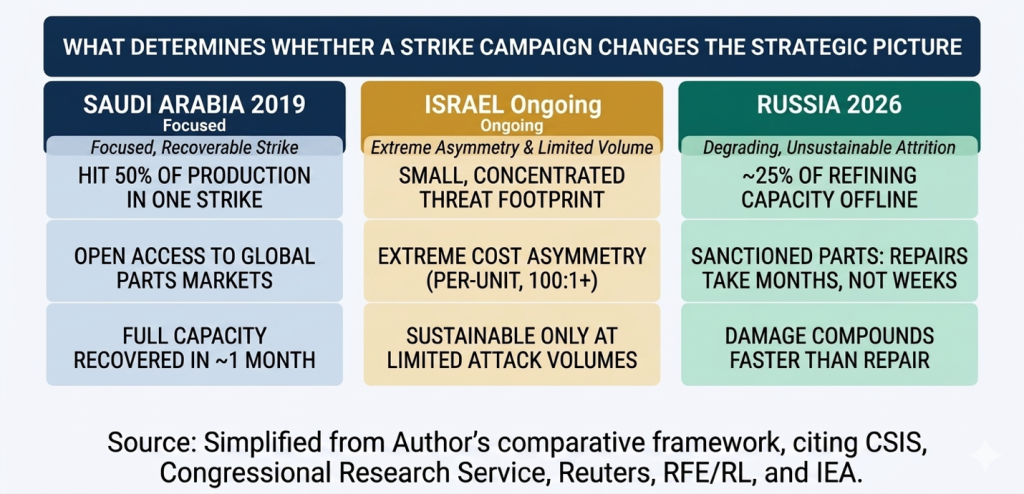
Figure 1 — What determines whether a strike campaign changes the strategic picture: a three-case comparative framework. Source: Author’s analysis, based on CSIS, Congressional Research Service, Reuters, RFE/RL, and IEA reporting cited throughout.
Table 1 — Three Cases, Compared
| Variable | Saudi Arabia (2019) | Israel (Ongoing) | Russia (2026) |
| Capacity hit at peak | ~50% of national oil output | N/A — territorial defence, not output | ~25% of refining capacity |
| Defender’s per-unit cost | Patriot battery, ~$3M | Iron Dome interceptor, ~$40–100K | Patriot/NASAM, ~$1–3M |
| Attacker’s per-unit cost | ~$15K per drone/missile | ~$300–600 per rocket | ~$35–50K per Shahed-type drone |
| Access to repair parts | Open — US and European suppliers | N/A | Restricted — Western export controls |
| Recovery time | ~1 month to full capacity | Continuous, sustainable defence | Weeks to months; damage compounding |
Source: Author’s comparative framework, drawn from verified reporting cited throughout this article.
THE DIPLOMATIC LAYER
Sanctions Are Now Doing Double Duty
This is the dilemma in its sharpest form. Russia cannot harden every energy site without diverting resources from the front line it is actually trying to hold, and Ukraine does not need to threaten occupation — only to make the war’s cost visible and recurring inside Russia itself, in a way that an economy already squeezed by sanctions struggles to absorb at Saudi Arabia’s pace. The diplomacy now surrounding the campaign reflects the same logic. Zelenskyy raised the issue directly with President Trump at the G7 summit on 17 June, and Trump has since signalled that sanctions on Russian oil — eased in March to calm prices during the Iran war — could be reimposed now that the Strait of Hormuz has reopened. The G7’s joint statement on tightening oil and shadow-fleet sanctions points the same direction.
Sanctions, it turns out, do not just restrict what Russia can sell. They restrict how fast it can recover from being hit — and that is a vulnerability sanctions and drones are now reinforcing together, not separately.
None of this means Russian depth has stopped mattering, or that occupation is now plausible. What has changed is narrower: the cost of reaching deep into Russia, and the cost of repairing the damage once it lands, no longer favour the defender the way they did for Saudi Arabia in 2019. The Abqaiq comparison suggests the deciding variable was never the drones themselves — Saudi Arabia faced nearly identical technology and a larger single-day loss, and shrugged it off within a month. What Russia lacks, and Saudi Arabia had, is the open global market to repair the damage drones leave behind. That, not the drones, is the actual story of 2026.
Sources and Further Reading
Reuters, cited via The Moscow Times. “Drone Strikes Force Central Russian Refineries to Halt or Cut Output.” May 20, 2026.
Reuters, cited via Kyiv Independent. “Central Russia’s Major Oil Refineries Halt Production Following Ukrainian Drone Attacks.” May 21, 2026.
Reuters, cited via Militarnyi. “Russia’s Fourth-Largest Oil Refinery Partially Suspends Operations After Ukrainian Strike.” May 20, 2026.
International Energy Agency (IEA). Oil Market Report, May 2026.
Radio Free Europe/Radio Liberty (RFE/RL). “Drone Hits On Hydrocrackers Spark Fuel Crunch, As Ukraine Pounds Russia’s Refineries.” June 2026.
Bloomberg News. “Ukraine Launches Record Drone Attack on Moscow, Hits Oil Refinery.” June 18, 2026.
NBC News. “Moscow Refinery Attack: Ukrainian Drones Hit Kapotnya in Biggest Attack in Years.” June 18, 2026.
NPR. “Ukraine Hits a Moscow Oil Refinery and Other Sites in a Large-Scale Drone Attack.” June 18, 2026.
ABC News. “Ukraine Strikes Moscow Oil Refinery in Large-Scale Drone Attack.” June 18, 2026.
Newsweek. “Ukraine Strikes Moscow’s Largest Oil Refinery in Long-Range Drone Attack.” June 2026.
Center for Strategic and International Studies (CSIS). “Attack on Saudi Oil Infrastructure: We May Have Dodged a Bullet, at Least for Now.” 2019, republished analysis 2026.
Congressional Research Service. “Attacks on Saudi Oil Facilities: Effects and Responses.” Report IN11173, 2019.
Foreign Policy. “How an Aerial Barrage Cut Saudi Oil Production in Half.” September 2019.
CNBC. “Saudi Arabia Is Shutting Down Half of Its Oil Production After Drone Attack.” September 14, 2019.
Fortune. “Saudi Aramco Says Damage From Drone Attacks That Plunged World Oil Market Into Chaos Is Already Fixed.” October 14, 2019.
Wikipedia. “Abqaiq–Khurais Attack.” Accessed June 2026, citing Aramco statements and contemporaneous wire reporting.
United Against Nuclear Iran (UANI). “The September 2019 Attacks on Abqaiq and Khurais.”
Britannica. “Iron Dome: Cost, Missile, Success Rate, & Israel.” Accessed June 2026.
Air & Space Forces Magazine. “Iron Dome.” 2016, with cost figures corroborated by subsequent reporting.
Foundation for Defense of Democracies (FDD). “Ballistic Missile Defense: Iron Dome’s Role.” March 2026.
PBS NewsHour / Associated Press. “Trump Signals He May Reimpose Sanctions on Russian Oil as G7 Refocuses on Ukraine.” June 17, 2026.
House of Commons Library (UK Parliament). “Israel/US-Iran Conflict 2026: Reopening the Strait of Hormuz.” Research Briefing CBP-10636, 2026.
Note
Figures on capacity loss, recovery timelines, and unit costs vary across sources and are inherently approximate in an active conflict; this article uses the figures most consistently reported by named outlets and flags genuine uncertainty where it exists. The Russia recovery-time estimate in Chart 1 is indicative rather than precise, since no single source provides a confirmed full-recovery date as of this writing; it is built from RFE/RL’s reporting on sanctioned-parts lead times of “weeks or months.” The Iron Dome and Patriot cost figures cited are open-source estimates that vary by source and are not officially disclosed by the relevant governments. All facts in this article were checked against named, primary or major wire-service sources before publication.
The views expressed in this article belong to the author and do not necessarily reflect the editorial policy of Thinktanks Monitor.