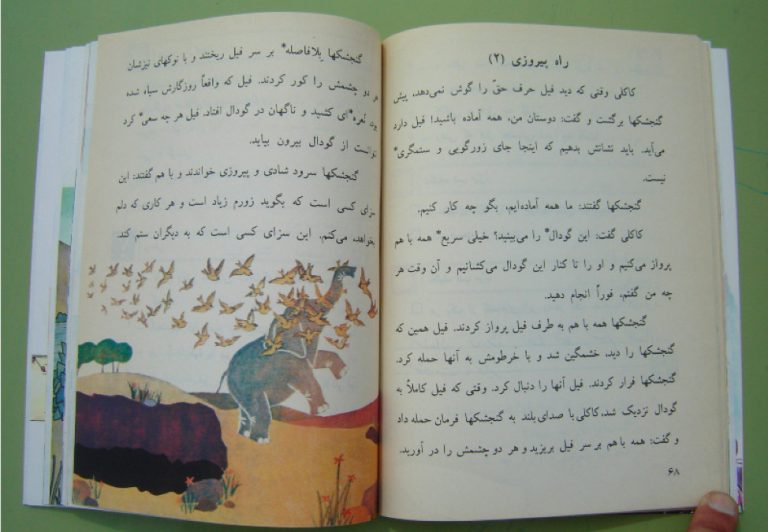
There is a story in Iran’s second-grade reading curriculum about a flock of desert birds whose nests are threatened by a stomping, indifferent elephant. Peaceful appeals fail. The elephant, certain of its own unstoppable strength, refuses to yield. So the birds act together — they swarm the elephant, pecking out his eyes, and drive him into a ditch. It is a children’s fable with a vivid message: when reason fails to protect the homeland, collective violent resistance is not just permitted — it is the only correct response.
Understanding why Iran has fought the way it has over the past forty days requires reading stories like this one. Not because Iranian generals are consciously enacting second-grade parables — but because those parables are one strand in a much larger fabric of national identity that shaped the men who give the orders and the millions who have so far refused to collapse under pressure. Iran’s official curriculum is built around curricula consistent with national identity, Islamic, and cultural values, and those values are not incidental to the country’s behavior in wartime. They are foundational to it.
Stories That Outlast Governments
The basis of Iranian military doctrine was developed during the long and traumatic war with Iraq from 1980 to 1988, and most senior officers are veterans of that conflict. Concepts such as self-reliance, “holy defense,” and export of the revolution first entered the military lexicon during that war and were codified as doctrine in the early 1990s. But those concepts were not invented by generals. They were already present in the classroom — layered into fables and reading exercises that generations of Iranians encountered before they were old enough to understand geopolitics.
Drawing on three decades of post-revolutionary textbooks, researchers have traced the development of recurring characters in Iran’s early elementary curriculum, shaped against the historical context of Iranian modernization and state formation. A recurrent message: look at what has happened to peoples who were not able to defend their homes and their homeland, and look at what has not happened to us. That refrain — we defended ourselves when others did not — is not abstract nationalism. It is a specific, repeatable lesson in what happens to the weak who cannot resist the strong.
In the face of decades of sanctions, political isolation, and technological embargoes, Iran emerged as a formidable player in missile and drone warfare — not because its capabilities match those of global powers, but because they reflect a shrewd, calculated approach to asymmetric warfare. At the heart of Iran’s defense strategy lies a profound application of self-reliance and an implicit mastery of constraint-based thinking. Ferdowsi preserved the Persian language by writing around his constraints. Iranian engineers built drone programs the same way. The two things are not unrelated.
“Neither East Nor West” Is Not a Slogan — It’s a Curriculum
Iran’s state broadcaster’s logo shows two intertwined depictions of the Arabic word for “no,” symbolizing Iran saying “no” to both the West and the East — the Soviet Union — with its charter emphasizing the goal of self-sufficiency and the principle of “Neither East, Nor West” in all fields of politics, social affairs, culture, economics, and military. That principle has been woven into schoolbooks for over four decades. Rejecting the Shah’s West-centric self-orientation, the Islamic Republic’s elites promoted the geopolitical slogan “Neither East, Nor West,” rejecting alignment with the Cold War’s imperial camps.
Academic research identifies an historically enduring Iranian insistence on self-sufficiency — which can be summed up as the idea that the world needs Iran more than Iran needs the world. That idea appears in children’s fables about cows that keep their horns, birds that outwit elephants, and sparrows that defeat crocodiles through guile rather than force. It appears in Iran’s decision, after the experience of the Iran-Iraq War, to develop indigenous missile technology rather than depend on foreign suppliers. And it appears now, in the refusal of a battered country to treat American military superiority as a reason to surrender.
To challenge a technologically superior adversary such as the United States, Iranian doctrine emphasizes aspects of asymmetric warfare that play to Iran’s strengths, including geography, strategic depth, and public willingness to accept casualties. That willingness to accept casualties — which has baffled American strategists — is not irrational. It is the product of a culture that has spent decades teaching its children that the homeland is worth fighting for, that resistance against the powerful is righteous, and that defeat at the hands of an unjust giant is worse than death.
The Catastrophic Gap in Understanding
The Iranian worldview is informed by perceptions, values, and norms that define its strategic culture, and since 1979, the main conduit of this culture has been the regime established by Ayatollah Khomeini. But the culture itself predates the Islamic Republic by centuries. Ferdowsi wrote his 50,000-line epic to preserve Persian identity against Arabization — a project of civilizational self-defense conducted entirely through language and story. The same impulse runs through Iran’s post-revolutionary curriculum, its military doctrine, and its current refusal to treat the ceasefire as a capitulation.
The famous revolutionary slogan — “Neither East nor West, only the Islamic Republic” — reflects this worldview, and in the face of ongoing US-Israeli aggression, opposition inside Iran has been weakened as external pressure serves to validate and reinforce these revolutionary ideals. Washington’s assumption that military strikes would fracture Iranian society misread this dynamic completely. It assumed Iranians would direct their anger at a vulnerable government. Instead, it handed that government a narrative it had been telling schoolchildren for decades: we are the small birds; they are the elephant; and we do not yield.
History shows that no regime which has subordinated Iranian national identity to its ideology has survived for long — but the inverse is also true. When regime ideology and national identity fuse around the story of resistance against overwhelming foreign power, the combination becomes extraordinarily durable. The United States has spent forty days discovering what Iran has been teaching since the second grade: that the homeland is not negotiable, and that a sparrow, properly organized, can defeat a crocodile.
The Iran-Iraq War shaped a generation of commanders and left a doctrinal legacy that no amount of bombing has erased. The children who sat in those classrooms with those fables are now the men negotiating in Islamabad. Their red lines were drawn a very long time ago — in stories, not strategy papers — and that is precisely why Washington still does not fully understand them.
Original analysis inspired by Shervin Malekzadeh from FPIF. Additional research and verification conducted through multiple sources.