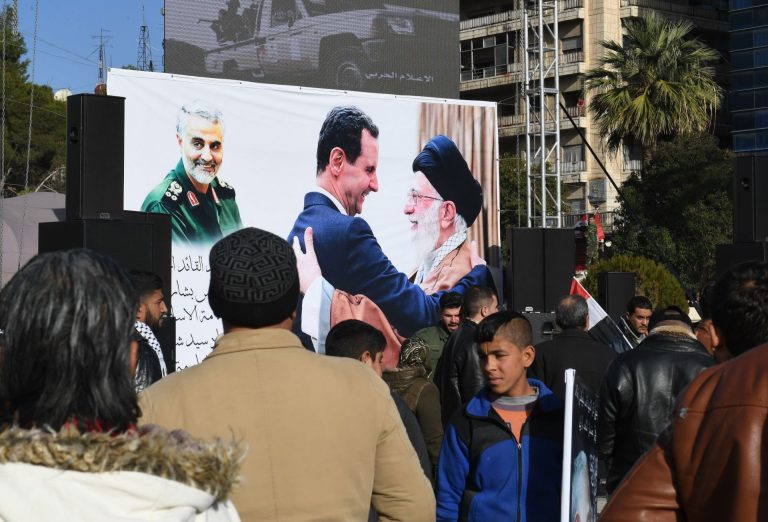
The banner hung at the entrance to Tehran University on January 21 read: Death or Khamenei. It was a deliberate echo of the slogan that defined Syria’s descent into civil war — Assad or we burn the country — chanted by loyalists as Bashar al-Assad’s forces opened fire on unarmed protesters in 2011. The parallel was not accidental. The Islamic Revolutionary Guard Corps spent over a decade helping Assad crush a popular uprising with staggering violence. Now, with its own regime facing the gravest threat in its 47-year history, Tehran has turned those same tactics inward — against the Iranian people.
Holly Dagres, a senior fellow at the Washington Institute for Near East Policy, documents this transfer of repression in a devastating account for New Lines Magazine. Her central argument is stark: Syria was a practice run for what to do at home when the Islamic Republic faced a threat to its continued existence.
The January Massacre
The protests that erupted on December 28, 2025, were the latest wave in a movement that has demanded the overthrow of the Islamic Republic since 2017 — one that reached global visibility during the 2022 Woman, Life, Freedom uprising. What distinguished this round was the scale of killing. Security forces wielded knives and machetes alongside military-grade weapons, firing indiscriminately at peaceful protesters and bystanders alike, mostly under the cover of a communications shutdown designed to conceal the atrocities.
The numbers are staggering. According to Human Rights Activists in Iran, at least 6,488 protesters were killed, with another 11,744 cases under review. More than 53,000 people were arrested. The UN special rapporteur on human rights in Iran suggested the actual death toll may exceed 20,000, while anonymous Health Ministry officials put the figure above 30,000. By even the most conservative estimates, the regime killed more people in December and January than during the 1979 revolution itself.
Ali Ansari, director of the Institute for Iranian Studies at the University of St. Andrews, told Dagres: You have to go back to Agha Muhammad Khan in the 1790s to witness a similar intensity of violence meted out by the Iranian state against its people.
The Assad Playbook
The methods bore Assad’s fingerprints. Protesters’ corpses were dumped from ice cream vans and meat trucks, forcing families to search through piles of bodies for their relatives. Authorities charged exorbitant sums to return the dead and forced families to sign paperwork claiming their loved ones were “martyred Basij members” — transforming victims into regime defenders in official records. Families of detained protesters were compelled to attend state rallies marking the anniversary of the 1979 revolution if they wanted relatives released or spared execution.
Dagres draws a direct line from Syria to Iran. The Assad regime controlled public mourning for those killed by its own security forces, compelling grieving families to claim their loved ones were “killed by terrorists.” Iran replicated this system almost exactly. Both regimes framed all protesters as foreign agents — “terrorists and spies” — and both used communications blackouts to hide the scale of killing. The IRGC’s Quds Force, which spent years enabling massacres of Syrian civilians, brought those operational lessons home.
The protests were temporarily suppressed by the time Operation Epic Fury began on February 28. But moments of defiance continued. When Khamenei was killed in the opening strikes, Iranians in multiple cities flooded streets dancing, waving white napkins, and honking car horns. When Mojtaba Khamenei was named successor, some chanted “Death to Mojtaba” from their windows — acts of resistance that carry the risk of death in a country where the national police chief has declared that protesters would be treated as an enemy with forces keeping their fingers on the trigger.
The War as Cover
The war has provided the regime with both a shield and a weapon. The constant roar of jets, the strikes hitting all parts of Tehran, and the flight of residents from the capital have kept people largely off the streets. The internet shutdown — now among the longest government-imposed blackouts in recorded history — has severed the digital infrastructure that protest movements depend on. Iranian state media has explicitly threatened that after the war ends, security forces will pursue every single one of you, warning dissidents they would make your mothers mourn.
The regime has also threatened diaspora Iranians with transnational repression — asset seizures, travel bans, harassment, and retaliation against family members inside Iran. Some of this is already happening. The Islamic Republic carried out 2,066 executions in 2025, the highest number since the 1980s. Before the war began, it was on track to surpass that figure, with at least 587 since January. Rights organizations fear that wartime conditions could enable mass killings of political prisoners reminiscent of the 1988 massacre.
After the Bombs Stop
Dagres’s most chilling insight concerns what happens when the war ends. If the Islamic Republic survives — and its institutional design, as other analysts have argued, was built precisely for this kind of crisis — it will turn inward with even greater ferocity. The regime’s paranoia will be heightened, not diminished, by the experience of simultaneous war and uprising. Every protester who danced when Khamenei died will be remembered. Every chant from a window will have been recorded by informants.
One Iranian who briefly managed to get online during the blackout captured the impossible position of ordinary citizens: Even though another country is attacking us, I’m still more afraid of the officials in my own country, and I don’t even know what to do with that feeling.
The Islamic Republic learned in Syria that mass violence works — that a regime willing to kill enough of its own people can survive almost anything. Assad eventually fell, but only after 13 years and only because his foreign backers were weakened. Iran’s leaders have studied that timeline too. They believe they can outlast both the bombs from above and the protests from below. The question is whether the Iranian people — who have buried thousands and still find the courage to chant from their windows — believe the same.
Original analysis inspired by Holly Dagres from New Lines Magazine. Additional research and verification conducted through multiple sources.