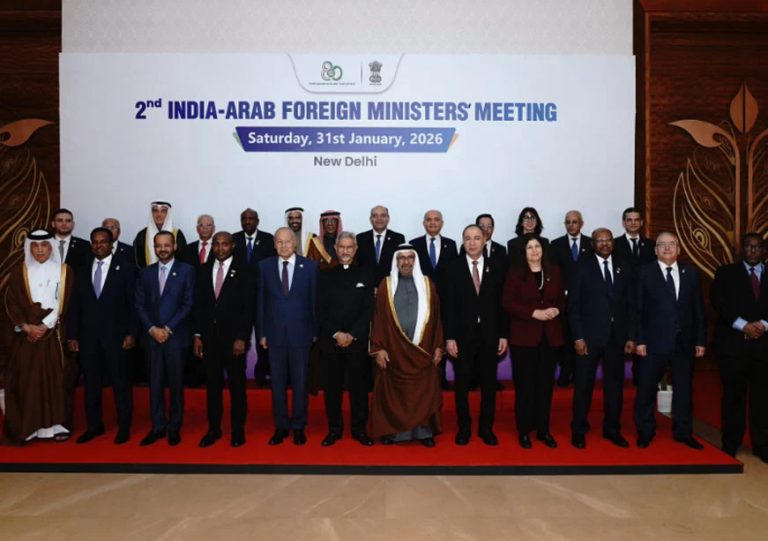
When New Delhi hosted foreign ministers from 19 Arab League nations on January 31, it revived a diplomatic channel that had gone quiet for a decade. The second India–Arab Foreign Ministers’ Meeting, co-chaired with the UAE, produced the Delhi Declaration — a document pledging cooperation on everything from counterterrorism to artificial intelligence. But the real story behind the summit was not trade or technology. It was timing. With Washington dismantling the very order it once built, both India and Gulf Arab states are scrambling to position themselves as architects of whatever comes next, even as neither side is entirely sure what that new structure should look like.
The week of the summit offered a striking snapshot of India’s diplomatic juggling act. While External Affairs Minister S. Jaishankar addressed Arab counterparts in New Delhi, Deputy National Security Adviser Pavan Kapoor was in Tehran meeting his Iranian counterpart amid a mounting U.S. military buildup around Iran. Days later, news confirmed that Prime Minister Narendra Modi would visit Israel on February 25–26. Engaging Tehran, Tel Aviv, and the Arab League within the same fortnight is not a contradiction for Indian diplomacy — it is the entire strategy.
The Art of Belonging Everywhere
India’s approach draws from a political instinct cultivated since independence in 1947: avoid permanent alliances, keep every door open. Today that means sitting in the Quad alongside the United States, Japan, and Australia while also holding a seat in BRICS and the Shanghai Cooperation Organisation, where Russia and China set much of the agenda. The Indian Air Force captures this philosophy in hardware — BrahMos missiles built jointly with Russia fly on French-designed Mirage jets loaded with Israeli munitions.
Gulf states have arrived at a similar posture through a different route. Saudi Arabia, the UAE, and Qatar increasingly act as diplomatic mediators on conflicts far beyond their borders, from the war in Ukraine to tensions with Iran. Riyadh hosted Ukraine-related talks that earned recognition from Chatham House as proof that the kingdom is now a major diplomatic player. Even Turkey, a NATO member, has carved out a mediating role in the Black Sea region, exploiting its geographic position to stay relevant to both Moscow and the West.
Yet a critical gap separates the two camps. Gulf monarchies still depend on American security guarantees — a dependency that constrains their room to maneuver. India, by contrast, has no comparable defense pact tying it to Washington, giving New Delhi wider latitude when it chooses not to pick sides.
A Western Order Cracking From Within
The backdrop to all these diplomatic moves is a Western-led system that its own creators seem eager to abandon. At the World Economic Forum in January, Canadian Prime Minister Mark Carney delivered a blunt speech declaring the international rules-based order “partially false.” Carney admitted that countries like Canada had benefited for decades from a framework underwritten by U.S. hegemony — a framework now being actively unwound by Washington itself. Donald Trump’s aggressive tariff disputes with New Delhi and erratic security signaling toward Gulf partners have only reinforced the sense that old bargains no longer hold.
Writing in Foreign Affairs, scholar Matias Spektor warned that a world stripped of even hypocritical norms might prove more dangerous than the flawed system it replaces. Without institutions and expectations to soften the exercise of raw power, emerging states could find themselves in a free-for-all rather than a genuinely shared order.
Ready or Not
The question is whether India and the Arab world are prepared to fill the vacuum. With a GDP approaching $4.5 trillion and a population of 1.4 billion, India has the economic mass to be a genuine pole of power. The Delhi Declaration’s long list of planned working groups — on counterterrorism, space, agriculture, startups — suggests both sides want institutional depth, not just photo-op diplomacy. Bilateral trade between India and Arab League nations already tops $240 billion.
But mass and ambition are not the same as readiness. India’s reluctance to take bold positions, born of decades of hedging, sometimes blunts its influence at moments that demand clarity. Gulf states, despite their newfound mediator credentials, still lack a shared internal consensus on leadership within the Arab world — a fracture that predates the current global upheaval.
The IAFMM’s revival after a ten-year gap is a promising signal, yet forums alone do not build order. If New Delhi and the Gulf capitals genuinely see themselves as two poles in a multipolar system, they will need to move from declarations to joint action — on trade corridors, conflict resolution, and institutional reform at the United Nations — far faster than either has managed so far. The old architecture is being dismantled. The blueprints for a replacement remain rough sketches at best.
Original analysis inspired by Kabir Taneja from ORF Middle East. Additional research and verification conducted through multiple sources.