Tag: Hezbollah

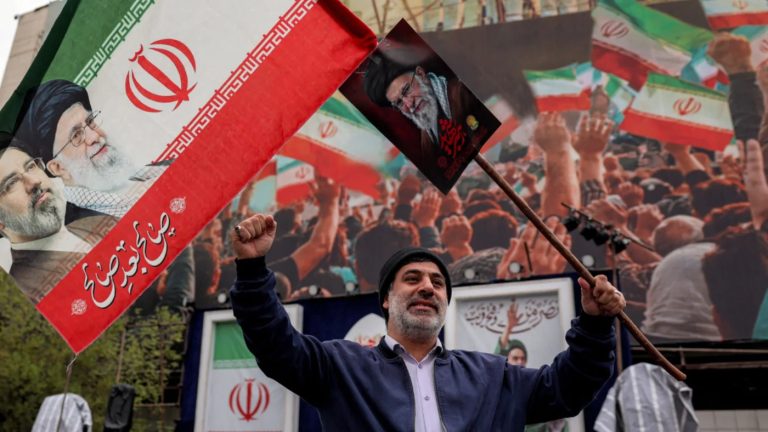
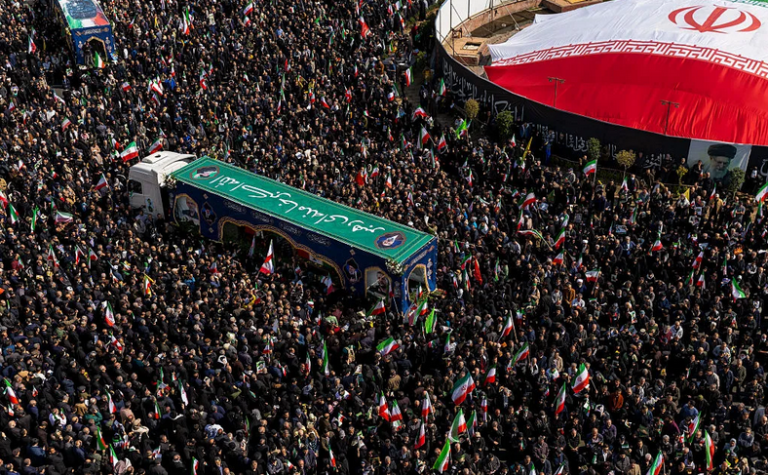
Large outdoor gathering in Iran featuring portraits of Ayatollah Khamenei and Ebrahim Raisi with national flags and a crowd background.

Why the Islamic Republic Won’t Surrender and Can’t Be Made To

Iran’s regime, built for crisis and sustained by the IRGC’s deep entrenchment, can absorb U.S. and Israeli strikes without collapsing; external pressure only hardens its resolve, ensuring the conflict shifts into prolonged asymmetric retaliation rather than surrender, leaving Washington facing an adversary it cannot defeat or coerce into ending the war.

Read More »
A large oil tanker ship sailing on choppy ocean waters under a hazy sky with other vessels in the distance.

Israel Invades Lebanon as Iran Drone Shuts Down Dubai Airport

Israel’s push deeper into Lebanon, Iran’s drone strike that shut Dubai’s airport, and a still‑closed Strait of Hormuz show a war widening on every axis. With Gulf capitals under fire, oil above $100, and sacred sites hit by falling debris, Day 17 underscores a conflict accelerating faster than any effort to contain it.

Read More »
A four-panel collage showing a fire truck at night, a highway sign near smoke, a crowd carrying a coffin, and a street with distant smoke.

Day 14: Iran Hits Ships in Iraqi Waters as War Spreads Beyond All Borders

On Friday, March 13, 2026—the fourteenth day of Operation Epic Fury—the conflict has metastasized into what the International Energy Agency (IEA) calls the “largest supply shock in the history of the global oil market.” As of mid-day, the war has reached twelve countries, and the “shipping war” has effectively paralyzed the northern Persian Gulf.

Read More »
Ali Khamenei pinning a medal onto the chest of Amir Ali Hajizadeh's military uniform, while Mohammad Bagheri and Abdolrahim Mousavi watch from the background.

Iran’s ‘Mosaic Defense’: The Doctrine Built to Outlast Decapitation

Iran’s “mosaic defense” is built for decapitation: 31 autonomous IRGC units, layered successors, and dispersed stockpiles keep the system fighting despite leadership losses. As Mojtaba Khamenei takes power, fragmented command creates both resilience and volatility — from rogue strikes to Hormuz disruption — turning time, terrain, and cost asymmetry into Iran’s core weapons.

Read More »
A tattered Israeli flag overlooks a damaged building interior where a large metal structure has collapsed, with emergency responders in orange vests and armed security personnel walking through the debris behind red and white caution tape.

US Threatens Iran With ’20 Times’ Harder Response Over Hormuz

The U.S.–Israel war with Iran has entered a deadly rhythm: heavy American strikes, rising regional casualties, and Iran threatening the Strait of Hormuz. Over 140 U.S. troops are wounded, Gulf states face missile barrages, and oil flows have nearly halted. Trump warns Iran will be hit “20 times harder” if Hormuz is mined.

Read More »
Candid behind-the-scenes shot of Donald Trump reading a document backstage.

Washington May Be Speaking the Wrong Language With Tehran

Khamenei’s invocation of Karbala signals a shift from deterrence to existential defiance, undermining Washington’s assumption that limited strikes can coerce Iran. Tehran’s doctrine favors horizontal escalation, hardened nuclear sites, and regional proxies. With succession fears rising, even a “surgical” U.S. attack risks unifying Iran’s system and triggering unpredictable retaliation.

Read More »
A composite historical and modern image featuring Saddam Hussein on the left and Ali Khamenei on the right, separated by a digital blue vertical line, with blurred scenes of soldiers and military vehicles in the background.

Beyond Iraq: The High Cost of a Conflict With Iran

The renewed deployment of U.S. naval power to the Gulf has revived a debate that Washington never fully resolved: can the United States coerce Iran militarily without triggering a regional or global crisis. The answer, increasingly, is no. Iran is not Iraq — not geographically, not militarily, not diplomatically, and not economically. Any conflict would be multidimensional, prolonged, and globally destabilizing.

Read More »