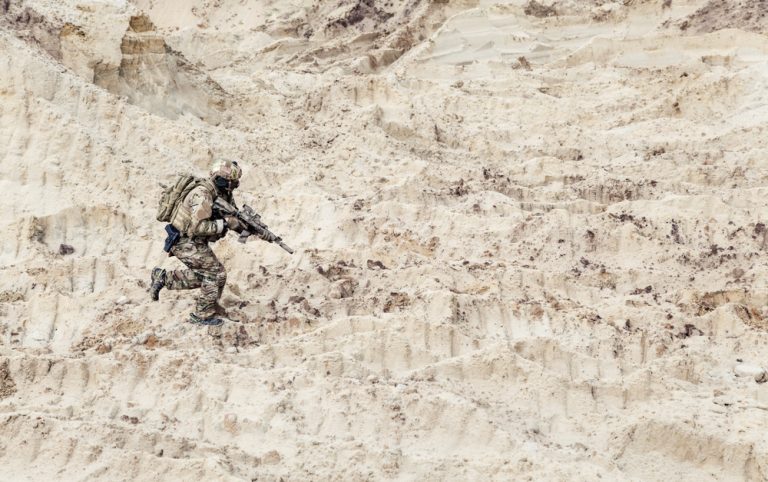
On Saturday, the Washington Post reported that the Pentagon is preparing for weeks of limited ground operations inside Iran, including raids on Kharg Island and coastal sites near the Strait of Hormuz. Thousands of Marines and soldiers from the 82nd Airborne Division are arriving in the Middle East. Iran’s parliament speaker responded by warning that “our men are waiting for the arrival of the American soldiers on the ground to set them on fire.” The rhetorical escalation tracks a physical one: after a month of air and missile strikes that have destroyed over 8,000 military targets yet failed to reopen the strait or break Iranian resistance, Washington appears to be inching toward the one option every serious military planner has spent decades warning against. A new analysis from the Foreign Policy In Focus argues that a ground war in Iran would demonstrate not American strength but its limits — and the evidence from every domain of warfare supports that conclusion.
The Natural Fortress
Iran is not Iraq. That sentence has been repeated so often it risks becoming a cliché, but the underlying facts remain devastating for any invasion plan. Iran is roughly three times the size of France, covering over 1.6 million square kilometers. Its sheer scale and difficult terrain mean an occupation would require more troops than any modern military can deploy. Iran’s mountainous interior — dominated by the Zagros and Alborz ranges and the plateau that runs between them — creates natural defensive barriers that would complicate a large-scale ground invasion. The Zagros alone form a 1,600-kilometer wall along the western border with peaks exceeding 4,000 meters, while the central deserts — the Dasht-e Kavir and Dasht-e Lut — are among the hottest and driest places on Earth.
A Foreign Policy analysis published today examined five potential ground invasion scenarios and reached a stark verdict: “this is the central illusion. The same geography that makes invasion conceivable also makes it strategically self-defeating. Iran’s military geography channels outside forces into a narrow set of coastal choke points, energy hubs, and border corridors that are less pathways to success than triggers of wider escalation. What appears to be a menu of options is, in reality, a map of consequences.”
Even the most discussed “limited” operation — seizing Kharg Island, which handles 90% of Iran’s crude exports — illustrates the trap. Seizing terrain is only the beginning. Holding it against Iranian missile strikes, drone attacks, naval mines, IEDs, and counterattacks from the mainland is a far more complex challenge. Retired Lieutenant General Mark Hertling, writing in The Bulwark, warned that this is “exactly the kind of ‘limited’ mission that can pull a nation into a much longer and more strategically damaging war.”
Twenty Years of Preparation
What makes Iran different from every previous American military engagement is the degree to which Tehran has studied and planned for exactly this scenario. Iranian Foreign Minister Araghchi stated on the war’s first day: “We’ve had two decades to study defeats of the US military to our immediate east and west. We’ve incorporated lessons accordingly. Bombings in our capital have no impact on our ability to conduct war.”
The doctrine he was describing — Mosaic Defense — was formally adopted by the IRGC in the mid-2000s after Iranian strategists watched the U.S. dismantle Saddam Hussein’s centralized military in hours. After observing the “Shock and Awe” campaign in Iraq, Iranian planners concluded that they could not win a conventional war against the U.S. Instead, they broke their system into smaller “cells” like pieces of a mosaic, allowing each province to function as an independent unit even if central command is disrupted. Devised by former IRGC Commander Muhammad Ali Jafari, the model decentralized the IRGC into 31 provincial corps, each empowered to decide the course of war locally without requiring direct validation from above. Each of the 31 units is equipped with its own weapons, intelligence, and logistical capabilities.
This is not theoretical. One month into the war, with Khamenei dead and dozens of senior officials killed, the decapitation of the center has not translated into the collapse of the politico-military system. On the contrary, it has activated a process of command diffusion in which operational authority is redistributed among several tactical centers capable of acting with relative autonomy. Iran is still launching missiles at Israel, still firing at Gulf infrastructure, and still holding the Strait of Hormuz closed.
The Cost Asymmetry Trap
Ground operations would walk directly into Iran’s most calculated advantage: cost asymmetry. Low-cost weapons, such as Shahed drones costing $20,000–50,000, are used to force opponents to spend millions on interceptors like the Patriot missile. On the ground, every American soldier requires fuel, food, ammunition, medical evacuation, and force protection — all delivered through supply lines that would be under constant attack from dispersed IRGC units, Basij irregulars, and coastal defense batteries.
A Marine Corps veteran and director at the Stimson Center put it bluntly: “The Iranians are going to do whatever they can to kill and capture as many Americans as they can, for the propaganda victory alone.” An Atlantic Council analyst warned that “every commander will face the daily decision of assuming risk to troops or risk to mission — force protection becomes paramount, especially if we start to see casualties mount up,” adding, “there’s a high risk of that in this operation.”
The fundamental asymmetry of objectives seals the argument. For the United States, success requires well-defined, attainable goals — regime change, deterrence, or disarmament. For Iran, success means survival. That asymmetry inherently favors the defender. As long as Iran holds together and exacts costs on the aggressor, it is strategically winning. Young men and women will be asked to carry out extremely difficult missions in a complex and unforgiving environment against an enemy that has prepared for decades and sees our invasion as an existential threat. And if the end state is undefined, the war and the enemy will define it for us.
Every modern conflict offers the same lesson. The United States won every battle in Vietnam, every firefight in Afghanistan, every engagement in Iraq — and lost every war. Iran is bigger, better prepared, and more geographically forbidding than any of them. Boots on Iranian soil would not demonstrate American power. They would reveal the gap between what firepower can destroy and what force can actually achieve.
Original analysis inspired by Michael Harrison from Foreign Policy In Focus. Additional research and verification conducted through multiple sources.