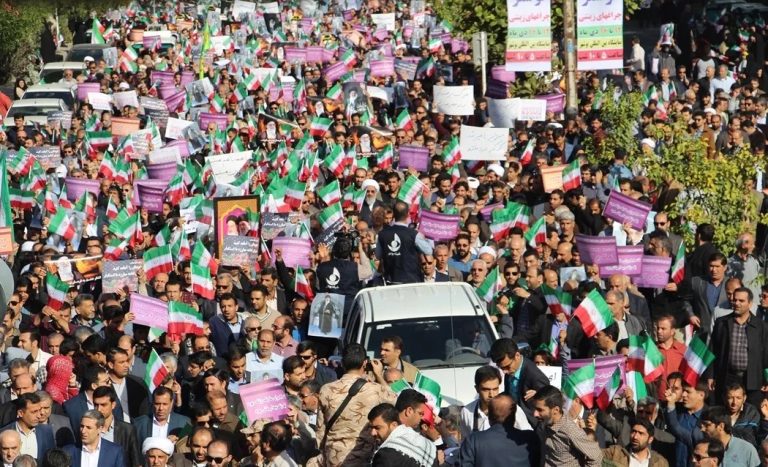
When Trump took to Truth Social six days into Operation Epic Fury to demand Iran’s “unconditional surrender,” he paired the ultimatum with a promise: a “GREAT & ACCEPTABLE Leader” would emerge, and Iran would become “stronger than ever.” Just three days later, speaking in Doral, Florida, he proclaimed the end of the war would happen “very soon.” A month on, no popular uprising has materialized, the IRGC has tightened its grip on power, and the very concept of regime change from the air — without troops, without allies, without a plan — looks less like strategy and more like wishful thinking. A new analysis from the Jerusalem Center for Foreign Affairs warns that the administration’s pursuit of total regime change carries psychological and systemic risks that could produce the very instability it claims to prevent.
The case for removing the Islamic Republic is straightforward on paper. A theocratic government driven by religious ideology — one that views diplomatic concessions as spiritual betrayals — cannot be trusted the way a secular state can. Decades of behavior confirm this. But the assumption that toppling such a regime automatically produces something better collides with everything we know about how power vacuums actually work. The fundamental misunderstanding at the heart of American regime-change strategy is the assumption that destroying the existing order creates space for something better — it does not; it creates space for whoever is best organized, best armed, and most willing to fill it.
The Iraq Precedent Won’t Stay Buried
Defense Secretary Pete Hegseth has been emphatic: “This is not Iraq.” But the parallels keep asserting themselves. In April 2003, Paul Bremer arrived in Baghdad and issued two orders that defined the next two decades — dissolving the ruling Baath Party and purging its administrative class, then disbanding the Iraqi army without disarming it, sending approximately 400,000 soldiers home with their weapons and without their paychecks. Washington handed the insurgency its recruiting pool. By some accounts, about 80% of Iranians would welcome regime change — roughly the same percentage as in Iraq, where that enthusiasm did not lead to peace because the 20% who benefited from the old regime took up arms against whatever replaced it.
Iran is a harder case by every measure. Iraq in 2003 had 25 million people, a military degraded by 12 years of sanctions, and no active nuclear program; Iran has 92 million people, proxy networks that would activate — not disappear — if Tehran fell, and a stockpile of over 880 pounds of highly enriched uranium. The Iranian military’s dual architecture — the regular Artesh army alongside the ideologically driven IRGC and its vast Basij paramilitary network — was designed precisely to resist the kind of decapitation Washington has attempted.
The IRGC Paradox
This is the trap the administration cannot escape. You cannot dismantle the Revolutionary Guard without collapsing the economy, and a collapsed economy does not produce a transition government — it produces a failed state; Washington already ran that experiment in Libya. Yet you cannot leave the IRGC in place without leaving the regime’s coercive core intact.
The succession after Khamenei’s killing confirmed the bind. Since Khamenei’s death at the start of the bombing campaign, the Revolutionary Guard has taken effective control of decision-making, and the naming of Mojtaba Khamenei — with deep ties to the IRGC — as supreme leader represents maximum continuity with the old regime, not regime change. An Iran expert told NBC News: “Even if they replace the supreme leader, what is left of the regime is the IRGC.”
Several weeks into the war, no large-scale uprising against the regime has materialized, and U.S. officials have largely ceased to speak of regime change. Trump acknowledged the reluctance of protesters to take to the streets given their lack of weapons and the fact that Iranian security forces were “machine-gunning people down.” The administration has quietly shifted its rhetoric toward capability degradation — counting warships sunk and missile silos destroyed — while the original promise of liberation fades.
There is also a cognitive trap that rarely gets discussed: the assumption that any secular successor government would be friendlier. Nationalism can be as rigid as religious ideology. A post-theocratic Iranian leadership might still pursue nuclear capabilities or regional dominance driven not by faith but by deeply ingrained national pride — meaning the old dangers persist under a new label. Decades of research on rally-around-the-flag effects confirm what common sense suggests: external attack fuses regime and nation even when citizens despise their leaders.
Past administrations have gamed out scenarios of externally imposed regime change in Iran, and a former State Department official who participated in many of those exercises said virtually every scenario, every tabletop exercise, and every war game conducted over the last decade or more led to the same conclusion — that imposed change produces chaos, not cooperation. The administration appears to have skipped the exercise entirely. Trump’s announcement of Operation Epic Fury was telling: he did not outline a post-ayatollah blueprint.
Bombs can shatter a regime’s buildings, kill its leaders, and sink its navy. What they cannot do is force a change in belief — or guarantee that what comes next will be any less hostile than what came before. If Washington wants a stable Iran rather than another failed state, it will need a plan that is as psychologically sophisticated as it is militarily capable. So far, there is no sign one exists.
Original analysis inspired by Dr. Irwin J. Mansdorf from Jerusalem Center for Foreign Affairs. Additional research and verification conducted through multiple sources.