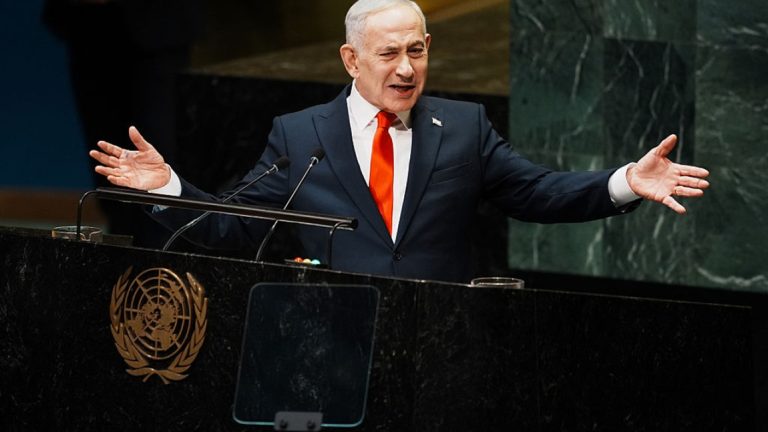
According to political commentator Richard Silverstein, Israeli Prime Minister Benjamin Netanyahu’s recent address at the United Nations General Assembly highlighted a growing divide between Israel’s international standing and its domestic political strategies. Silverstein observes that global support for Israel has seen a sharp decline over the past several years, citing polling data that indicates a significant drop in favorability within the United States. To counter this, the Israeli government has reportedly invested heavily in public diplomacy and digital campaigns to defend its ongoing military operations.
During the UN assembly, Netanyahu faced a highly polarized environment. Reports indicate that numerous delegates from dozens of countries walked out in protest as he took the podium.
Furthermore, a significant diplomatic dispute erupted between Israeli officials and New York City Mayor Zohran Mamdani. Mamdani had previously called for the federal government to enforce an International Criminal Court arrest warrant for Netanyahu on charges of war crimes. During his UN speech, Netanyahu directly addressed Mamdani, fiercely condemning him. “Mr Mamdani, you tried to stop me from coming here,” Netanyahu said. “You tried to silence me. Well, you can’t silence me. You can’t silence the truth.” Netanyahu also accused Mamdani of making Jewish residents feel unsafe in New York since his election.
Outside the UN headquarters, large-scale protests reflected the tense atmosphere. Demonstrators gathered to protest the ongoing military campaigns in Gaza and Lebanon. Among those arrested during the demonstrations was Hollywood actress and comedian Hannah Einbinder, who was detained alongside several other public figures advocating for Palestinian rights.
Netanyahu also used his platform to push back against European leaders. A notable point of contention involved French President Emmanuel Macron, who had denounced the violence in the West Bank. A dispute arose over the exact translation of Macron’s speech regarding whether Hamas “dominated” or “operated” in the West Bank, sparking intense debate and pushback from Israeli officials.
Ultimately, Silverstein argues that Netanyahu’s combative posture on the international stage—framing Israel as a nation besieged by a hostile global community—is primarily political theater designed for a domestic audience. By rallying his right-wing base against foreign criticism and international bodies, observers suggest Netanyahu seeks to consolidate power ahead of upcoming elections, utilizing international friction to unite his domestic political coalition.
Original analysis inspired by Richard Silverstein from The New Arab. Additional research and verification conducted through multiple sources.