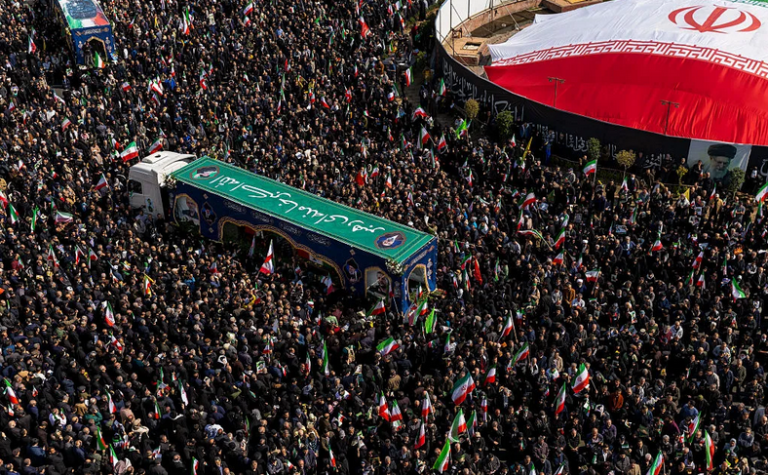
Three weeks into the war on Iran, Israel has done something no state in modern history has attempted at this scale: run a systematic campaign to kill enemy leaders while actively fighting a conventional war. Israel has stepped up assassinations of top Iranian officials in what the IDF described as a push to undermine command and control in Iran — and the list of those killed is striking. On February 28, Ali Khamenei was assassinated on the opening day of the war, and the killings have not stopped since. IRGC commander Mohammad Pakpour, intelligence minister Esmail Khatib, armed forces chief of staff Abdolrahim Mousavi, defense minister Aziz Nasirzadeh — around 30 officials in all have been eliminated. The most recent high-profile target was Ali Larijani, assassinated in Tehran on March 17 as part of a series of Israeli airstrikes aimed at high-ranking Iranian officials.
The tactic itself is not new for Israel. Targeted killings date back decades — from the PLO leadership in the 1970s and 80s, to the systematic removal of Hamas commanders during the Second Intifada, to the decapitation of Hezbollah’s senior ranks between 2023 and 2025. What is new is the setting. This is the first time Israel — or any state — has applied this doctrine against a sovereign government while simultaneously fighting a conventional war against it.
The Larijani Question
Larijani’s killing is the most consequential of the campaign. Having been appointed secretary of the Supreme National Security Council by President Masoud Pezeshkian in August 2025, Larijani was described by numerous outlets as the most powerful man — or the de facto leader — of Iran in the lead-up to the war. His status and influence extended far beyond any formal position, said Meir Ben-Shabbat, once Netanyahu’s national security adviser; since Khamenei’s death, Larijani “managed the fight against Israel and served as the chief coordinator of Iran’s security bodies.”
But his death may have closed more doors than it opened. With Larijani gone, a relatively moderate figure accustomed to dealing with the West is eliminated, making any potential diplomatic settlement of the war vastly more difficult. He had been involved in talks with the Trump administration before the war, and as one former Jordanian ambassador put it, he “seemed to be the one person who the international community could talk to.” Removing him did not weaken the regime’s will to fight. It removed its most credible off-ramp.
Does Decapitation Work?
History suggests the answer is: sometimes, partially, never completely. The assassination of Fathi Shaqaqi in 1995 permanently stunted Palestinian Islamic Jihad as an organization. The killing of Qassem Soleimani in 2020 disrupted Iran’s militia coordination for years. In both cases, the damage was real — but the organizations survived, adapted, and continued. There is no modern example of a state being dismantled through the killing of its leaders alone.
Iran’s own response makes the limits of this strategy plain. Iran’s foreign minister Abbas Araghchi said the US and Israel had yet to understand that “the Islamic Republic of Iran has a strong political structure with established political, economic, and social institutions,” and that “the presence or absence of a single individual does not affect this structure.” That may be self-serving rhetoric — but it isn’t entirely wrong. The IRGC is now headed by Ahmad Vahidi, a figure far more hardline than his predecessors; as one analyst put it, “hardliners waste no time in filling vacancies thanks to Israel.”
If regime decapitation is a catastrophic success, a governmental collapse could unleash the splintering of the state and civil war. Some experts think it’s unlikely leader assassinations will promote positive political change. The most troubling scenario is not that the strategy fails — it’s that it succeeds in the wrong way, producing a more fragmented, more radical Iran without leadership capable of negotiating an exit from the war.
What Israel is doing carries a deeper significance beyond this conflict. For decades, Iran blurred the line between state and non-state warfare through its proxy network — using Hezbollah, Hamas, and the Houthis to project power while maintaining plausible distance. Israel is now returning the favor, applying the tools of irregular warfare against a state actor. The boundaries between conventional war and insurgency are eroding — and not just in the Middle East. That precedent, more than any individual killing, may be what future strategists remember about this war.
Original analysis inspired by Jonathan Spyer from The Spectator. Additional research and verification conducted through multiple sources.