On the seventeenth day of the war, shrapnel from an intercepted Iranian missile struck the rooftop of the Greek Orthodox Patriarchate in Jerusalem’s Old City — meters from the Church of the Holy Sepulchre. There were no injuries, but the image of missile debris landing on one of the holiest sites in Christendom captured a grim reality: this war has now touched the sacred, the ancient, and the irreplaceable, and it is still spreading.
Across the region on Monday, the conflict burned on every front simultaneously. Israel launched its heaviest strikes yet on Beirut and began pushing ground forces deeper into southern Lebanon. Iran hit Dubai’s international airport with a drone, shutting down the world’s busiest hub for international passengers. Meanwhile, the Strait of Hormuz remained effectively closed — despite President Trump’s appeals to half a dozen countries to send warships — as Brent crude held above $101 a barrel.
Israel Escalates in Lebanon
The Lebanese front has become the war’s most violent secondary theater. Massive explosions shook Beirut before dawn Monday as Israel launched what it called strikes on Hezbollah infrastructure in the capital’s southern suburbs. The Israeli military issued sweeping evacuation orders covering large sections of Beirut and southern Lebanon, while IDF troops from the 91st Division pushed deeper into territory south of the Litani River.
Israeli military spokesman Lt. Col. Nadav Shoshani told reporters that Israel has carried out some 7,600 strikes on Iran since the war began, claiming to have neutralized 85% of its air defenses. However, the Lebanese campaign is generating an acute humanitarian crisis. More than one million Lebanese have been displaced, and at least 850 people have been killed. U.S. and Israeli officials told Axios that Israel is planning a “massive” ground invasion to seize the entire southern region. “We are going to do what we did in Gaza,” a senior Israeli official stated.
Hezbollah has shown no signs of collapse. The movement has claimed responsibility for more than 280 attacks since joining the war on March 1, launching coordinated volleys timed to coincide with Iranian missile fire. Israeli defense analysts acknowledged that earlier assessments of Hezbollah’s degraded capabilities had proven inaccurate.
Dubai Airport Shut, Gulf Under Fire
At dawn on Monday, an Iranian drone struck a fuel tank near Dubai International Airport (DXB). A large fire broke out, and though no injuries were reported, all flights were suspended for several hours. Later, a fatality was reported in Abu Dhabi when an Iranian missile hit a vehicle, and fire erupted at an oil facility in Fujairah after a separate drone attack. Saudi Arabia reported intercepting a wave of 35 Iranian drones targeting its Eastern Province.
The attacks underscore a pattern: Iran cannot match American and Israeli firepower, but it can impose massive costs on every country within range. The UAE has intercepted over 1,700 missiles and drones since February 28. The cumulative effect has transformed the Gulf — the world’s premier investment destination — into an active war zone.
Iranian Foreign Minister Abbas Araghchi rejected any suggestion of negotiations. “From our perspective, the strait is open — just not for the United States, Israel and its allies,” he stated, dismissing claims that Tehran was seeking a “truce or talks” as delusional.
The Strait Nobody Can Open
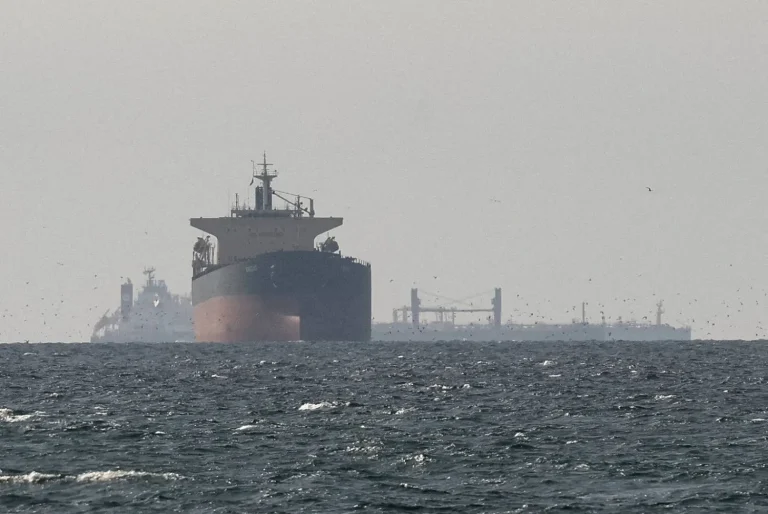
The virtual shutdown of the Strait of Hormuz remains the war’s most consequential strategic fact. Commercial traffic remains at a fraction of pre-war levels, and marine insurance rates have made most voyages economically impossible. Iranian attacks on shipping continue despite U.S. strikes on over 50 Iranian naval vessels, including 16 minelayers.
President Trump said Monday that “numerous countries” had told him “they’re on the way” to help police the strait, though he warned that the “level of enthusiasm” would impact future defense relationships. However, responses from potential partners remain cautious. EU foreign policy chief Kallas said ministers would discuss the matter without a specific timeline, while Italy expressed opposition to expansion. Britain signaled it would not be drawn into the wider war, and Japan and Australia stated they have no current plans to deploy.
The Numbers That Won’t Stop Growing
The human toll continues to mount. More than 1,300 people have been killed in Iran, according to the Iranian Red Crescent — a figure human rights groups believe is an undercount due to the internet blackout. In Lebanon, 850 have died and over a million are displaced. At least 13 U.S. service members have been killed and approximately 150 wounded.
The economic damage extends far beyond fuel prices. Brent crude at $101 represents a 40% increase since the war began. The International Energy Agency (IEA) warned that while member countries hold 1.4 billion barrels in reserves, these are a finite buffer against a disruption with no end in sight.
Seventeen days in, neither side has offered terms the other can accept. As Iranian President Masoud Pezeshkian demands reparations and international guarantees, and President Trump rejects all conditions, the war continues to pull more countries and sacred sites into its expanding orbit.
Original analysis inspired by Asharq Al-Awsat / Reuters / AP from Asharq Al-Awsat. Additional research and verification conducted through multiple sources.
By ThinkTanksMonitor