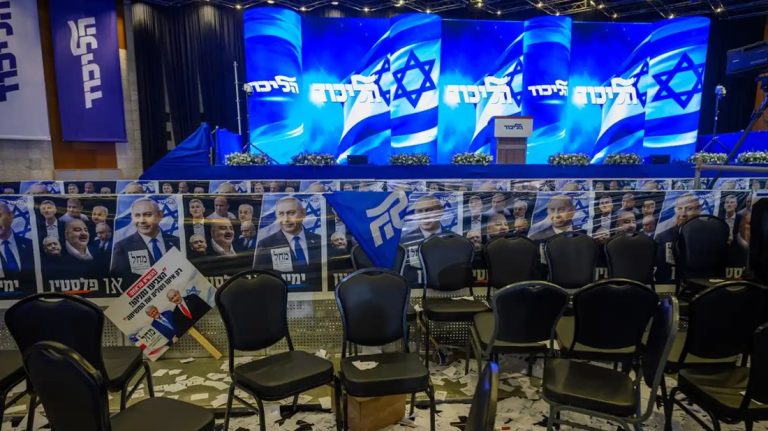
Israel’s 2026 election weakened Benjamin Netanyahu without producing a government capable of replacing him. The final count left Netanyahu’s governing bloc with 53 seats, Gadi Eisenkot’s opposition with 48 and the two Arab parties with a combined 19. Reuters confirmed the result after an election that drew unusually high participation. The arithmetic creates an anti Netanyahu parliamentary majority in theory, but deep political divisions make translating those seats into a functioning coalition far more difficult.
The biggest electoral change came from Israel’s Arab citizens. Ra’am and the Joint List won 19 seats together, almost doubling their representation and giving Arab lawmakers unprecedented leverage over government formation. Reuters reported that turnout among Arab voters surged as communities mobilized against Netanyahu and his far right partners. Their success means neither of Israel’s main Jewish political camps can easily control the Knesset without confronting the question of Arab participation in national government.
Eisenkot faces the sharper dilemma. His coalition partners won only 48 of the Knesset’s 120 seats, far below the conventional 61 seat majority. During the campaign he rejected governing with parties that he does not consider Zionist, making direct cooperation with the Arab factions politically costly. Yet without their votes or outside support, his route to removing Netanyahu is extremely narrow.
Netanyahu Can Survive Without Winning
The deadlock gives Netanyahu an important advantage. He does not need to assemble a new majority immediately to remain prime minister. Israel’s official rules state that the outgoing government continues operating until a replacement is formed, meaning Netanyahu can remain caretaker prime minister throughout coalition negotiations.
President Isaac Herzog will consult the parliamentary factions before choosing a lawmaker to attempt to form a government. The first candidate receives 28 days, with a possible extension of up to 14 days. Further attempts can follow if that effort fails. If the political system exhausts those options without producing a government, Israel could return to another election, potentially in early 2027.
This creates an unusual outcome in which the parties opposed to Netanyahu collectively control more seats than his allies, but may still be unable to remove him. Reuters described the stalemate as a contest with no clear route to government for either camp. Netanyahu could seek a broader unity arrangement with elements of the opposition, while Eisenkot could reconsider his position toward Arab parties. Neither option would be politically easy.
Domestic Paralysis Meets Regional Pressure
The timing of the deadlock makes the problem more serious. Israel remains under international pressure over Gaza, settlement expansion and violence in the occupied West Bank. The European Union has already sanctioned settlers and organizations accused of serious abuses against Palestinians. Britain has also announced tougher restrictions connected to settlements and said it will refuse export licences for equipment that materially contributes to the occupation. British policy therefore adds another source of pressure on whichever government eventually emerges.
Washington could become another source of uncertainty. Reuters reported that a Democratic victory in the United States midterms could bring stronger congressional efforts to restrict or reduce military assistance to Israel. Such pressure would come as Israel continues dealing with Iran, Gaza and instability across the region. A caretaker government retains executive authority, but major military or diplomatic decisions could become more politically contentious when the prime minister no longer commands a parliamentary majority.
The election therefore exposed a problem deeper than Netanyahu’s personal political survival. Israel now has a parliamentary majority that opposes his bloc, but that majority is divided over whether Arab representatives should participate in governing the country. With Arab parties controlling nearly one sixth of the Knesset, repeatedly excluding them from coalition calculations makes stable majority governments increasingly difficult to construct.
A second election could temporarily postpone that contradiction, but it would not resolve it. Unless Netanyahu attracts opposition partners, Eisenkot changes his coalition strategy, or the balance of parliamentary seats changes dramatically, Israel may continue cycling between caretaker governments, fragile coalitions and repeated elections. The 2026 vote has made Arab political participation central to the country’s governing arithmetic, whether Israel’s major parties are prepared to acknowledge it or not.
Original analysis inspired by William A. Galston from Brookings Institution. Additional research and verification conducted through multiple sources.