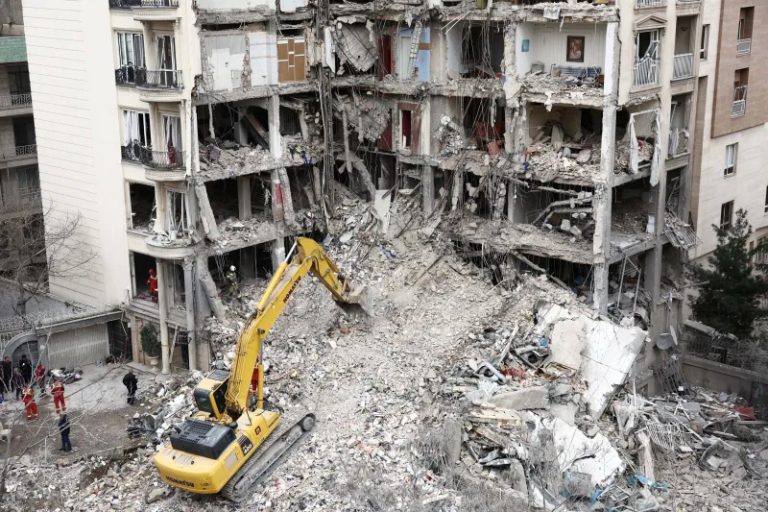
A month ago, the White House expected Operation Epic Fury to follow the Venezuela playbook — a swift decapitation strike, a regime in disarray, a quick declaration of victory. Instead, Iran has fought back with a strategy Washington never war-gamed for: an attrition campaign built not on matching American firepower but on making the war too expensive for America to sustain. Tehran has accepted attrition as a strategy, not seeking a quick end to the war but sustaining pressure over time — militarily, politically, and economically — to alter the adversary’s cost-benefit calculation, with the objective being not battlefield victory but producing a new strategic equation. A veteran diplomat who served seven U.S. administrations now warns in Foreign Affairs that the conflict increasingly resembles Russia’s grinding war in Ukraine — and that Washington risks the same trap Moscow fell into.
The comparison stings because it is precise. Russia invaded Ukraine in February 2022 believing a quick strike on Kyiv would cause resistance to collapse. It did not. The fierce Iranian response has led to a war of attrition and possible stalemate similar to the conflict in Ukraine, and the United States, like Russia, does not have an obvious way to achieve a decisive victory. Both aggressors now face the same brutal arithmetic: air power alone has never won a war, and ground invasion is either politically impossible or logistically unthinkable.
The Hormuz Trap
Iran’s most effective weapon is not a missile — it is geography. Brent crude surpassed $100 per barrel on March 8 for the first time in four years, rising to $126 at its peak, and the closure has been described as the largest disruption to energy supply in the history of the global oil market. Major shipping firms including Maersk and Hapag-Lloyd ceased transiting the strait almost immediately; as of late March, commercial traffic remains at a near-total halt. The Strait of Hormuz has been Iran’s most effective lever in this war, creating immediate, systemic pressure by disrupting or conditioning the flow of energy and imposing costs not only on the United States and its allies but on the global economy.
Even killing Iran’s top naval commander, Alireza Tangsiri, in an Israeli airstrike on March 26 has not broken the blockade. Shipping lanes are just two nautical miles wide, and Iran’s Revolutionary Guards still have plenty of options including fast attack craft, mini submarines, mines, and even jetskis packed with explosives — all far cheaper than the $4 million Patriot interceptors the U.S. is burning through to defend against them.
Running Out of Bullets
The munitions math is devastating. In the first 16 days, the U.S. used over 6,000 defensive and offensive munitions, including nearly 46% of ATACMS and Precision Strike Missiles and nearly 40% of U.S.-operated THAAD interceptors — and the Payne Institute estimates the U.S. would deplete stockpiles of those three munitions within a month at that rate. The Pentagon burned through $5.6 billion in munitions in the first 48 hours alone. More than 850 Tomahawk cruise missiles have been launched in a month, with Washington Post sources describing supplies as “alarmingly low.”
A retired Marine colonel at CSIS captured the real danger: “The major risk is not that we’re going to run out for this war, but that the inventories are inadequate for a possible conflict with China.” The Heritage Foundation found that U.S. initial munition stocks would run out within 25 days of a high-intensity conflict with a peer adversary. The Iran war is consuming the weapons earmarked for a Taiwan contingency — and Beijing is watching.
No Off-Ramp in Sight
The classic military solution to stalemate is a ground offensive, but that option barely exists here. There is no neighboring territory from which to stage an invasion, Iran’s landmass and population are more than double Iraq’s, and 59 percent of Americans already feel U.S. military action in Iran has been excessive. The Senate has twice failed to pass a War Powers resolution, with votes falling along party lines.
Trump’s 15-point peace plan, released last week, offered what looked like an exit. But Iran rejected the ceasefire-first framework, with Foreign Minister Araghchi stating that Tehran does not seek a ceasefire because it does not wish to see “last year’s scenario to repeat,” demanding instead a permanent end to hostilities — a rational position for a state that has engaged in two rounds of nuclear diplomacy with Washington and been subjected to military strikes on both occasions.
A Carnegie analysis explains why: Iran believes its coercive leverage has improved its bargaining position and will avoid framing any contacts as negotiations while the pressure is working. Tehran wants guarantees before a ceasefire, not promises after one. Washington wants the reverse. That structural gap is why the Jeffrey article in Foreign Affairs argues the U.S. will almost certainly have to accept an outcome short of its maximum goals — exchanging a halt in operations for strict limits on enrichment, removal of highly enriched uranium, and caps on ballistic missiles.
The alternative is indefinite war — or what Israeli strategists call “mowing the lawn,” periodically degrading Iranian capabilities without ever achieving a resolution. Iran’s strategy of closing the Strait of Hormuz using naval mines, coastal missile batteries, and drone swarms is holding the global economy hostage; if the plan was to mirror the Venezuela playbook with swift, overwhelming action, it has backfired horribly. Russia learned in Ukraine that you cannot bomb a country into submission from the air. Washington is now learning the same lesson — at a cost of billions per week, with allies drifting away, weapons stocks draining, and no theory of victory in sight.
Original analysis inspired by James F. Jeffrey from Foreign Affairs. Additional research and verification conducted through multiple sources.