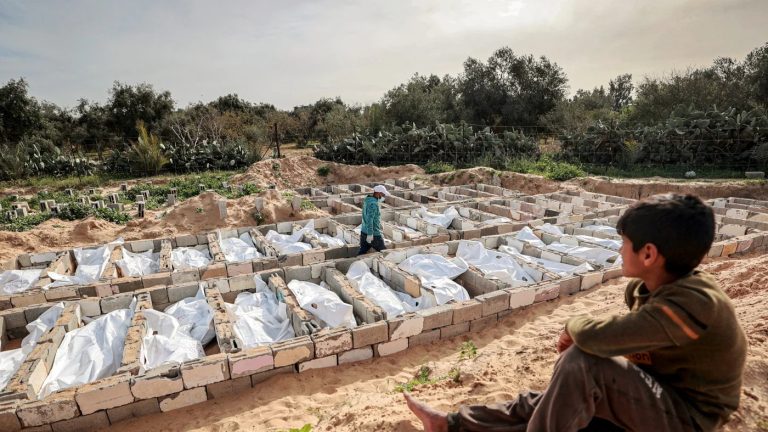
Four months into a fragile ceasefire, Gaza remains a place where survival itself is contested. Between October 2023 and late January 2026, more than 71,600 Palestinians have been killed in the strip, with nearly 500 more dying since the ceasefire took effect in October 2025. The UN’s aid coordination office has warned that the humanitarian crisis is “far from being over,” with Palestinian lives still “defined by displacement, trauma, uncertainty, and deprivation.” Against this backdrop, Washington and Tel Aviv have placed a stark condition on rebuilding: hand over your weapons first.
The demand carries enormous weight. The Gaza peace plan calls for the demilitarization of the strip, the deployment of an international stabilization force, transitional governance by Palestinian technocrats, and large-scale reconstruction. Prime Minister Netanyahu has said reconstruction should not be allowed to begin before Hamas is disarmed. For Palestinians, the arrangement feels less like a path to peace and more like an ultimatum designed to strip them of their last tool of political agency.
Reconstruction as Leverage
The gap between what has been promised and what has materialized on the ground is enormous. From October 2025 to early January 2026, only 23,019 aid trucks entered Gaza out of a projected 54,000 — just 43 percent of the agreed amount. Israel has blocked essential and nutritious food items including meat, dairy, and vegetables. Since March 2025, Israeli authorities have been blocking UNRWA from directly bringing humanitarian personnel and aid into the strip.
Meanwhile, the vision being sold to the world bears little resemblance to conditions on the ground. At the World Economic Forum in Davos, Jared Kushner unveiled a “master plan” for Gaza featuring residential towers, data centres, seaside resorts, and an airport — all conceived without any consultation with Palestinians. Architecture professor Ali Alraouf has described this approach as the “Vegas-ification” of Gaza. Legal scholar Hassan Jabareen has warned the plans amount to “silent demographic engineering,” designed to convert a national rights struggle into a real estate problem.
The logic is plain: reconstruction will only flow to areas where armed groups have been neutralized. Trump’s envoy Jared Kushner stated at an October press conference that “no reconstruction funds will be going into areas that Hamas still controls.” Gaza would be functionally divided — one zone where rebuilding proceeds, another left frozen under Hamas presence. The weapon becomes the excuse; the suffering becomes the tool.
Colonial Echoes
Strip away the diplomatic language and the demand to disarm echoes a pattern familiar across centuries of settler-colonial history. Settler colonialism functions by replacing indigenous populations with an invasive settler society that develops its own identity and sovereignty over time. Scholar Patrick Wolfe’s influential framework describes this as a “logic of elimination” — not a single event but a permanent structure aimed at securing territory by removing its original inhabitants. This logic “requires the elimination of the owners of that territory, but not in any particular way.”
In the Palestinian case, that elimination is taking concrete form. A UN Commission of Inquiry found that Israeli authorities extensively demolished civilian infrastructure and continuously enlarged areas under their control, reaching 75 percent of the strip by July 2025, substantially reducing territory available for Palestinians. The Commission determined that such actions deliberately inflicted conditions calculated to destroy Palestinians in Gaza — an underlying act of genocide.
The same pattern extends to Jerusalem. Israel is advancing two major settlement plans for occupied East Jerusalem, including 9,000 units on the ruins of Qalandiya airport and a project in Sheikh Jarrah to displace 40 families. Peace Now warns this amounts to “de facto annexation,” deepening the separation of Palestinian East Jerusalem from the West Bank and undermining prospects for a viable state. Between 2024 and mid-2025, Israeli authorities demolished 2,577 Palestinian structures in the West Bank, including East Jerusalem.
The False Binary
Palestinians are being presented with a choice that is no choice at all. Accept disarmament and watch the remaining levers of political resistance dissolve. Refuse it and be blamed for the ongoing catastrophe that continues to kill people even under a supposed ceasefire. Israel violated the ceasefire agreement at least 1,193 times from October to January, attacking Gaza on 82 of 97 days.
Hamas has signalled willingness to disarm if Israeli forces withdraw and progress is made on statehood, though recent statements suggest it wants to retain small arms or participate in Gaza’s police. Palestinian Islamic Jihad leader Ziyad al-Nakhalah has called the peace plan an attempt by Israel to impose through the US “what it could not achieve through war.”
History offers little comfort. From the disarming of Native Americans to the forced pacification of Aboriginal Australians, indigenous communities that surrendered their means of armed resistance rarely found the promised peace waiting on the other side. The aim of settler colonialism is to replace the original population along with its beliefs and practices, accomplished through violent depopulation, forced assimilation, and eradication of indigenous knowledge and cultures. What followed was not coexistence but managed decline.
The demand for demilitarization in Gaza cannot be separated from this broader context. When a population already living under occupation, blockade, and systematic destruction is told that the price of bread is the surrender of its last bargaining chip, the transaction is not one of peace. It is one of permanent subjugation dressed in the language of reconstruction.
Original analysis inspired by Raja Abdulhaq from Middle East Eye. Additional research and verification conducted through multiple sources.