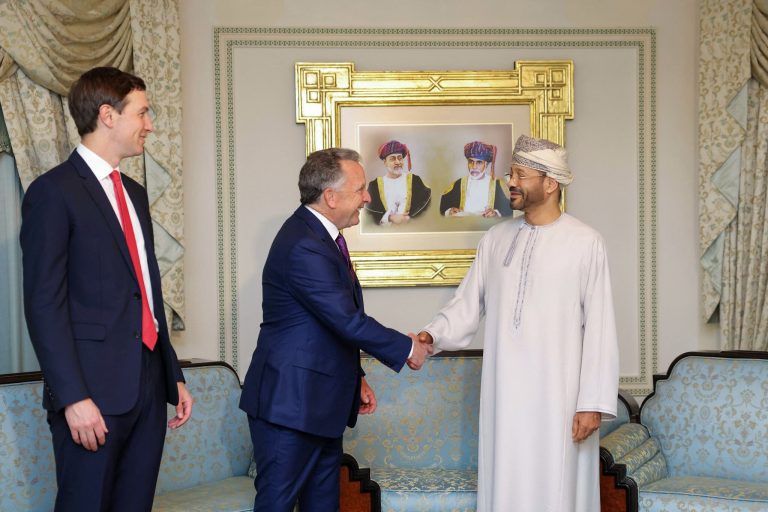
Thirty-six hours before the first American bombs fell on Tehran, Steve Witkoff and Jared Kushner sat in a room in Muscat, Oman, across from Iran’s foreign minister. The Iranians had just presented a seven-page proposal that went further than any nuclear offer Tehran had made in a decade. The American negotiators looked at the document, told the Iranians they needed to leave the next day to visit the USS Abraham Lincoln, and flew out. Within two days, the war had begun.
In the weeks since, a picture has emerged — from Gulf diplomats, Omani mediators, arms control experts, and participants in the talks themselves — that two men with no nuclear expertise, deep ties to Israel, and an apparent inability to distinguish a research reactor from a weapons program may have provided the misleading advice that helped push the United States into its largest military operation since the 2003 invasion of Iraq.
Witkoff has made three central claims to justify the collapse of diplomacy. First, that Iran boasted about having enough enriched uranium for “11 nuclear bombs.” Second, that Iran was enriching and stockpiling uranium at the Tehran Research Reactor rather than producing medical isotopes. Third, that Iran was on the verge of a nuclear weapon — “in a year, you’d have 30 or 40 nuclear bombs,” he told CNBC.
Each claim has been challenged by people who were in the room or have direct knowledge of the talks. A Gulf state diplomat told MS NOW that the “11 bombs” exchange simply never happened as Witkoff described it. The Iranians were instead trying to convey that their stockpile of enriched material “can all go away should we have a deal and Iran can be relieved from sanctions.” A second Gulf diplomat said Witkoff mischaracterized a conversation with IAEA Director Rafael Grossi about the Tehran Research Reactor, taking remarks “completely out of context.”
Elena Sokova, executive director of the Vienna Center for Disarmament and Non-Proliferation, called the administration’s technical assessments “confusing and misleading” and riddled with “technical errors.” Multiple nuclear experts told reporters there is no evidence the Tehran Research Reactor was being used, or even could be used, to produce a weapon. Both US intelligence and the IAEA had concluded before the war that Iran was not pursuing a nuclear bomb and was not close to producing one.
Yet the Trump administration chose not to include nuclear technical experts in its negotiating team — a decision that reportedly baffled the Iranians. Witkoff defended his credentials: “I wouldn’t tell you I’m an expert in nuclear, but I’ve learned quite a bit.” Kushner, a real estate developer with no government role, has offered no public explanation of his qualifications.
The Omani Warning Washington Ignored
Oman’s foreign minister, Badr bin Hamad Al Busaidi, took the extraordinary step of flying to Washington after the talks collapsed to tell both the White House and the American public that Iran had made concessions that went well beyond the 2015 JCPOA. In a televised interview, Al Busaidi said the US attacks came at a time when Tehran had already signaled readiness for “unprecedented concessions” related to its nuclear activities. The framework proposed by Oman, Qatar, Turkey, and Egypt included a three-year halt on all enrichment, limits to below 1.5% enrichment in perpetuity, and the transfer of Iran’s highly enriched uranium out of the country.
A Gulf diplomat told MS NOW that Iranian Foreign Minister Abbas Araghchi offered to stay in Oman as long as necessary to finalize a deal — “even if it’s one to two weeks” — but that Witkoff and Kushner said they needed to leave the following day. The diplomat added that Witkoff “conducted himself in a manner not befitting the office he represented.”
Araghchi himself told CBS that his American counterparts had not actually demanded zero enrichment during the latest session — contradicting Washington’s public position — and said Iran was preparing a draft proposal that could “accommodate both sides’ concerns.” He suggested any eventual agreement could exceed the terms of the Joint Comprehensive Plan of Action (JCPOA).
The Israel Factor
The question of motive hangs over every aspect of the story. Witkoff is a longtime supporter of Israel who counts pro-Israel megadonor Miriam Adelson as a “dear friend.” He carries a custom pager gifted to him by Netanyahu and senior Mossad officials — a reference to Israel’s operation detonating thousands of Hezbollah pagers in Lebanon. During the 2024 campaign, Witkoff raised massive sums from pro-Israel donors for Trump after Biden briefly paused bomb shipments to Israel.
Kushner’s ties run even deeper. He grew up with Netanyahu as a family friend — the future Israeli prime minister occasionally borrowing the teenager’s bedroom during visits. Kushner reportedly consulted with Netanyahu’s office to draft Trump’s 2016 AIPAC speech and has donated to illegal West Bank settlement construction.
In the lead-up to the war, both men were speaking almost daily with Israeli officials, including Netanyahu and the head of Mossad, according to reports. Witkoff’s role has since expanded from negotiator to coordinator of the joint war effort with Israel. Iranian officials have reportedly come to view the pair not as incompetent but as having deliberately misled Trump to produce the outcome Israel wanted.
Congress Demands Answers
The question of whether the United States went to war because its negotiators didn’t understand what they were negotiating — or understood perfectly and chose to sabotage it — has now reached Capitol Hill. Democratic senators have called for hearings into the conduct of the negotiations. Senator Chris Murphy said the classified briefing he attended “confirmed to me that the strategy is totally incoherent.” Senator Tim Kaine said the war authorization question was inseparable from the question of whether diplomacy was given a genuine chance.
Arms Control Association president Daryl Kimball told reporters that, based on the administration’s own on-the-record briefing about the failure of talks, Witkoff and Kushner appeared to have “fatally misunderstood a series of basic technical and historical matters.” The Quincy Institute called the situation “a catastrophic failure of diplomatic process” that “demands congressional investigation.”
Witkoff and Kushner will almost certainly be involved in any future diplomatic efforts with Iran. That makes the question of their competence and honesty not merely historical but existential. If the war started because two men without nuclear knowledge told the president that Iran was bluffing when it was actually conceding, then the American public — now paying higher gas prices, watching service members come home wounded, and absorbing the costs of a war most of them opposed — deserves to know. The tab for this war, by the Pentagon’s own estimate, exceeded $11 billion in its first week alone. The price of the diplomatic failure that preceded it may prove incalculable.
Original analysis inspired by Branko Marcetic from Responsible Statecraft. Additional research and verification conducted through multiple sources.
By ThinkTanksMonitor