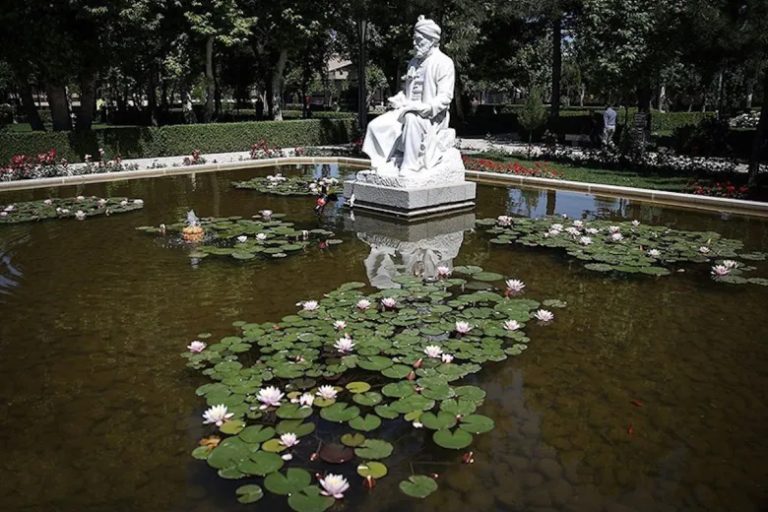
Somewhere in northeastern Iran, not far from the city of Mashhad, a poet has been buried for over a thousand years. His name was Ferdowsi. He spent thirty-five years writing an epic of 50,000 rhymed couplets — a medieval work composed to preserve the myths, legends, history, language, and culture of ancient Persia, the longest work by a single author in world literature. The country Donald Trump recently threatened to bomb “back to the Stone Age” was already shaping organized civilization when much of the Western world was still in its infancy.
Trump declared he would “bring them back to the Stone Ages, where they belong” — a statement made in a prime-time address that was followed, hours later, by the first US military strike on major civilian infrastructure in Iran. A professor of global security at the University of Oxford told Al Jazeera that if the threat implies destroying structures that characterise modern society, “then this would be illegal because it implies directing attacks against civilian objects.” Over a hundred legal scholars signed a letter making the same point. But beyond the legal argument lies a historical one — and it is just as damning.
What a Thousand Years of Persian Culture Actually Looks Like
Ferdowsi is widely regarded as the preserver of the Persian language and of pre-Islamic Iranian cultural identity. Of all the peoples conquered by the Arabs in the seventh century, the Persians are the only ones who can boast a major literature in the indigenous language they were using before the conquest. When asked why the vast majority of Egyptians speak Arabic rather than Coptic, a leading Egyptian historian replied: “Because we had no Ferdowsi.”
That is not a small claim. Some experts believe the main reason modern Persian today is more or less the same language as that of Ferdowsi’s time, over a thousand years ago, is due to the very existence of works like the Shahnameh — which has itself become one of the main pillars of the modern Persian language. Ferdowsi’s role in the formation of Persian language and literary culture is comparable to that of Goethe for the Germans, Pushkin for the Russians, or Shakespeare for the English-speaking world. This is not nationalist mythology. It is the assessment of the world’s leading institutions of Persian studies, including Cambridge University and the Library of Congress.
The Shahnameh was composed during a period when Arab-Islamic culture was displacing the indigenous Persian heritage. Ferdowsi wrote it deliberately to preserve the Persian language, historical memory, and the Zoroastrian worldview that had defined Iranian civilization for over a millennium — and it ensured the survival of the Persian language, becoming the foundational text of Persian cultural identity to this day. That a single poet could accomplish something of such lasting consequence — through language, not armies — is precisely the kind of historical achievement that Trump’s rhetoric erases.
What Is Actually Being Destroyed
The war has not spared Iran’s cultural heritage. Beyond the capital, strikes have reached the heart of Iran’s Islamic golden age. In early March, in Isfahan, the 17th-century Chehel Sotoun Palace and the Masjed-e Jame — Iran’s oldest Friday mosque — were hit. According to UNESCO, the mosque “illustrates a sequence of architectural construction and decorative styles of different periods in Iranian Islamic architecture, covering 12 centuries.”
The US and Israel also attacked the Pasteur Institute in downtown Tehran, founded over a hundred years ago. The institute works on infectious diseases, producing vaccines and biological products and providing advanced diagnostics. Universities including leading engineering institutions have been bombed. Medical infrastructure has not been spared. Laboratories, universities, and medical centres are described not as incidental casualties — but as targets.
Iran’s minister for culture and tourism told Al Jazeera: “Restoration, no matter how perfect, can never return an artefact to its starting point. When you lose the original stone of a Qajar palace or the 17th-century tilework of an Isfahan mosque, you lose a physical layer of history that cannot be manufactured again. Every crack is a permanent scar.”
The Rage and the Resilience of a Civilisation Under Attack
Trump’s threat, followed by strikes that reportedly included a not-yet-opened bridge, sparked anger among Iranians at home and abroad. Iran’s president Masoud Pezeshkian condemned the remarks, writing: “Does threatening to send an entire nation back to the Stone Age mean anything other than a massive war crime?” Anger also surged among ordinary Iranians and diaspora communities — many of whom oppose the government but object strongly to threats against national infrastructure and civilian sites.
Trump’s frustration, expressed privately as well as publicly, stems from the fact that Iran’s leaders don’t believe they’re losing the war and therefore don’t feel motivated to strike a deal. “The Iranian military leadership has lost so much but they’re not feeling the pain,” said one confidant who spoke with Trump last week about the war. That gap — between punishment delivered and political capitulation achieved — is the central failure of the entire campaign. The history of aerial bombardment offers no example of a society being bombed into political surrender through the destruction of its civilian foundations. What it does offer is evidence of exactly the opposite: external attack tends to consolidate national identity, not fracture it.
“What President Trump is describing as the destruction of ‘a whole civilization’ would be a war crime, plain and simple,” said Sarah Yager of Human Rights Watch. “There is no gray area on this under international law.” The word “civilization” is not rhetorical. Iran gave the world the concept of paradise — from the Persian pairi-daeza, meaning an enclosed garden, a cultivated refuge from wilderness. It produced Rumi and Hafez. It built the first empire in history to issue a declaration of human rights, under Cyrus the Great in the sixth century BCE. The Shahnameh has been read continuously for over a thousand years and shows no sign of stopping.
Bombs have come and gone across Iranian history. Invasions too. As one Iranian official put it: “A civilisation that has survived several millennia cannot be erased with aerial bombardment.” Ferdowsi himself knew something about powerful rulers who underestimated what they were dealing with. He wrote about them, at length, in verse. They are mostly forgotten. The poetry remains.
Original analysis inspired by Tor Farovik from Asia Times. Additional research and verification conducted through multiple sources.