Category: Cartoon

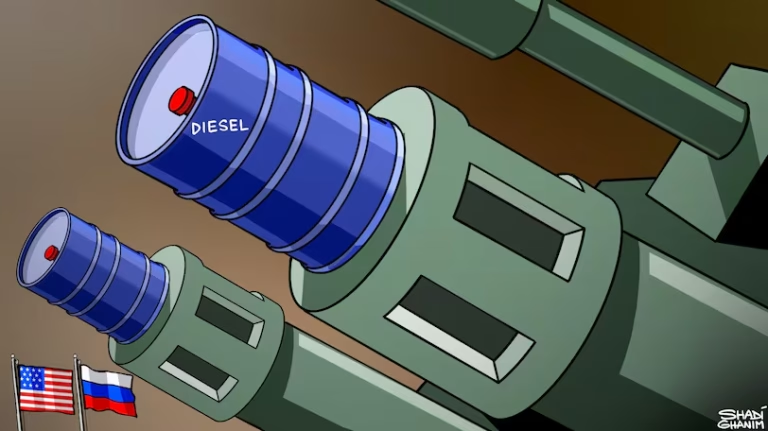
Shadi’s take on the US-Russia diesel deal

Analysis: Visually, Shadi Ghanim’s editorial cartoon utilizes stark symbolic imagery of Russian fuel pumps and pipelines directly servicing American energy demands, contrasting Washington’s public anti-Moscow posture with its covert economic reliance. The underlying message exposes the hypocrisy of US economic statecraft, where European and Global South nations are pressured to sever Russian energy ties while Washington cuts bilateral deals to tame domestic fuel prices. This matters strategically as it visually encapsulates the failure of the Western sanctions regime and the undeniable leverage of Russian energy commodities in a multipolar market.
Read More »
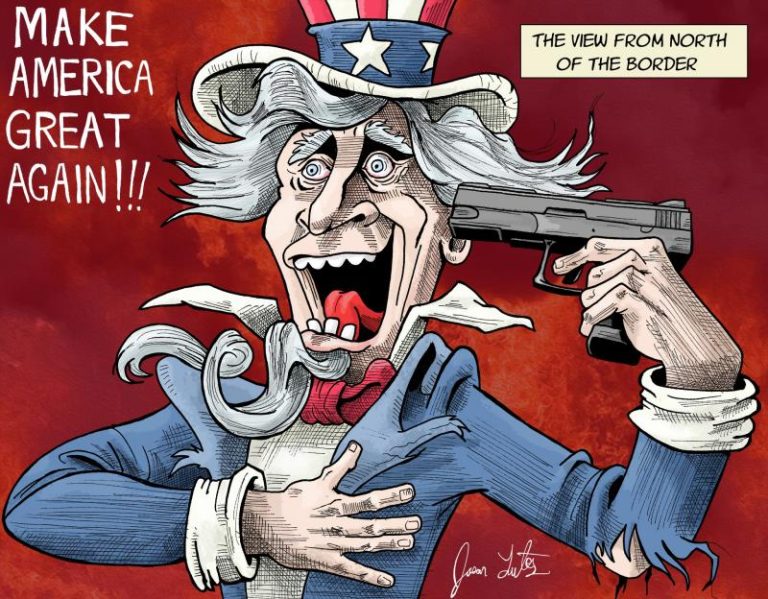
Political cartoon of Uncle Sam in tattered clothes holding a handgun to his head while shouting Make America Great Again.

America is Killing Itself

Analysis: Drawn from an external northern neighbor’s vantage point, the cartoon frames modern American populism and intense domestic hyper-partisanship not as national revitalization, but as acute institutional self-destruction. Uncle Sam’s deranged expression and self-inflicted threat reflect the view that the greatest existential danger to American hegemony comes from internal societal decay rather than external rivals. It underscores how unbridled internal polarization accelerates the decline of the state’s global standing and domestic stability.

Read More »
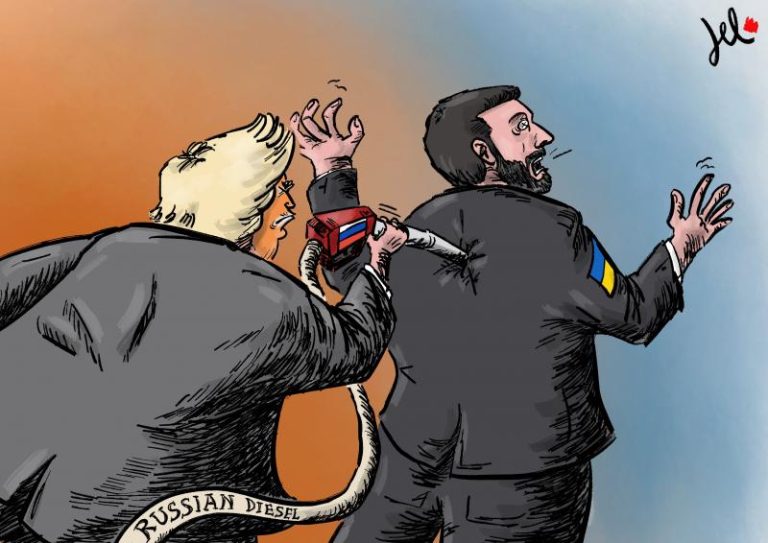
Political cartoon showing a man in a suit stabbing Ukrainian President Volodymyr Zelenskyy in the back with a Russian diesel fuel pump nozzle.

Backstabbing

Analysis: The illustration uses the visual trope of a literal backstab to critique Western and European duplicity regarding energy sanctions against Moscow. While political leaders outwardly pledge diplomatic and military solidarity to Kyiv, secondary energy flows and the continued reliance on Russian-refined diesel effectively undercut Ukraine’s wartime strategy. The piece highlights how commercial dependency and energy realpolitik quietly compromise stated geopolitical alliances.

Read More »
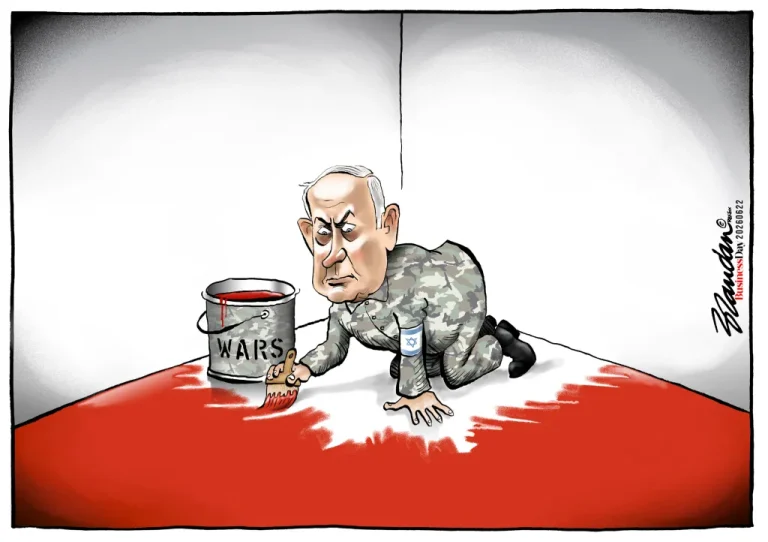
Editorial cartoon by Brandan Reynolds depicting Israeli Prime Minister Benjamin Netanyahu in military fatigues painting himself into a corner with red paint labeled Wars.

Israel’s Benjamin Netanyahu increasingly isolated…

The cartoon by South African editorial cartoonist Brandan Reynolds draws on the classic idiom of “painting oneself into a corner”. Israeli Prime Minister Benjamin Netanyahu is depicted in full military camouflage, wearing an Israeli flag armband, on his hands and knees on a stark white floor. With a brush in hand and a tin marked “WARS” filled with bright red paint, he has systematically coated the entire surrounding surface, leaving only a tiny patch of unpainted ground beneath himself. His facial expression is one of grim, trapped realization, staring down at the shrinking space left to stand.

Read More »

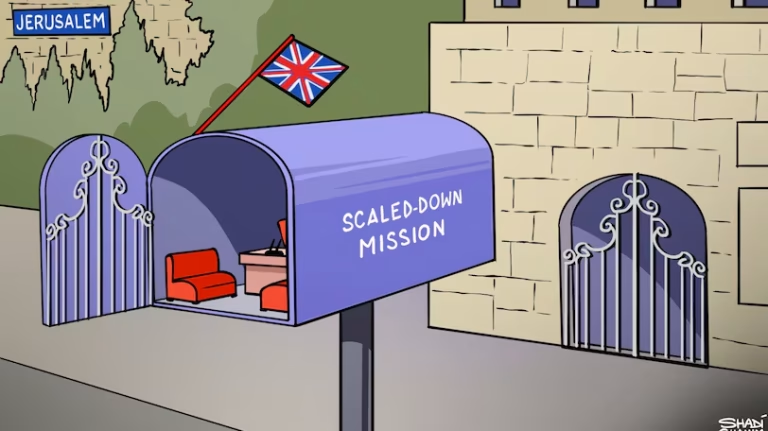
Shadi’s take on diplomatic tensions between the UK and Israel

Analysis: The illustration depicts a literal mailbox labeled “SCALED-DOWN MISSION” functioning as a cramped diplomatic office with miniature furniture, flying the Union Jack outside a grand stone compound marked “JERUSALEM”[cite: 1]. Ghanim uses visual literalism and scale contrast to satirize how British diplomatic leverage and consular operational capacity have been reduced to mere symbolic, mailbox-sized representation amid escalating friction with Israeli authorities[cite: 1]. This visual underscores how Western diplomatic missions face operational marginalization and political paralysis as traditional diplomatic engagement collapses under intensifying regional conflict[cite: 1].

Read More »
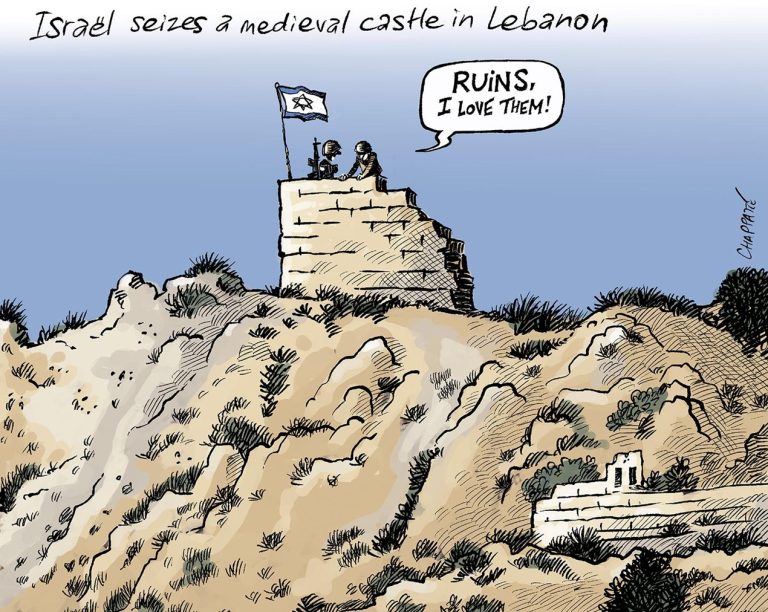
Political cartoon showing Israeli soldiers on a ruined ancient fortress in Lebanon saying "Ruins, I love them!"

War rages on in Lebanon

Analysis: The illustration depicts two Israeli soldiers raising their national flag atop a dilapidated hilltop fortification (referencing Beaufort Castle), with one remarking, “Ruins, I love them!”[cite: 1]. Chappatte delivers a biting double entendre that equates the capture of ancient stone remnants with the widespread destruction visited upon Lebanon’s contemporary civilian and physical infrastructure[cite: 1]. Strategically, the cartoon frames the cross-border incursion as an empty operational trophy—symbolizing an entrenched doctrine that manufactures desolation without achieving long-term strategic pacification or political stability.

Read More »
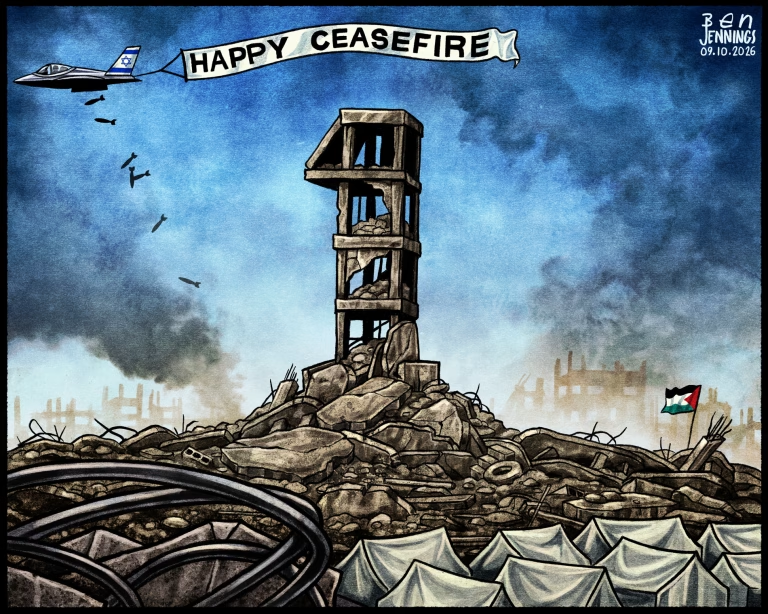
Editorial cartoon by Ben Jennings showing a ruined building shaped like the number one amidst rubble, displaced persons' tents, and an Israeli fighter jet dropping bombs while towing a "Happy Ceasefire" banner.

Ben Jennings on the Gaza ‘ceasefire’ – cartoon

Analysis: The visual depicts a hollow diplomatic podium labeled “Ceasefire Talks” erected over an endless expanse of pulverized concrete, under which a conveyor belt of heavy Western ordnance quietly feeds military positions. The underlying message skewers Western diplomatic posturing, portraying diplomatic statements as rhetorical theater intended to pacify domestic voters while maintaining strategic complicity. It underscores the profound disconnect between stated humanitarian norms and the structural continuation of aggressive military operations.

Read More »
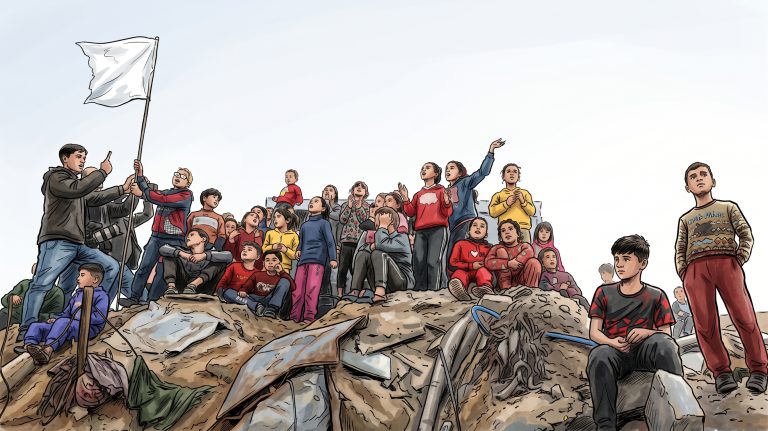
Comic-style editorial illustration of Palestinian children and families sitting atop rubble while raising a white flag.

Gaza and the choice ahead for Palestinians and Israelis

Analysis: The artwork portrays dozens of displaced Palestinian children and youths gathered atop a massive mound of concrete debris, shattered masonry, and twisted rebar, with a young man on the left hoisting a tattered white flag toward an open sky. Visually, the stark contrast between the children’s desperate upward glances and the surrounding wreckage captures the utter breakdown of civilian protections in prolonged asymmetrical urban warfare. The piece powerfully emphasizes that military attrition targets the future generation most severely, rendering humanitarian ceasefires and political resolution an urgent imperative rather than a deferred diplomatic option.

Read More »
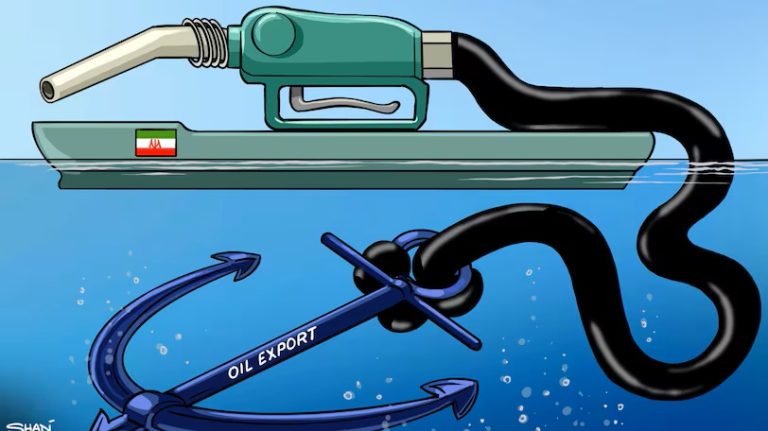
Editorial cartoon showing a ship shaped like a fuel nozzle with an Iranian flag, tied underwater to an anchor labeled Oil Export.

Shadi’s take on Iranian oil shipments

Analysis: The cartoon depicts a hulking US naval patrol boat attempting to deploy a symbolic sanctions banner across the Persian Gulf, while deeply shadowed oil tankers effortlessly maneuver around it beneath an overarching regional web. It visually encapsulates the structural failure of unilateral Western coercive economic measures in the face of decentralized supply networks. The work matters because it conveys the reality of waning Western enforcement authority alongside the normalization of alternative, non-dollar energy trade routes.

Read More »