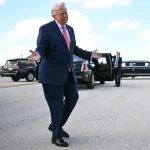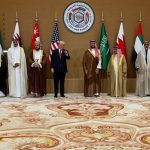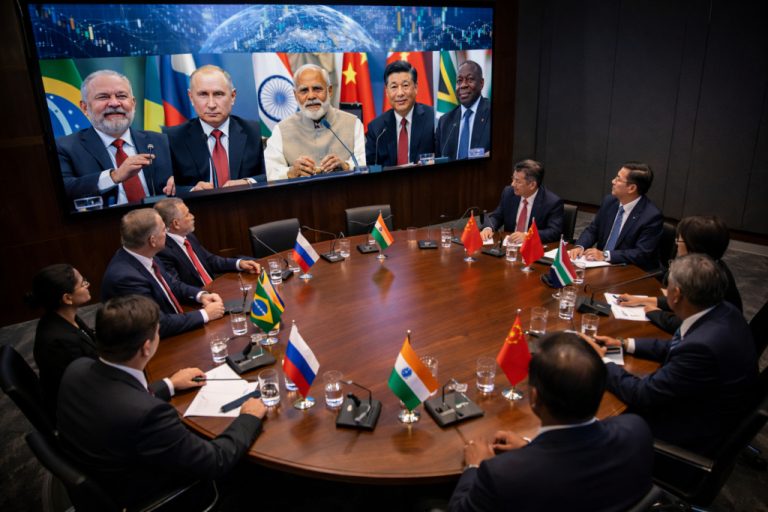
When Donald Trump casually claimed that Spain belonged to BRICS in early 2025, the Spanish government scrambled to respond. The gaffe was absurd on its face, but the panic it triggered in Madrid said something real about the weight the acronym now carries. A bloc that began as an investment banker’s shorthand has grown into a geopolitical force that Washington itself treats as a threat — one serious enough to warrant repeated threats of 100% tariffs.
With the addition of Vietnam as a partner in mid-2025, the extended BRICS+ now counts 20 members and partners. The 10 full members are Brazil, Russia, India, China, South Africa, Egypt, Ethiopia, Indonesia, Iran, and the United Arab Emirates. The 10 partners include Belarus, Bolivia, Cuba, Kazakhstan, Malaysia, Nigeria, Thailand, Uganda, Uzbekistan, and Vietnam. Together, they make up roughly 44% of the global economy measured by purchasing power parity and 56% of the world’s population. IMF data shows these eleven member countries are becoming more economically significant than the G7: developed nations accounted for approximately 28% of global GDP last year, while BRICS accounts for 40%, with average growth rates of 3.4% compared to the G7’s 1.2%.
Building Financial Alternatives
The most consequential move isn’t the headline-grabbing talk of a shared currency — that idea remains impractical. It’s the quieter work of building payment infrastructure designed to bypass the dollar-dominated financial system.
As India prepares to host the BRICS summit later this year, the focus will be on a payment system linking national digital currencies. By prioritizing infrastructure over launching a new currency, the bloc makes a pragmatic bet that practical systems will reshape global finance more than symbolic gestures. The current initiative does not seek to create a single BRICS currency, nor does it require member states to cede monetary sovereignty. Earlier proposals along those lines faltered for predictable reasons: divergent inflation regimes, incompatible capital controls, and concerns about dominance of the Chinese yuan. The present approach moves in a different direction — linking existing national CBDCs like India’s digital rupee, China’s digital yuan, and Russia’s digital ruble through interoperable infrastructure.
A prototype of BRICS Pay was showcased in Moscow in October 2024, but as of mid-2025, the system remains in its planning and early pilot stages, with integration efforts progressing slowly and secure links between national systems only partially implemented. No fully unified BRICS payment system exists yet. Russian Deputy Foreign Minister Sergey Ryabkov clarified in October 2025 that the system is now targeted for operational status by 2030, though the roadmap calls for integration with CIS countries, Turkey, and the UAE in early 2026, broader BRICS+ integration by mid-year, and CBDC integration by late 2026.
The institutional scaffolding extends beyond payments. The New Development Bank, established in 2015, is spending nearly $28 billion across 92 projects in six member countries, with total project approvals reaching $39 billion by end of 2024 — matching long-standing multilateral institutions despite its small membership. The NDB distinguishes itself by not imposing the conditionalities typical of institutions such as the IMF and the World Bank. The Ukraine crisis accelerated a strategic turn toward de-dollarization and local-currency financing, as BRICS members recognized how vulnerable their development pathways were to the geopolitical leverage embedded in the dollar system.
Washington Pushes Back
Trump has made clear he views these moves as hostile. “The idea that the BRICS Countries are trying to move away from the Dollar, while we stand by and watch, is OVER,” he wrote, demanding commitments that members “will neither create a new BRICS Currency, nor back any other Currency to replace the mighty U.S. Dollar” or face 100% tariffs. A 10% tariff on BRICS nations announced in July 2025 has already materialized.
The Peterson Institute for International Economics modeled the consequences of Trump’s threats and found them self-defeating. While Trump has said repeatedly he would impose 100% tariffs on countries that seek to reduce the dollar’s dominant role, such action would result in slower growth and higher inflation in the US and most targeted economies. By the end of Trump’s second term, GDP would be $432 billion lower than it would be without the tariffs, and the overall price level 1.6% higher.
Brazil’s President Lula responded bluntly at the July 2025 summit in Rio. “We don’t want an emperor, we are sovereign countries,” he said, adding that “it’s not right for a president of a country the size of the United States to threaten the world online.”
Yet for all the momentum, deep structural barriers persist. Disparities in financial regulation, capital mobility, and political trust among member states obstruct meaningful progress. The dollar remains embedded in institutional stability and liquid capital markets that BRICS countries lack. There is no unified monetary policy, no shared capital market, and no single central bank capable of underwriting a collective financial system. The bloc includes close US partners like India and the UAE alongside enemies like Iran, and countries that don’t see eye to eye, like India and China — a diversity that blunts consensus.
Experts suggest the world may be entering a cyclical dollar bear market, not a full collapse of dollar dominance — a cycle that typically lasts five to nine years. The real story of BRICS may be less about dethroning the greenback and more about building a parallel track — one where a growing share of global trade can flow without passing through Washington’s financial gatekeepers.
Original analysis inspired by Ana Lorenzo López from Global Security Review. Additional research and verification conducted through multiple sources.