
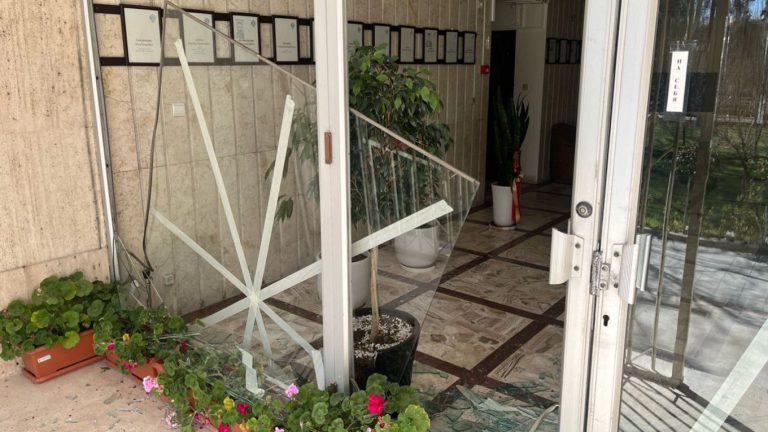
Shattered glass, blown-out windows, and Russian diplomats thrown across rooms by a blast wave — that was the scene at Russia’s consulate in Isfahan on Sunday, after a US-Israeli airstrike aimed at the provincial governor’s office next door sent shrapnel tearing through the diplomatic compound. The attack on the governor’s administration of Isfahan province, located south of Tehran, damaged the Russian consulate on March 8. No serious injuries were reported, but the incident is sharpening the most uncomfortable question of the Iran war for Moscow: how long can Russia play peacemaker and arms supplier at the same time?
Foreign Ministry spokeswoman Maria Zakharova posted photos of the damage on Telegram and called it “a flagrant violation of such basic documents of international law as the 1961 Vienna Convention on Diplomatic Relations and the 1963 Vienna Convention on Consular Relations.” She demanded that all parties “strictly observe the inviolability of diplomatic premises” — but pointedly avoided naming the United States or Israel as the attackers. “We call on the parties to the conflict to immediately end the military confrontation and return to the negotiating table,” she said.
A Growing Diplomatic Crisis
The Isfahan consulate is not an isolated case. The war has triggered the largest drawdown of diplomatic missions in the Middle East since the 2003 Iraq invasion. Ten US embassies and consulates in the region now have reduced staffing, with two having fully suspended operations — the largest reductions since the Iraq War began in 2003. On March 3, the State Department ordered nonessential staff to leave Kuwait, Qatar, Bahrain, Iraq, Jordan, and the UAE, and later extended those orders to Saudi Arabia and the US consulate in Adana, Turkey. Department officials acknowledge that they — and the Trump administration more broadly — underestimated the scale and scope of Iran’s retaliation.
Russia maintains one of the largest diplomatic footprints in Iran of any major power, with its Isfahan consulate serving as a key liaison point for defense cooperation and commercial ties. Isfahan is also home to major Iranian military infrastructure — satellite imagery showed tunnel entrances at the Isfahan missile complex before the strikes began on February 28. The proximity of diplomatic and military sites across Iran means the risk of collateral damage to foreign missions will only grow as the air campaign intensifies.
The Intelligence-Sharing Shadow
The consulate strike arrives at a moment when Moscow’s role in the war is under intense scrutiny. Russia is providing Iran with targeting information to attack American forces in the Middle East, the first indication that another major US adversary is participating — even indirectly — in the war, according to three officials familiar with the intelligence. Much of the intelligence Russia has shared with Iran has been imagery from Moscow’s sophisticated constellation of overhead satellites.
The Washington Post described the effort as “pretty comprehensive.” The types of targets Iran appears to be aiming for suggest Tehran is receiving enhanced intelligence. Iranian aerial attacks appear to be more precise than in the 12-Day War in June, more focused on radar sites and communication posts. “They appear to be going after command and control” for US forces, and Iranian tactics also appear to resemble Russia’s air campaign in Ukraine, with swarms of drones hitting infrastructure followed by ballistic missile attacks.
In 2025, the two countries signed a strategic partnership agreement that includes provisions for countering shared threats. However, the pact stops short of mutual defense obligations, unlike the security agreement Russia has signed with North Korea. Iranian Foreign Minister Abbas Araghchi told NBC News that “military cooperation between Iran and Russia is no secret” and that he hoped it would “continue in the future.”
The Trump administration’s response has been to look away. Russian leaders denied in a call with Trump on Monday that they were sharing intelligence with Iran. “We can take them at their word,” envoy Steve Witkoff told CNBC. “Let’s hope that they’re not sharing.” Trump himself lashed out at a Fox News reporter who raised the issue, calling it a “stupid question.”
Anna Borshchevskaya of the Washington Institute for Near East Policy offered a sharper reading. “What Russia was far more likely to do was exercise restraint and speak about being a mediator in public, and then offer Iran support in private, and look for ways to benefit from this crisis. That’s exactly what Russia is doing now — this intelligence sharing. Russia was not going to offer direct military assistance to Iran because they don’t want to fight with the United States or Israel.”
Putin’s Profitable Neutrality
Moscow’s balancing act is driven by cold arithmetic. The war has been an unexpected windfall for Russia’s energy sector. With Iranian oil off global markets and the Strait of Hormuz effectively shut, demand for Russian crude has surged — an ironic reward for a country still under Western sanctions over Ukraine. Trump on Monday said he would waive some oil-related sanctions “till this straightens out,” a gift to Moscow that Senate Democrats called the result of “a reckless and poorly conceived war.”
EU foreign policy chief Kaja Kallas drew a direct line between Russia’s behavior in Iran and its war in Ukraine. “Reports that Moscow and Tehran are working together to kill US troops should come as no surprise,” she told the EU. “Ukraine, on the other hand, is offering to help defend Americans and our partners in the Gulf. That alone should tell you who your friends are.”
The Isfahan incident will likely produce a diplomatic protest, perhaps a raised eyebrow at the UN, and nothing more. Russia has too much to gain from a war that raises oil prices, distracts Washington from Ukraine, and deepens Tehran’s dependence on Moscow to let a few broken windows change its calculus. The consulate can be repaired. The strategic windfall cannot be replaced.
Original analysis inspired by The Moscow Times / AFP from The Moscow Times. Additional research and verification conducted through multiple sources.


