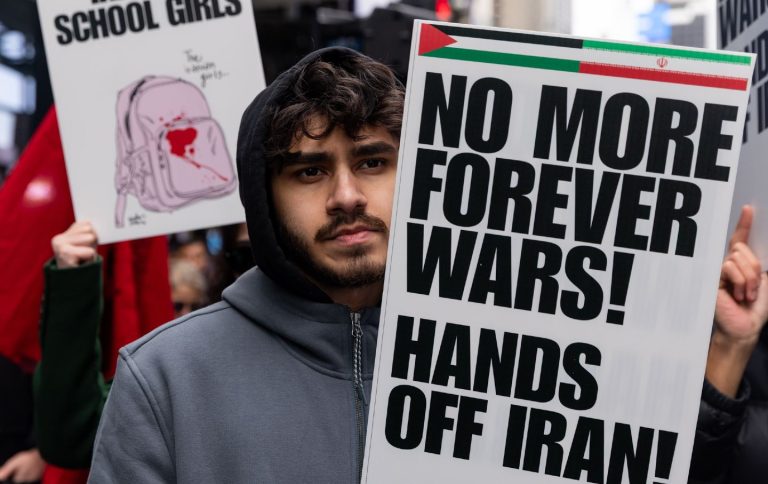
The war on Iran is now in its fourth week, and the protests keep coming — Times Square, Chicago, Los Angeles, London. Signs are held, chants are raised, social media fills with footage. Yet something that defined the most consequential anti-war movements of the twentieth century remains largely absent from this one: the working-class Americans whose children are most likely to fight it. That gap is not new, but in 2026 it has become impossible to dismiss.
War has always generated profit for those farthest from the front lines. Defense contractors, energy traders, and institutional investors have watched portfolios surge since February 28. Raytheon, Lockheed Martin, and Northrop Grumman collectively added tens of billions in market capitalization in the weeks following the first strikes. Meanwhile, working families are absorbing $4-a-gallon gasoline, food inflation driven by Hormuz disruptions, and the prospect of their relatives being deployed to a conflict that Congress never formally authorized. The divide between those who absorb war’s costs and those who extract its profits has rarely been this visible.
The Coalition Gap
The anti-war left has a long, uncomfortable history of speaking past the communities it most needs. The protests against the Iraq War in 2002 and 2003 mobilized millions globally but failed to build durable alliances with veterans, military families, or working-class communities in rural and suburban America — precisely the constituencies that could have made the movement impossible to ignore politically. Those protests were loud; they were not ultimately decisive. The war lasted twenty years.
Something similar risks playing out now. Campus demonstrations and urban rallies generate headlines, but they remain concentrated in the same zip codes and social networks that have always produced them. Organizations like About Face: Veterans Against the War, Veterans for Peace, and Common Defense represent the most politically potent bridge between those communities — veterans who served, understand the institutional military, and have concluded that this war serves no legitimate national interest. Their voices carry moral weight that no college campus activist can replicate, and their involvement in the current mobilization remains underutilized.
The National Iranian American Council has emerged as an essential resource for Americans trying to understand what is actually happening inside Iran — beyond the administration’s framing and beyond Iranian state media. With family and community ties across both countries, Iranian Americans are navigating a uniquely painful moment, and their leadership in any serious anti-war coalition is both a political and a moral necessity.
What a Real Coalition Looks Like
The organizations now most active against the war represent a broader cross-section than previous cycles. Groups like Win Without War are pushing for diplomatic alternatives at the policy level, while Dissenters focuses on campuses and younger organizers. Multi-issue coalitions such as the Working Families Party are connecting the war to domestic grievances — housing costs, healthcare, wages — in a way that narrowly anti-war messaging rarely manages. The No Kings rally scheduled for March 28 is shaping up as the largest coordinated action since the war began.
What remains harder is the longer-term infrastructure. An emerging initiative called Funders for Demilitarization — a pooled philanthropic fund hosted by MADRE — is attempting to address the chronic underfunding of grassroots peace organizing. The project, partnering several established human rights and international solidarity organizations, is a recognition that anti-war movements consistently lose not because the public opposes peace, but because the institutional resources available to peace advocates are dwarfed by those available to the defense industry and its allies in Washington.
Trump’s approval rating has been sliding, driven by economic anxiety, the cost of living, and growing unease about a war that nobody in Congress formally voted for and that the administration cannot coherently explain. That political vulnerability is an opening — but only if opposition is organized across the full range of Americans who are paying the price. A movement confined to the usual constituencies will generate the usual results: morally serious, politically marginal. The question for the coming weeks is whether the organizations now mobilizing can build the kind of cross-class, cross-community coalitions that turned American opinion — and eventually American policy — during Vietnam. The window exists. Whether it stays open depends on choices being made right now.