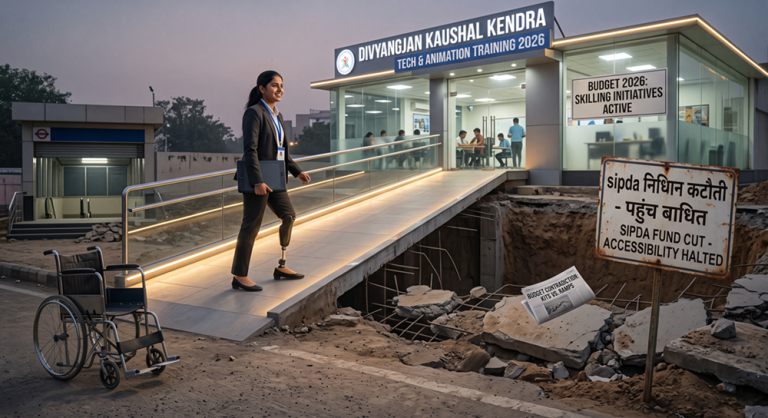
For years, India’s disability budget has been read through a single lens: how much welfare cash reaches people with disabilities, and how little of it there is. Union Budget 2026-27 tries to change that conversation. Two new flagship schemes, the Divyangjan Kaushal Yojana and the Divyang Sahara Yojana, reframe disability spending as an investment in workers rather than a handout to dependents. It is a genuine philosophical shift. Whether the numbers back it up is a different question.
The Department of Empowerment of Persons with Disabilities (DEPwD), which sits under the Ministry of Social Justice and Empowerment, has been allocated ₹1,669.72 crore for 2026-27, up nearly 30 percent from the ₹1,275 crore revised estimate of the previous year. On paper, that looks like a strong vote of confidence. In practice, almost the entire increase is swallowed by two new schemes, which raises an uncomfortable question: is this fresh money for disability inclusion, or a reallocation dressed up as expansion?
The centrepiece is the Divyangjan Kaushal Yojana, a ₹200 crore vocational training push aimed at roughly 20,000 beneficiaries. It marks a deliberate departure from the government’s older skilling model, which tended to steer disabled trainees toward low-value craft work. This time, the target sectors are IT, animation and visual effects, gaming, hospitality, and food and beverage services all growth industries with real hiring demand. Enrolment, identity verification through the Unique Disability ID, course selection and placement will run through a single digital gateway, the PM-DAKSH-DEPwD portal.
It is a sensible design on the surface. But two structural risks sit underneath it. First, a curriculum built around process-driven, task-specific roles risks becoming a pipeline into entry-level jobs with little room to grow, unless it is matched by rules that push private employers to offer accommodations and real career ladders. Skilling someone for a job is not the same as guaranteeing that the job pays fairly or leads anywhere. Second, a portal-first model assumes the beneficiary already has reliable internet access, digital literacy and support to complete UDID registration assumptions that hold far more often in Indian cities than in its villages. A scheme this centralised could end up serving urban, digitally fluent applicants disproportionately, leaving rural persons with disabilities exactly where they started.
The second pillar, the Divyang Sahara Yojana, carries a ₹100 crore allocation and works through the Artificial Limbs Manufacturing Corporation of India (ALIMCO). Its ambitions go well beyond wheelchairs and calipers: the scheme funds research into AI-linked assistive devices, smart hearing aids, e-Braille readers and cognitive-support technology. Distribution is also being modernized, 100 existing Pradhan Mantri Divyasha Kendras are being upgraded into multi-service hubs, alongside new retail-style Assistive Technology Marts where users can test and customize devices before buying them, rather than simply receiving whatever is issued to them. Treating assistive technology as workplace infrastructure, not charity, is a meaningful reframe. But hardware alone will not sustain participation, devices that break down without nearby repair services or ongoing customisation support tend to get abandoned, quietly undoing the scheme’s own goals.
The sharpest contradiction in this budget, though, sits away from the two headline-grabbing schemes. The Scheme for Implementation of the Rights of Persons with Disabilities Act (SIPDA), the fund that pays for ramps, accessible transit and barrier-free public buildings under the Accessible India Campaign has been cut by 37.5 percent, from ₹200 crore to ₹125 crore. That is not a rounding error; it is a direct cut to the physical infrastructure that determines whether a newly-trained, newly-equipped worker can actually get to their job. Training people for IT careers means little if the bus stop, the metro station or the office building on the way there remains inaccessible. The government is investing in the worker while quietly disinvesting in the road to work.
Social security tells a similarly uneven story. The Indira Gandhi National Disability Pension has been frozen at ₹300 a month since 2012, unchanged even as the cost of living, and the cost of disability-related care in particular, has climbed steadily for over a decade. Layer on the department’s recurring problem of underspending its own budget in past years, and the overall picture is one of ambition undercut by execution.
Zoomed out, DEPwD’s entire allocation still amounts to roughly 0.03 percent of the Union government’s total expenditure, a fraction of the 5 percent disability rights groups have long demanded, and one that leaves India’s stated commitments under the Rights of Persons with Disabilities Act, 2016 and the UNCRPD looking more aspirational than funded.
None of this means the skilling and assistive-technology push is the wrong idea. It is arguably the right one, decades overdue. But its success now depends on decisions this budget doesn’t make: restoring and ring-fencing SIPDA funding on a non-lapsable basis, requiring every line ministry, not just DEPwD, to budget for accessibility, pairing skilling with tax incentives or hiring quotas for inclusive employers, and indexing the disability pension to inflation. Until then, Budget 2026-27 has built a bridge from welfare to work, but left the last mile literally, the pavement, the transit stop, the office ramp, unfunded.
By Sanya Roy
The views expressed in this article belong to the author and do not necessarily reflect the editorial policy of Thinktanks Monitor.