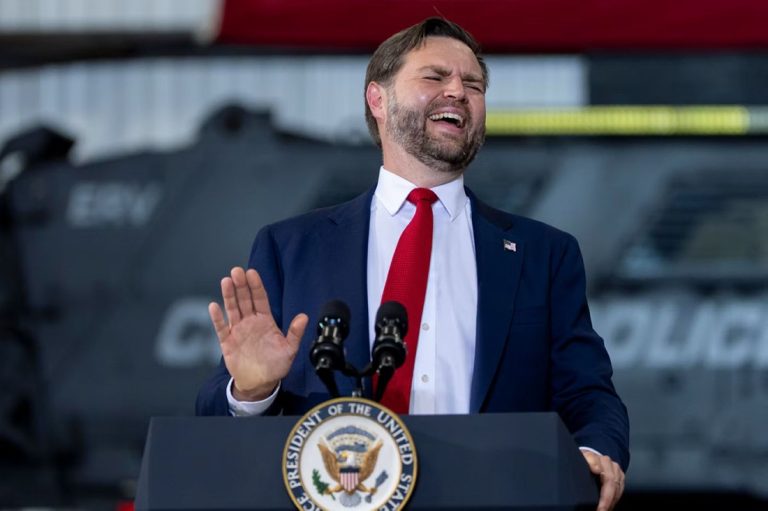
JD Vance is already positioned as the early favorite to inherit Donald Trump’s Republican coalition in 2028. National polling places the vice president well ahead of potential rivals, while his growing visibility inside the administration gives him advantages few prospective candidates can match. Yet succeeding Trump may require something harder than winning his endorsement or copying his rhetoric. Vance must persuade Republican voters that the movement can survive when Trump himself is no longer its candidate.
That problem is becoming visible during the 2026 midterm campaign. Trump continues to make the election largely about himself, even as Republicans confront difficult House and Senate races and voters express frustration over inflation and the Iran conflict. Reuters reports that Republicans hold narrow congressional majorities, leaving both chambers potentially vulnerable on November 3. The outcome will also offer an early indication of whether Trump’s political coalition can mobilize voters when his own name is absent from the ballot.
Vance Has an Early Advantage
For now, Vance is hardly struggling inside the Republican Party. Recent polling shows him at roughly 44 percent among Republican voters considering the 2028 nomination, compared with 21 percent for Secretary of State Marco Rubio. Those numbers make Vance the clearest early favorite rather than simply one contender among many.
His position inside the movement is also strengthening. At the Republican convention in Dallas, supporters greeted Vance with chants of “48,” a direct reference to the next presidency. Trump praised his vice president but stopped short of endorsing anyone for 2028, preserving his leverage over the eventual succession battle.
That uncertainty matters because Trump remains the central source of political legitimacy for much of the Republican base. A future nominee will inherit his voters, policies and political enemies, but cannot simply reproduce the personal relationship Trump developed with supporters over more than a decade. Vance therefore faces an unusual challenge. He must present himself as the continuation of Trump’s project while also giving voters a reason to support him independently.
Policy Could Define the Succession Fight
Foreign policy may provide one opening for Vance to establish that identity. His approach to Iran and Israel has sometimes differed from Rubio’s more traditional Republican internationalism. Vance has generally represented the party faction that is more skeptical of prolonged American military commitments, even while serving an administration engaged in a major conflict with Iran.
That distinction could become important in a 2028 primary. Vance has remained involved in Iran diplomacy and has recently pressed Tehran for major restrictions on uranium enrichment as negotiations over the Strait of Hormuz continue. Rubio, meanwhile, has built his profile through traditional diplomacy and closer relationships with American allies. Their competition could eventually become a debate over what Trump era foreign policy means after Trump.
The immediate test, however, remains domestic politics. Vance has openly acknowledged that Republicans are “swimming upstream” in the midterms, pointing to the historical tendency of governing parties to lose seats. Trump has adopted a more confident posture even as Republican strategists confront weakening prospects in several competitive races.
That contrast may ultimately help Vance. He does not need to become another Trump if he can convince Republican voters that he can preserve the movement while adapting it to a different political era. His early polling suggests the opportunity is real. The harder question is whether Republican loyalty belongs to a political program that Vance can inherit, or to Donald Trump personally. The answer will shape not only the 2028 nomination but the Republican Party after Trump leaves office.
Original analysis inspired by Alex Shephard from The New Republic. Additional research and verification conducted through multiple sources.