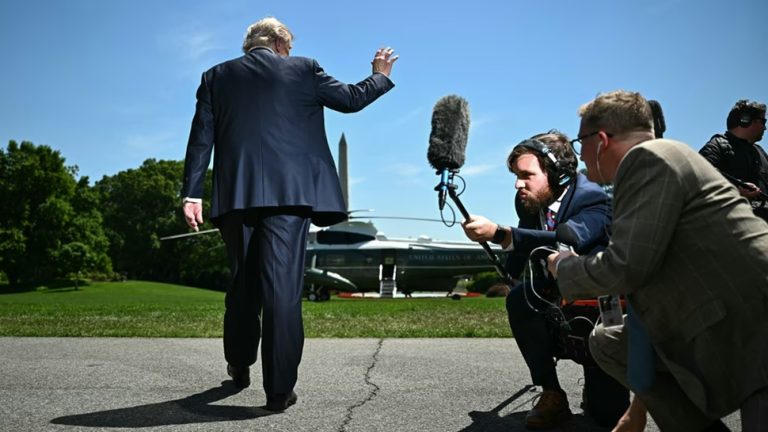
President Donald Trump recently barred three prominent news organizations from entering the White House. The administration revoked credentials for correspondents from CNN, Politico, and MS NOW following complaints regarding their critical coverage. This unprecedented exclusion prompted major television broadcasters to pause their shared filming agreements, creating a significant disruption in presidential reporting.
The chief executive frequently blames independent journalists for his political and economic difficulties. When faced with declining approval ratings or international policy setbacks, he often targets familiar media adversaries rather than acknowledging structural failures. Observers note that attributing administrative missteps to unfavorable news coverage creates a convenient distraction for his supporters. However, attempting to silence critical voices does not alter the underlying domestic and foreign policy realities confronting his administration.
This recent restriction immediately triggered a severe backlash across the journalism sector. When security personnel confiscated the credentials of the targeted reporters, the five largest television networks jointly suspended their traditional rotational coverage arrangements. CNN was originally scheduled to provide the broadcast feed for an upcoming diplomatic trip to New York. By refusing to assign a replacement crew, competing networks demonstrated unexpected solidarity against government interference. The public will now lack standardized video access to several high profile presidential appearances.
The three excluded organizations rapidly filed a federal lawsuit to regain their building access. Their legal complaint argues that officials cannot arbitrarily revoke press passes purely because they dislike a specific editorial viewpoint. The administration consistently faces intense scrutiny for prioritizing political loyalty over constitutional speech protections. A similar legal battle currently remains unresolved after the Associated Press refused to adopt a mandated geographic name change for a southern body of water last year.
As legal proceedings advance, the confrontation tests the fundamental boundaries between executive authority and an independent press. Retaliatory measures against publishers only magnify the controversies they are designed to suppress. While the administration seeks to curate a purely flattering media environment, reality eventually breaks through the most carefully managed public relations strategies.
Original analysis inspired by David A. Graham from The Atlantic. Additional research and verification conducted through multiple sources.