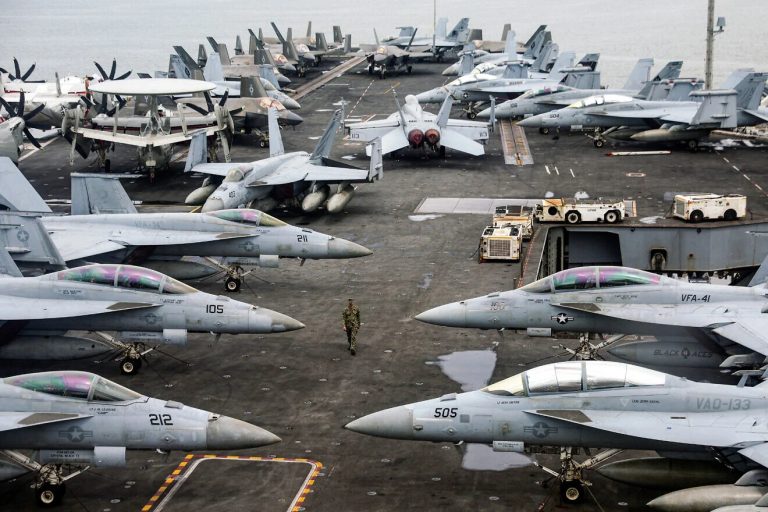
The largest American military concentration in the Middle East since the 2003 Iraq invasion is now in position. President Trump says Iran has 10 to 15 days at most to agree a deal over its nuclear program and stock of ballistic missiles. The U.S. military is prepared to strike Iran as early as this weekend, though Trump has yet to make a final decision. Two carrier strike groups, hundreds of fighter jets, and B-2 stealth bombers on high alert form the backbone of a force configured not for a quick punch but for a sustained campaign — and three distinct operational scenarios sit on the president’s desk.+2
The Armada
On January 26, the USS Abraham Lincoln carrier strike group deployed to the region, accompanied by additional air, naval, and missile defense forces. On February 13, the USS Gerald Ford was sent on its way to the Middle East as part of the buildup. Ship tracking websites reported on Friday that the Ford entered the Mediterranean Sea through the Strait of Gibraltar en route to the Gulf region.+2
The air component is equally massive. More than 50 F-35, F-22, and F-16 fighter jets moved to the region over a 24-hour period. Trackers have logged more than 85 fuel tankers and over 170 cargo planes heading into the region in mid-February. Six F-22 Raptors arrived at RAF Lakenheath in England alongside E-3 AWACS and communication aircraft — moves analysts view as the strongest signals of preparation for major conflict. The B-2 Spirit stealth bomber fleet is being maintained at abnormally high readiness to deliver the 30,000-pound GBU-57 Massive Ordnance Penetrator, the only conventional weapon capable of reaching facilities buried under 80 to 100 meters of granite.
Officials signaled that all U.S. military forces required for possible action would be in place by mid-March.
Three Scenarios
According to leaks and public statements, the administration is weighing three courses of action.
The first is a sustained weeks-long campaign designed to collapse the regime by targeting the Islamic Revolutionary Guard Corps, its command infrastructure, and state media. Retired Admiral Robert Harward, former deputy commander of CENTCOM, explained that advances in targeting technology mean where previously you could do 40 or 50 strikes a day, we now can conduct hundreds of strikes a day. This option would likely attempt to decapitate the leadership simultaneously.
The second focuses on degrading military-industrial capabilities — specifically Iran’s nuclear and ballistic missile infrastructure. Israel has requested that the U.S. strike the Parchin and Shahroud complexes, where satellite imagery shows the reconstruction of buildings housing solid-fuel planetary mixers. High-resolution satellite imagery from February 10 shows Iran continuing to harden tunnel entrances at the underground complex carved into Pickaxe Mountain near Natanz, with fresh concrete visible at both entrances.+1
The third is an asymmetric stranglehold — combining targeted strikes with economic pressure against Iran’s oil exports and shadow fleet to force either collapse or capitulation at the negotiating table. Iran is already reeling from 60% headline inflation and 72% food inflation.
Tehran’s Response
Iran is not sitting still. War veteran and former IRGC commander Ali Shamkhani was appointed this month as secretary of the Defense Council, aimed at comprehensively strengthening defense preparations. His appointment signals that Iran is preparing for the possibility of a U.S. decapitation strike — potentially targeting the Supreme Leader himself.
On February 3, a U.S. Navy F-35C launched from the Abraham Lincoln shot down an Iranian Shahed-139 drone after it aggressively approached the carrier strike group. Hours later, IRGC fast boats attempted to board a U.S.-flagged tanker in the Strait of Hormuz before being deterred by a destroyer. Just as talks got underway in Geneva, Iranian state media reported that parts of the Strait of Hormuz would close while the Revolutionary Guard conducted military drills.+1
Iran’s reconstituted arsenal includes over 3,000 ballistic missiles capable of striking U.S. bases across the region. The IRGC commander told Al Mayadeen television that Israel will be Iran’s first target if the U.S. attacks. Central to any escalation is the activation of what Tehran calls its Ring of Fire — regional proxies designed to overwhelm allied defenses through multi-front saturation strikes. In Iraq, Kataib Hezbollah’s leader warned that any strike on Iranian soil would trigger total war.
The Diplomatic Gap
The talks, mediated by Oman, were held in Geneva on Tuesday against a backdrop of increased military flexing by both sides. Tehran reportedly offered to suspend enrichment for three to five years — a timeframe extending past Trump’s presidency. Washington demanded that any agreement must permanently block Iran’s pathway to a nuclear weapon by dismantling enrichment infrastructure. Iran’s foreign minister stated that missiles are not subject of negotiations and shall not be infringed.+1
According to reports, Prime Minister Starmer has indicated to Trump that the U.S. cannot use British airbases — including Diego Garcia and RAF Fairford — for strikes on Iran, as this would breach international law. One Trump adviser told Axios: There is a 90% chance we see kinetic action in the next few weeks.
Israel is preparing in parallel. The IDF Home Front Command has placed the civilian sector on a war footing, with hospitals executing emergency readiness plans. Iran predicts a military conflict with the U.S. that will be bigger than the 12-day war it had last summer with Israel, but not anything like the 2003 invasion of Iraq. Whether that prediction holds depends entirely on which scenario Trump selects — and whether either side can find an off-ramp before the clock runs out.
Original analysis inspired by Shimon Sherman from Jewish News Syndicate. Additional research and verification conducted through multiple sources.
Tags:
Categories: Middle East | War, Defense & Security | Iran | USA