
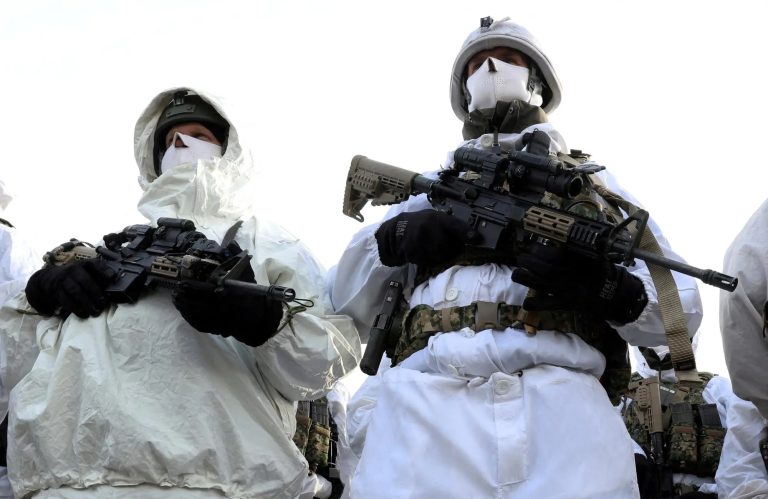
On February 11, NATO launched Arctic Sentry, its first attempt to bring every allied military activity in the High North under a single command. Secretary General Mark Rutte framed the move simply: “What is really new about it is that for the first time now, we will bring everything we do in the Arctic together under one command.” Fighter jets from Sweden, Germany, and Denmark are deploying to Iceland and Greenland. Britain plans to double its troops in Norway to 2,000 and send a carrier strike group north. It is NATO’s third such operation in the past year, following Baltic Sentry in January 2025 and Eastern Sentry that September. The alliance is now running concurrent military activities along its entire northern and eastern perimeter — and doing so with almost no functioning channels to prevent an accident from becoming a catastrophe.
The official rationale centers on Russia and China. According to a NATO primer, Russia has significantly increased its military activity in the region, setting up a new Arctic command, reopening former Soviet-era military sites including airfields and deep-water ports, and testing novel weapons systems. China’s interest is also growing, as Beijing seeks access to energy, critical minerals, and sea lines of communication. Norwegian F-35s were scrambled 41 times in 2025, documenting 53 Russian aircraft.
But the timing tells a different story. NATO launched the effort a month after Trump ramped up tensions in the alliance with his threats to annex Greenland. The crisis that preceded Arctic Sentry was not with Moscow but within NATO itself. Trump escalated in early 2026 after refusing to rule out the use of military force to annex Greenland and threatening a 25% import tax on EU goods unless Denmark ceded the territory. He asked the chairman of the Joint Chiefs to present options for using military force to seize Greenland, ultimately deciding against an invasion.
By January 2026, the United Kingdom, France, Denmark, and Germany had all come to regard the United States military as a credible security threat — a sentence that would have been unthinkable months earlier. Danish Prime Minister Mette Frederiksen was blunt: “If the United States decides to attack another NATO country, then everything would stop – that includes NATO and therefore post-World War II security.”
The resolution came not through concession but through redirection. Rutte acknowledged that in its early days, Arctic Sentry will primarily consist of military exercises and national deployments already in the works. Some say the operation was hastily gathered together, primarily to calm tensions created by Trump’s repeated desire to acquire Greenland. Peter Viggo Jakobsen of the Royal Danish Defence College shares that view. A senior NATO diplomat acknowledged that “although there is no immediate crisis, our threat assessment indicates that both Russia and China have demonstrated ambitions in the region.”
In other words, Arctic Sentry gave Rutte a way to address Trump’s complaints about Arctic security without legitimizing his annexation demands — and gave European allies a platform to demonstrate resolve without confronting Washington directly.
The trouble is that the military machinery now spinning up in the Arctic carries real risks, regardless of the political motivations behind it. While European NATO members’ defense planning revolves around worst-case assumptions about Russia’s aggressive intentions, another and arguably more probable risk is being neglected: inadvertent escalation. The risk is particularly high in Northern Europe, where tensions and militarization have created destabilizing subregional dynamics of their own.
The nuclear dimension makes this especially dangerous. The Arctic has always been key to deterrence dynamics given the deployment of Russia’s strategic nuclear submarines in the region. Allied force build-up in the Arctic, while intended to boost territorial defense, has unintended consequences for strategic stability. Russian experts have pointed to the possibility that Russia might respond to massive deployments of long-range deep-strike capabilities in Europe with a more pre-emptive nuclear doctrine. SIPRI’s late-2025 assessment warned explicitly that NATO reinforcements in the Arctic could raise the specter of nuclear escalation.
Moscow has responded predictably. The Russian Foreign Ministry called the mission “yet another provocation by Western countries, which are attempting to impose their own rules in this part of the world.” Russia’s embassy in Denmark said its “military-technical” reaction will be proportionate to NATO decisions. Each side insists its buildup is merely a response to the other’s — the textbook action-reaction spiral that arms control specialists have warned about for decades.
Meanwhile, the diplomatic infrastructure that could prevent a mishap from becoming a confrontation is essentially absent. NATO has not formally invited Russian observers to exercises since 2022. The last invitation was for Cold Response 2022, which Russia declined after the Ukraine war started. Norway did not invite Russia to observe Nordic Response 2024 or Joint Viking 2025. Russia has refused to exchange routine military data since 2022, calling it a response to non-compliance by other OSCE member states.
While Russia’s Arctic forces have taken a beating in Ukraine, leaving it less prepared in the region, NATO military planners are still acutely aware of potential for conflict down the road. A top Norwegian officer said Western militaries are using this period to train for a more capable Russia in the future. But training without talking creates blind spots. High tensions combined with the frequency of incidents point to a risk of escalation that could lead to open conflict between NATO and Russia. This could happen if an incident were to end up claiming casualties — an aircraft flying dangerously close to an adversary’s ship, causing an accident, or being shot down while violating territorial borders.
The biggest risk in the Arctic isn’t a planned offensive. It’s a near-miss between a submarine and a warship in poor visibility, an air intercept gone wrong in winter conditions, or a political overreaction to a minor incident with no hotline available to de-escalate it. There is a foundation to build on: the U.S. and Russia recently agreed to restart high-level military-to-military dialogue for the first time since 2021. NATO allies should support and widen that effort, beginning with mutual observer invitations to exercises and resumed military data exchanges.
Arctic Sentry may have been born from the need to manage Trump as much as to deter Russia. But the forces it sets in motion don’t care about the politics behind them. Carrier strike groups, fighter patrols, and submarine deployments in contested waters generate friction whether the original intent was strategic or theatrical. Without functioning guardrails, deterrence in the High North is only half a policy — and the missing half is the one that prevents wars from starting by accident.

Original analysis inspired by Pavel Devyatkin from Responsible Statecraft. Additional research and verification conducted through multiple sources.
By ThinkTanksMonitor


