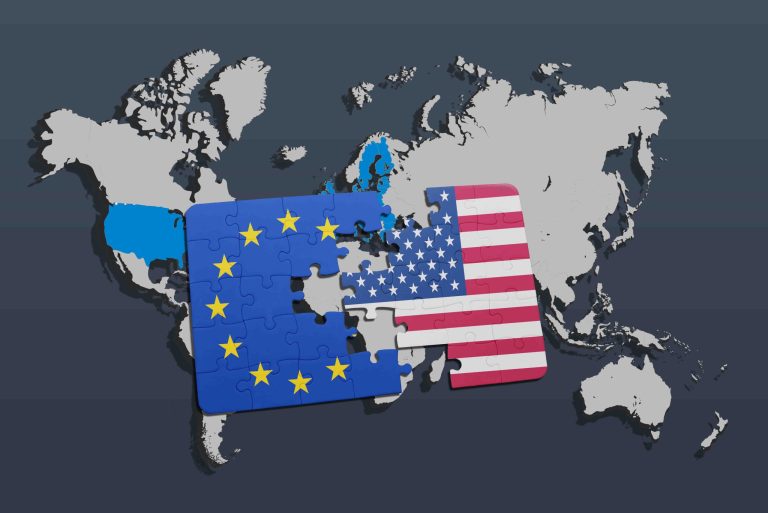
Washington and Brussels have long agreed on what they want from the Middle East — stability, open energy markets, no nuclear proliferation, and defeated jihadist networks. Where they consistently clash is on how to get there. That gap, always present, has grown wider and more visible under Trump’s second administration, where personal diplomacy, transactional deal-making, and executive discretion have displaced the structured coordination that European governments once relied on. The result is a transatlantic partnership that still shares goals but increasingly struggles to act in concert.
In Trump’s second administration, Tom Barrack serves as the United States Ambassador to Turkey, United States Special Envoy for Syria and the United States Special Envoy for Iraq. He has been characterized as one of the two most influential figures in U.S. regional policy alongside White House Special Envoy Steve Witkoff. His expansive mandate illustrates a broader pattern: policy is being channeled through a small circle of Trump confidants rather than through bureaucratic institutions. Turkish officials reportedly “perceive Tom Barrack to be their man,” viewing him as the first U.S. envoy who is “essentially on their side.”
This kind of personal-network diplomacy creates real coordination headaches for European foreign ministries. When access depends on proximity to a president rather than institutional rank, traditional counterparts — ministerial advisers, desk officers, regional directors — find themselves sidelined. The U.S. continues to see itself as a great power, but no longer as the primary architect or guarantor of global order. In its new security strategy, the Trump administration states that “the days of the United States propping up the entire world order like Atlas are over,” viewing the rules it once helped build as constraints that no longer serve American interests.
For Europe, this shift is disorienting. The upheaval in U.S.-Europe relations is accelerating changes in Europe’s military and economic policies that will affect its relations with the Middle East. Europe is now focusing on building its own military power to reduce its dependence on the United States. Yet those defense capabilities take years to develop. As a result, European economic assistance packages to the Middle East could dry up as priorities on the continent shift from soft power to hard power.
Where They Still Agree
Counterterrorism remains the strongest glue. Both sides were central to the campaign against ISIS, and cooperation continues in Iraq and Syria. The U.S.-led coalition is transferring ISIS detainees from Syria to Iraq, with around 5,000 detainees moved in three weeks. European programs in Iraq have focused on community reintegration, rule of law reform, and reconstruction — complementing American security operations.
On Iran, the shared objective of preventing nuclear weapons remains firm, though methods differ sharply. Iran is open to negotiating a nuclear deal with the United States if the U.S. is willing to lift sanctions. Iran is ready to discuss limits on its nuclear program in exchange for the removal of sanctions but does not want to connect this issue to topics like missile programs. Washington pursues maximum pressure and direct bilateral talks, while Brussels insists on preserving diplomatic frameworks. There were no European negotiators in the current round of talks. France stated its intention to participate, but was not included. The E3 countries — France, Germany, and the UK — initiated the snapback process in August 2025, and following the UN decision, the EU Council reimposed all the nuclear-related sanctions against Iran that had been lifted in 2016. Both sides oppose a weak deal and the risk of regional war, but the question of who sits at the negotiating table exposes real friction.
Palestine: The Sharpest Divide
The Israeli-Palestinian file produces the most visible transatlantic disagreements. Fifteen out of twenty-seven EU member states recognize the State of Palestine, a figure that jumped dramatically in 2024-2025. In September 2025, British Prime Minister Keir Starmer announced that the United Kingdom had formally recognized the State of Palestine. French President Emmanuel Macron formally recognized the state of Palestine during his address at the UN General Assembly, declaring that “the time for peace has come.”
The momentum has been striking. Fourteen of the nineteen member countries of the G20 have recognized Palestine as a state, four doing so in September 2025. Washington, by contrast, has maintained its alignment with Israel and blocked Palestine’s full UN membership. Trump endorsed Israel’s claim over Jerusalem in his first term, and has backed forced expulsion of Palestinians from Gaza and banned Palestinian leaders from attending UNGA.
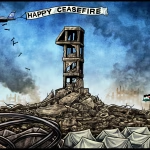
After criticizing the Trump plan in February, the foreign ministers of Germany, France, Italy and the United Kingdom backed the Egyptian plan adopted by Arab leaders in March. European policy is to stabilize Gaza and eventually bring it under the control of the Palestinian Authority. But the U.S. is highly unlikely to contribute financially to any Gaza reconstruction efforts as neither Democrats nor Republicans would be in favour.
Energy, Rivalry, and the Road Ahead
Energy politics no longer bind the two sides as tightly as they once did. America became a major producer; Europe has diversified away from Middle Eastern hydrocarbons, especially after the disruption caused by Russia’s war in Ukraine. Both engage the Gulf on investment and energy transition, but Washington’s approach remains overtly transactional — arms deals bundled with investment packages — while the EU tries to attach governance reform and human rights strings.
Saudi Arabia and the United Arab Emirates are moving closer to China, recalibrating their foreign policy away from exclusive dependence on Washington. Both Washington and Brussels watch this drift with concern but lack a coordinated response.
The structural incentives for cooperation remain strong: neither side wants a major regional war, uncontrolled migration flows, or unchecked Russian and Chinese influence in strategic sectors. But if American unilateralism keeps outpacing consultation, trust will keep eroding. The challenge is not about reconciling goals — those remain broadly aligned. It is about agreeing on tools, timing, and who gets a seat at the table, before the gap between the two becomes too wide to bridge.
Original analysis inspired by Clément Therme from Rasanah International Institute for Iranian Studies. Additional research and verification conducted through multiple sources.