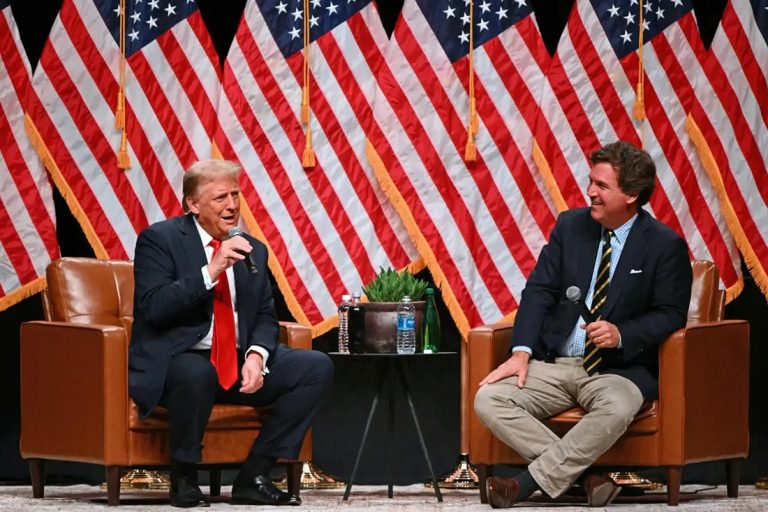
Donald Trump and Tucker Carlson’s disagreement over Iran exposes a fracture within the American right, but it does not establish a clean ideological separation. Opposition to one military campaign can coexist with support for coercion elsewhere. Their continuing convergence on immigration and Ukraine raises a more revealing question: whose sovereignty deserves protection, and whose rights can be subordinated to the preferences of a stronger power?
Carlson’s break with Trump over Iran has drawn attention to the limits of their alliance. Yet shared hostility toward immigration and skepticism of Western support for Ukraine remain substantial points of agreement. The distinction matters because a dispute over strategic priorities is different from a rejection of authoritarian politics. A commentator can oppose American intervention abroad without defending equal treatment or institutional restraint at home.
The administration’s own language shows how that tension enters policy. Trump’s January 2025 border proclamation invoked an invasion framework to justify exceptional restrictions on entry. That was an assertion of presidential authority, not simply a campaign metaphor. Describing migration through the vocabulary of warfare encourages the public to see a diverse population as a collective security threat, even though individual circumstances and legal claims differ.
Sovereignty for whom?
Carlson’s interview with Jacob Rees Mogg provoked a dispute about Hitler and Britain’s entry into the Second World War. The historical baseline is clear. The United States Holocaust Memorial Museum documents Germany’s invasion of Poland on September 1, 1939, followed by the Soviet invasion from the east later that month. The subsequent partition illustrates what happens when powerful states treat a smaller country’s independence as negotiable between themselves.
That history should inform scrutiny of contemporary arguments without turning every present conflict into a replica of 1939. Debates over military assistance, escalation and negotiations are legitimate. But evaluating those choices requires distinguishing criticism of Western strategy from acceptance of territorial conquest. Ukraine’s people and government have interests that cannot be reduced to the convenience of Washington or Moscow.
The UN General Assembly reaffirmed its commitment to Ukraine’s sovereignty and territorial integrity in February 2026. That principle does not dictate every weapons transfer or diplomatic tactic. It does establish a standard against which proposals for peace should be judged: negotiations must address the rights of the country being invaded, not merely the preferences of the largest military powers.
The same test applies to domestic authority. Governments can enforce immigration laws while remaining accountable for how they treat individuals, and they can pursue diplomacy without endorsing aggression. Carlson’s disagreement with Trump becomes a deeper political break only if it extends to those principles. Until then, the argument over Iran leaves significant parts of their shared worldview intact.
Original analysis inspired by Sasha Abramsky from The Nation. Additional research and verification conducted through multiple sources.