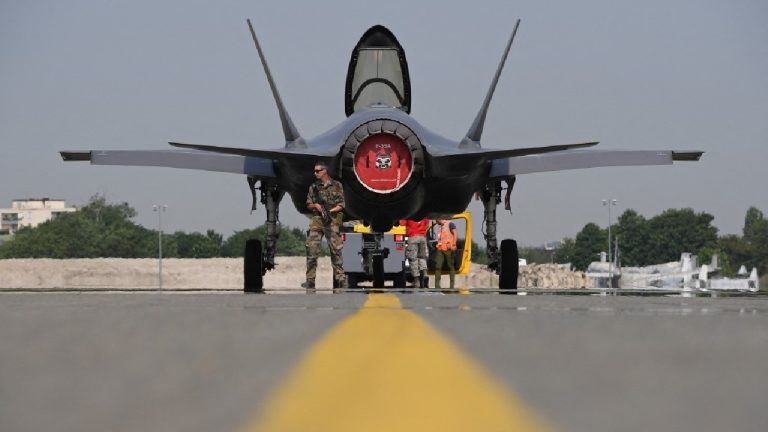
The Trump administration’s reported willingness to reconsider Turkey’s participation in the F-35 stealth fighter program has generated significant concern among regional security analysts and Israeli defense officials. This potential arms transfer raises fundamental questions about strategic coherence, alliance management, and long-term Middle Eastern stability.
Historical Context of Turkish F-35 Exclusion
Turkey’s original removal from the multinational F-35 Joint Strike Fighter program stemmed directly from Ankara’s 2019 decision to acquire Russia’s S-400 air defense system. The S-400, specifically designed to target advanced Western aircraft including the F-35, represented incompatible technology with NATO interoperability requirements. Congressional opposition led to Turkey’s formal expulsion from the program, with the United States citing legitimate concerns that Russian technicians operating S-400 systems in Turkey could gather intelligence on F-35 vulnerabilities.
The Trump administration now appears reconsidering this position based on Turkey’s perceived role in Gaza ceasefire negotiations and potential participation in regional stabilization frameworks. American officials have indicated willingness to resume F-35 sales contingent upon Turkey disposing of its Russian air defense systems. Turkey’s interest in abandoning the S-400 has reportedly increased following the system’s poor performance during recent Israeli-Iranian exchanges, where Israeli aircraft successfully neutralized Russian-made air defenses.
Turkish Leadership Rhetoric and Regional Tensions
Turkish President Recep Tayyip Erdogan’s public statements regarding Israel have grown increasingly confrontational. In October 2025, he declared: “Israel will have no choice but to kneel in front of Turkey. This is the only way for it to live. Otherwise, in the second quarter of the 21st century, there will be no Israel.” These remarks followed earlier statements advocating for Israel to “turn to dust” and encouraging mass movements toward Israeli borders.
Turkey hosted conferences in August and December 2025 bringing together organizations explicitly rejecting disarmament of Palestinian armed groups and advocating “armed resistance” against Israel. The December “Pledge to Jerusalem” conference issued declarations establishing what participants described as religious duty to resist normalization between Israel and Arab-Islamic countries.
These public positions contrast sharply with Erdogan’s simultaneous cultivation of closer ties with Washington. The Turkish president has worked to position himself as valuable intermediary between the Trump administration and Hamas leadership, leveraging Turkey’s relationships with Palestinian factions to demonstrate diplomatic utility.
Israeli Security Concerns and Strategic Calculations
Israeli defense officials view potential Turkish acquisition of F-35 aircraft as significant long-term threat. The F-35 has been deployed extensively by the Israeli Air Force, providing critical capabilities in regional operations. Israeli security analysts warn that Turkey’s acquisition of the same platform would fundamentally alter regional military balance, particularly given Erdogan’s explicit threats and Turkey’s expanding influence in Syria and elsewhere.
Intelligence assessments suggest Turkey is developing strategy to encircle Israel through proxy relationships and direct presence in neighboring territories. F-35 acquisition would substantially enhance Ankara’s power projection capabilities in any future confrontation, particularly after current American administration transitions.
Israeli concerns extend beyond immediate military capabilities to broader regional dynamics. Turkey’s active support for Hamas, including financial networks operating through Turkish infrastructure, raises questions about how advanced military technology might be employed in future conflicts. Israeli intelligence recently documented Hamas money exchange operations in Turkey moving hundreds of millions of dollars with Iranian coordination.
Alliance Dynamics and Strategic Incoherence
The proposed F-35 sale exposes fundamental tensions within American regional strategy. Turkey and Qatar—both identified as Hamas supporters by UAE officials and regional analysts—are reportedly working to prevent Hamas disarmament as stipulated in Gaza stabilization frameworks. The UAE has expressed concern over Turkish and Qatari policies in Gaza and declined participation in proposed International Stabilization Forces partly for these reasons.
Turkey’s exclusion from serious consideration for Gaza stabilization force participation stems from its Hamas connections. Yet the same administration considering this exclusion is simultaneously contemplating providing Turkey with advanced stealth fighters that could be employed against Israel in future scenarios.
This strategic inconsistency undermines coherent alliance management. NATO member Turkey maintains relationships with organizations explicitly targeting another American strategic partner. Providing advanced military capabilities to Ankara while simultaneously relying on Israeli security cooperation creates contradictory incentives that may prove destabilizing over extended timeframes.
Regional Balance and Arms Transfer Precedents
Beyond immediate Turkish acquisition, the F-35 sale would establish precedent for transfers to other regional actors. Saudi Arabia and additional states have expressed interest in acquiring the platform. Each potential transfer requires assessment of how such capabilities might be employed in regional conflicts, particularly given the platform’s qualitative military advantages.
Previous American arms sales to Middle Eastern states have operated under frameworks requiring consideration of Israeli qualitative military edge—the principle that Israel must maintain capability superiority over potential adversaries. F-35 transfers to multiple regional actors, some with contested relationships with Israel, could fundamentally alter this calculus.
The argument that Turkish F-35 acquisition would reduce Russian influence in Ankara assumes that military technology determines broader strategic alignment. However, Turkey has demonstrated capacity to maintain multifaceted foreign policy that includes cooperation with Russia on Syrian matters, energy projects, and diplomatic coordination despite nominal NATO membership. F-35 acquisition may simply add American technology to Turkish military inventory without fundamentally reorienting Ankara’s regional strategy.
Hamas Disarmament and Implementation Challenges
Current Gaza stabilization frameworks include requirements for Hamas disarmament—provisions that Hamas refuses to accept while insisting any weapons decisions occur through “internal Palestinian dialogue.” Reports indicate Hamas has rapidly reasserted territorial control in areas evacuated by Israeli forces under ceasefire terms, rebuilding operational capacity rather than demilitarizing.
Turkey and Qatar’s reported efforts to shield Hamas from disarmament requirements directly contradict stated American objectives for Gaza stabilization. Providing advanced military capabilities to states actively working against American policy goals creates perverse incentives that undermine diplomatic frameworks currently under negotiation.
Path Forward and Strategic Recommendations
The F-35 sale decision requires rigorous assessment beyond immediate diplomatic considerations. Key factors include:
Leadership Duration: Erdogan’s statements represent either sincere strategic intentions or domestic political theater. Either interpretation suggests that transferring advanced fighters to Turkey while current leadership maintains power poses substantial risks. Future Turkish governments might pursue different policies, but arms transfers cannot be easily reversed.
Regional Stability: Middle Eastern security architecture remains fragile, with multiple potential flashpoints including Syria, Gaza, and Iranian nuclear issues. Adding advanced military capabilities to an already volatile environment may increase rather than decrease conflict risks.
Alliance Credibility: American security commitments to Israel carry decades of precedent and substantial domestic political support. Actions perceived as undermining Israeli security—even if intended to strengthen Turkish-American relations—risk damaging American credibility with multiple regional partners.
Alternative Frameworks: If the goal is strengthening Turkish-American cooperation while reducing Russian influence, alternatives to F-35 sales merit consideration. Enhanced economic cooperation, infrastructure investment, or diplomatic coordination on regional issues could achieve similar objectives without transferring capabilities potentially employed against American partners.
The decision ultimately reflects broader questions about American regional strategy: whether short-term diplomatic gains justify long-term security risks, how to balance relationships with allies maintaining contradictory regional positions, and whether military technology transfers serve as effective diplomatic tools or merely complicate already complex security environments.
Original analysis inspired by Con Coughlin from Gatestone Institute. Additional research and verification conducted through multiple sources.