Diplomatic participation in international governance structures addressing territorial conflicts presents opportunities for influence and material benefit while simultaneously creating tensions with established advocacy positions on the underlying political disputes.
Institutional Framework and Multilateral Participation Architecture
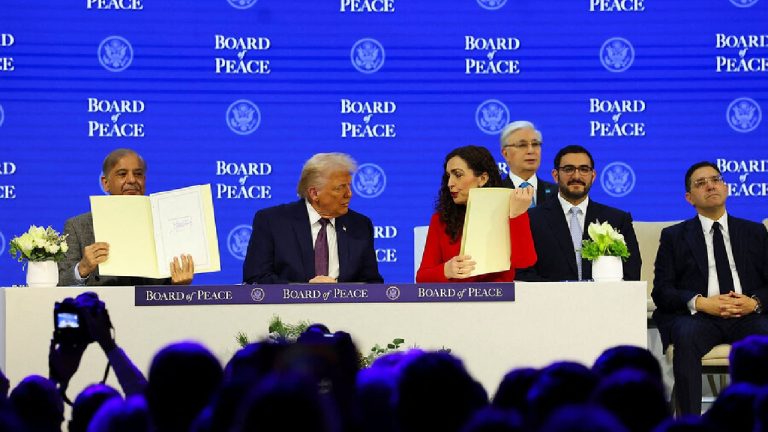
The establishment of the Board of Peace, endorsed through UN Security Council Resolution 2803 and formalized following Trump’s announcement of comprehensive Gaza settlement plans in September 2025, created new governance mechanisms for post-conflict territorial management. The institutional framework incorporates multiple pillars including transitional civilian administration, security force deployment, reconstruction coordination, and international stabilization operations. Eight major Muslim-majority states—Saudi Arabia, Turkey, Egypt, Jordan, Indonesia, Pakistan, Qatar, and the United Arab Emirates—formally accepted invitations to participate in this multilateral governance structure, signaling their determination to shape post-conflict institutional design rather than remaining external observers.
The institutional significance derives not from unanimous support for underlying political arrangements but from recognition that participation permits direct influence over implementation mechanisms affecting vulnerable populations and contested territorial futures. The Board’s mandate encompasses ceasefire enforcement, demilitarization supervision, humanitarian coordination, and reconstruction oversight extending through 2027, creating substantive opportunities for member states to affect outcomes through resource allocation, administrative appointments, and implementation decisions.
Economic Dimensions and Development Opportunity Structures
Participation in post-conflict reconstruction frameworks creates material incentives that extend beyond diplomatic positioning. Gaza reconstruction planning currently anticipates infrastructure development projects potentially generating billions in international investment and contracting opportunities, with Trump administration projections suggesting gross domestic product expansion targets of approximately $10 billion by 2035. Construction-intensive economies including Pakistan, Turkey, and Egypt possess substantial capacity in infrastructure development, engineering, and urban planning demonstrated through extensive Middle East projects.
Strategic participation positions participating states favorably for securing reconstruction contracts spanning housing, healthcare facilities, educational infrastructure, utility systems, and transportation networks, with Board membership providing institutional access to procurement processes and priority positioning for joint ventures with international firms. Additionally, closer alignment with Trump administration strategic preferences may facilitate improved bilateral economic relationships including technology transfers, preferential trade arrangements, and infrastructure investment, particularly relevant for nations pursuing economic diversification beyond traditional sectors.
Security and Strategic Alliance Dimensions
For participating states, institutional membership provides platforms for intelligence coordination, counterterrorism collaboration, and military dialogue with American and regional partners operating within formalized governance structures. Pakistan and other South Asian states face ongoing regional security challenges including border tensions and militant threats requiring strategic alliances and technology cooperation, with Board participation enabling security relationships that might otherwise prove difficult through conventional bilateral channels.
The multilateral framework permits collective advocacy for regional interests while maintaining bilateral relationships with great powers. Participation alongside Turkey, Qatar, and Saudi Arabia—states with varying relationships toward Israeli policies and Palestinian advocacy—creates coalition capacity enabling collective pressure for humanitarian corridors, settlement expansion opposition, and reconstruction transparency potentially exceeding individual state capacity.
Reconciling Advocacy Commitments with Institutional Participation
Strategic engagement with reconstruction governance frameworks creates obvious tensions for nations maintaining longstanding advocacy positions regarding Palestinian political self-determination and opposition to Israeli territorial claims. Domestic constituencies in participating states often view such institutional involvement as potentially compromising principle-based advocacy or implicitly legitimizing arrangements perceived as unfavorable to Palestinian interests.
Official statements from participating governments attempt to reconcile these tensions through explicit conditionality and principle-based framing. Pakistan’s Foreign Office clarifications distinguish Board participation from normalization frameworks, emphasizing conditionality on meaningful progress toward Palestinian statehood and maintaining traditional non-recognition policies pending just political settlement. This rhetorical framing positions institutional participation as principled activism—using insider access to advance Palestinian interests—rather than abandonment of established commitments.
The substantive question involves whether institutional participation from within governance frameworks provides greater capacity to influence outcomes than external advocacy positions. Insider status enables participation in implementation decisions, humanitarian coordination, aid distribution oversight, and reconstruction accountability mechanisms that external advocacy cannot directly affect. The joint statement by participating Muslim-majority states explicitly links Board engagement to advancing Palestinian self-determination and sustainable statehood, framing participation as mechanism for advancing rather than abandoning advocacy objectives.
Broader Implications and Future Trajectory
The institutional participation pattern reflects broader trend toward pragmatic engagement with governance mechanisms addressing contested territories. Rather than maintaining exclusively oppositional postures toward international arrangements viewed as unfavorable, participating states pursue hybrid strategies combining formal opposition to underlying political settlements with institutional participation enabling influence over implementation details affecting affected populations.
This approach succeeds politically to extent that participating governments can credibly demonstrate that institutional involvement produces tangible advocacy outcomes: humanitarian aid improvements, reconstruction accountability, governance participation by local constituencies, and protection for vulnerable populations. The approach fails when institutional participation becomes perceived as legitimizing underlying political arrangements opposed by domestic constituencies.
For participating states, the calculus involves assessment that material benefits—economic opportunities, security cooperation, regional influence—justify domestic political risks associated with institutional participation alongside arrangements viewed skeptically by significant constituencies.
Original analysis inspired by Waqas Abdullah from CSCR Pakistan. Additional research and verification conducted through multiple sources.