Two carrier strike groups are converging on the waters off Iran. Donald Trump says Tehran has “10 to 15 days at most” to agree a deal over its nuclear program and stock of ballistic missiles. The armada includes two aircraft carriers, a dozen warships, hundreds of fighter jets and multiple air defense systems. U.S. defense sources and satellite imagery indicate the largest American military concentration in the Middle East since the 2003 Iraq war. And nobody in Washington can clearly explain what bombing Iran would actually achieve.
Trump has not publicly laid out everything he is hoping to achieve by launching a new war. Nor has he made serious attempts to gain buy-in from the American public or members of Congress, who have been away from Washington this week as he mulls his options. His stated goals shift daily — sometimes it’s a nuclear deal, sometimes regime change, sometimes both. A Trump ally described the internal deliberations as “less of a debate” and more of a “series of updates” for a president who is reacting to each briefing, with few sure about which direction he might go.
The Buildup Nobody Can Stop
More than 150 U.S. military cargo flights have moved weapons and ammunition to the Middle East; in the past 24 hours alone, another 50 fighter jets — F-35s, F-22s and F-16s — headed to the region. One analyst noted this configuration enables approximately 800 sorties per day.
The diplomatic track hasn’t kept pace. Jared Kushner and Steve Witkoff met with Iran’s foreign minister for three hours in Geneva on Tuesday, and while both sides said the talks “made progress,” the gaps are wide and U.S. officials aren’t optimistic. Trump has demanded “zero enrichment,” a proposal rejected by Iranian officials. Iran indicated willingness to suspend enrichment for one to five years — a concession Washington dismissed as insufficient.
A former ambassador to Qatar captured the danger: “Just the fact that you have so much firepower creates a momentum of its own. And sometimes that momentum is a little hard to just put the brakes on.” Trump’s military and rhetorical buildups make it hard for him to back down, and his advisers don’t view the deployment of all that hardware as a bluff.
The Pattern
This is not new. What makes the Iran confrontation so dangerous is that it sits at the end of a three-decade slide in which the United States has reflexively reached for military force to solve political problems — and failed every time.
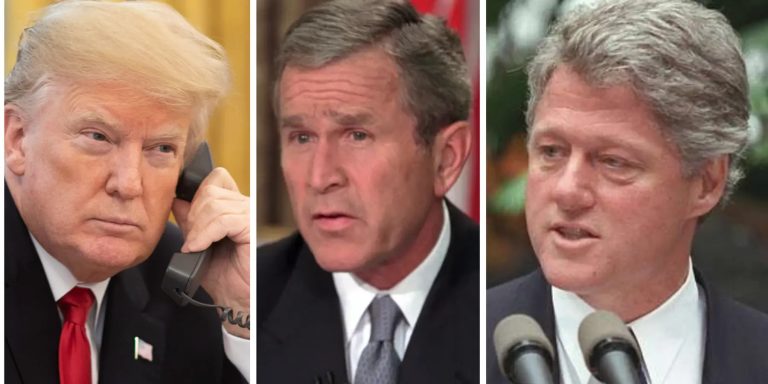
In 1998, Clinton ordered cruise missiles fired at the Al-Shifa pharmaceutical factory in Khartoum, claiming it produced chemical weapons precursors for al-Qaeda. It didn’t. Washington later acknowledged the evidence was nonexistent but never apologized.
Then came the invasions. More than 20 years of U.S. wars directly killed an estimated 940,000 people and cost $5.8 trillion. Indirect deaths — from disease, hunger, and destroyed health systems — are estimated at 3.6 to 3.8 million, bringing the total to between 4.5 and 4.7 million. Afghanistan is once again an authoritarian theocracy under the Taliban, and instead of transforming Iraq and the region, the U.S. invasion undermined democracy, unleashed sectarian violence, and strengthened autocratic regimes. Estimates are drawn from the Costs of War Project.
In 2011, NATO bombed Libya. Gaddafi was killed. The country descended into a civil war that persists to this day. The Houthi movement faced 14 months of bombing by the Biden administration — expending billions in ordnance while failing to change their behavior or stop attacks on Red Sea shipping.
Each intervention rested on the same assumptions: that American military superiority would produce quick results, that enemies were weak and would buckle, and that precision strikes from safe distances could reshape political realities on the ground. Each assumption proved wrong.
What Iran Actually Looks Like
Iran is not Iraq in 2003 or Libya in 2011. It is a country of 88 million people with a deeply layered defense architecture. Analytical reports suggest Iran has built a multilayered defense centered on mines, missiles, submarines and drones. Over the past six months, Tehran has “quietly taken additional steps to move critical assets further underground,” according to Vali Nasr of Johns Hopkins University.
“It will be very hard for the Trump administration to do a one-and-done kind of attack,” said Ali Vaez of the International Crisis Group. “Because the Iranians would respond in a way that would make all-out conflict inevitable.” Iran is unlikely to limit its response as it did after the June strikes, when it signaled its retaliation in advance. Iranian officials have now concluded “the only way they can stop this cycle is to draw blood.”
Ali Khamenei himself posted on X: “Of course, a warship is a dangerous piece of military hardware. However, more dangerous than that warship is the weapon that can send that warship to the bottom of the sea.” The International Crisis Group warned that “any miscalculation in these crowded waters could spiral into conflict.”
Meanwhile, Russia, China and Iran have launched “Maritime Security Belt 2026” naval drills in the Strait of Hormuz, signaling deepening military coordination as both U.S. carrier strike groups converge on the region. The oil market’s biggest fear is a prolonged disruption through the strait, where more than 14 million barrels per day passed through in 2025.
In Congress, Representatives Thomas Massie, a Republican, and Ro Khanna have said they will table a War Powers resolution to prohibit military action without congressional approval. But one Trump adviser put the odds differently: “There is a 90% chance we see kinetic action in the next few weeks.”
The carrier groups keep circling. The pattern keeps repeating. And the question nobody in the Situation Room seems able to answer remains the same one that went unanswered before Iraq, before Libya, before Yemen: what happens the day after the bombs fall?

Original analysis inspired by James A. Russell from Responsible Statecraft. Additional research and verification conducted through multiple sources.