The December 2024 Trump-Netanyahu meeting at Mar-a-Lago occurred during a period of profound regional instability rather than simple domestic political maneuvering. The discussion addressed converging pressures threatening Middle East stability: Iran’s aggressive proxy network extending from Gaza through Lebanon and Yemen across the Red Sea, combined with internal contradictions from actors presenting themselves as American partners while sustaining extremism’s regenerative ecosystems through action or omission.
Meeting topics included Gaza governance arrangements, regional security architecture, deterrence strategies, and potential responses to Iran’s capabilities. Significance lies not in disclosed details but in shared recognition that the old Middle East—characterized by proxy warfare, ideological capture, and legitimacy manipulation—attempts reasserting itself as foundations for new regional order struggle emerging.
Abraham Accords Strategic Foundation
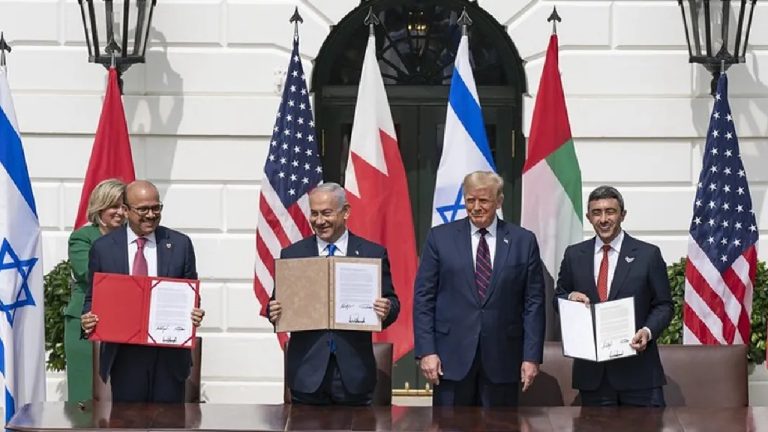
The Abraham Accords represent deliberate transition from ideological conflict toward pragmatic cooperation, from permanent grievance and proxy warfare toward regional integration and sovereign responsibility. These agreements resulted from sustained strategic effort, intellectual clarity, and unusual political courage. Jared Kushner’s statecraft and willingness to challenge failed orthodoxies deserve recognition. The Accords have endured through wars, regional shocks, and political transitions over five years, owing substantially to well-designed architecture of shared interests and serious implementation efforts.
Today, the United States, Israel, and Abraham Accords signatories confront dual challenges. The first remains overt and familiar: Hamas, Hizbullah, Houthis, and wider constellation of armed actors trained, financed, and politically shielded by Iran. The second proves more insidious: states speaking counterterrorism language while enabling Muslim Brotherhood-affiliated movements. They denounce extremism while empowering ideologues inside legitimate institutions, praise stability while tolerating and sponsoring destabilizing networks under state recognition protection.
Brotherhood Institutionalization in Yemen
In Yemen, these states support official governing authority penetrated by Brotherhood-aligned Islah party actors. This approach institutionalizes rather than defeats political Islam. Violent ideology undergoes bureaucratic laundering. International legitimacy shields long-term projects lacking genuine popular consent. Predictable outcomes emerge: Islamist networks embed themselves in ministries, security services, and patronage systems while presenting internationally as sole chaos alternatives. Meanwhile, external Houthi threat persists and Tehran retains leverage not through strength but through adversary division.
The central strategic question facing the contemporary Middle East concerns preventing Tehran from regenerating proxy capacity and exporting crisis as governing strategy. Iran itself demonstrates internal exhaustion signs. Regimes increasingly reliant on domestic coercion possess diminishing capacity to sustain complex external architectures indefinitely. Hizbullah, Hamas, and Houthis function not as autonomous actors but as extensions of an Iran supplying financing, coordination, weapons pipelines, and media support. As Tehran’s domestic legitimacy erodes, ideological credibility underpinning its proxies similarly diminishes.
Strategic Window for Coordinated Action
The present moment constitutes strategic window remaining temporarily open. Coordinated Western and regional action can exploit Iran’s internal strain to fragment proxy networks and raise asymmetric strategy costs beyond sustainability. However, coordination must prove operational rather than rhetorical: sanctions enforcement disrupting procurement, intelligence integration choking weapons routes, hardened maritime and air defenses, and diplomatic clarity denying legitimacy to ideological capture.
For states supporting violent Islamists including the Muslim Brotherhood, ambiguity must end. Strategic clarity constitutes survival logic, not moral theater. One cannot oppose Muslim Brotherhood while enabling its advance. One cannot fight terrorism while empowering regressive Islamist movements capturing governing institutions. One cannot defend Abraham Accords rhetorically while eroding their foundations practically.
Policy Coordination Requirements
The Netanyahu-Trump discussions should be understood as addressing how to fragment Iran’s proxy capacity while preventing its crisis export strategy. Iranian internal vulnerabilities create opportunities for coordinated pressure campaigns undermining regime stability and proxy network cohesion. Yet such pressure requires genuine operational coordination—disrupting procurement networks through sanctions enforcement, choking weapons routes through intelligence integration, hardening defenses, and maintaining diplomatic clarity denying legitimacy to ideological infiltration.
The Abraham Accords can still shape Middle East futures, but only if beneficiaries accept clarity’s costs. Strategic choices rather than intentions determine historical outcomes. The dual challenge from overt Iranian proxies and covert Brotherhood institutionalization demands unified response recognizing both threats undermine regional stability and Abraham Accords foundations.
States maintaining formal partnerships with Washington while sustaining Islamist institutional penetration create fundamental contradictions preventing coherent regional strategy. Brotherhood-aligned actors embedded in recognized governments provide neither genuine counterterrorism partnership nor democratic governance—instead offering ideological capture masquerading as legitimate authority.
The current regional moment demands choosing between strategic clarity and continued ambiguity. Those defending Abraham Accords must recognize that rhetorical support means nothing without concrete action against all extremist movements threatening regional order—whether Iranian-backed militias or Brotherhood-affiliated institutional infiltration. History records strategic choices, not stated intentions.
Original analysis by Ahmed Charai from Gatestone Institute. Republished with additional research and verification by ThinkTanksMonitor.