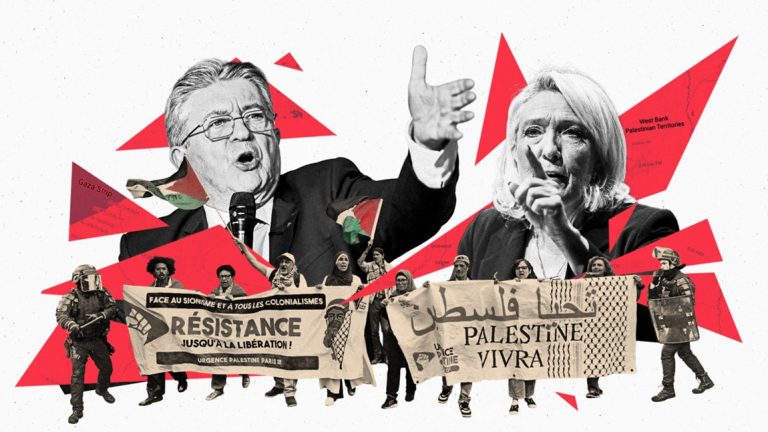
As France looks toward its upcoming 2027 presidential election, the political landscape is increasingly polarized between a surging far-right movement and a progressive left-wing bloc. Beyond domestic economic and social policies, commentators note that the electoral outcome will serve as a critical test for democratic freedoms, directly dictating how authorities police political dissent, free speech, and Palestine solidarity activism.
The Current Climate of Repression
Even under the current administration, the environment for pro-Palestinian advocacy has grown increasingly hostile. Since late 2023, authorities have frequently implemented strict protest bans, deployed tear gas and water cannons against demonstrators, and attempted to dissolve prominent solidarity organizations like Urgence Palestine under accusations of glorifying terrorism. University campuses have also witnessed intense crackdowns, with student activists facing severe disciplinary hearings and criminal charges for participating in solidarity occupations. Furthermore, legislative initiatives like the controversial Yadan bill—though ultimately withdrawn following fierce pushback—revealed a systemic effort to blur the lines between legitimate political critique of Israeli policy and unlawful antisemitism, threatening harsh penalties for speech critical of state actions.
Far-Right Gains and the Threat to Civil Liberties
A potential victory by the National Rally (NR), led by Marine Le Pen, would likely supercharge these restrictive measures. Having strategically repositioned the party as a defender of security and national identity, a far-right administration would inherit an extensive legal apparatus to suppress public demonstrations, shutter dissident groups, and prosecute online speech. On the international stage, a nationalist government would almost certainly align itself more closely with Israel, abandoning advocacy for Palestinian statehood, humanitarian aid, or international accountability. Activists and immigrant communities fear that a far-right presidency would institutionalize systemic discrimination and criminalize the very act of dissent.
Conversely, a victory by the progressive left, championed by figures like Jean-Luc Mélenchon and La France Insoumise, would chart a fundamentally different path. The left-wing coalition has consistently opposed protest bans, defended the right to criticize foreign governments, and advocated for the formal recognition of a Palestinian state alongside potential arms embargoes. Ultimately, the 2027 contest transcends traditional political boundaries, acting as a profound referendum on whether France will protect its foundational democratic freedoms or yield to authoritarian policing of public conscience.
Original analysis inspired by Oman Alyahyai from The New Arab. Additional research and verification conducted through multiple sources.