The release of the Trump administration’s 2025 National Security Strategy (NSS) has triggered a profound diplomatic realignment, effectively reversing decades of transatlantic consensus. While the 33-page document has been met with alarm in Berlin and Warsaw, it has found a receptive audience in the Kremlin.1 By framing European integration as a vector for “civilizational erasure” and prioritizing “patriotic” nationalism over collective defense, Washington appears to be dismantling the ideological pillars of NATO just as its members hit historic defense spending targets.2
Moscow’s Approval: A ‘Shared Vision’
The most telling reaction to the new U.S. doctrine came not from an ally, but from an adversary. Kremlin spokesman Dmitri Peskov publicly endorsed the document, describing it as “largely consistent” with Russia’s own worldview.3 This convergence is hardly coincidental; the NSS conspicuously avoids designating the Russian Federation as a primary threat, instead calling for a return to “strategic stability.”
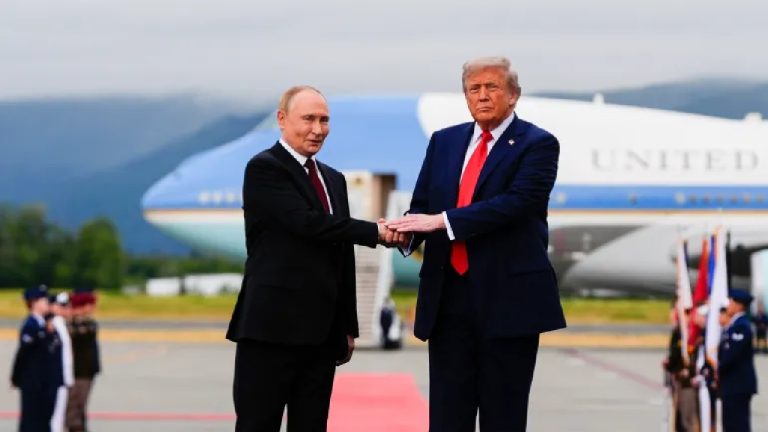
This rhetorical pivot aligns with recent diplomatic overtures, most notably the August 2025 summit between President Trump and Vladimir Putin at Joint Base Elmendorf-Richardson.4 For Moscow, the NSS represents a vindication of its long-standing narrative: that liberal internationalism, rather than Russian expansionism, is the true destabilizing force. The document’s focus on “stabilizing European economies” by normalizing relations with Russia suggests a potential unwinding of the sanctions regime, a move that would fundamentally undermine EU efforts to isolate the Russian war economy.
The ‘Patriotic’ Pivot and the Berlin Snub
The ideological core of the new strategy is a rejection of the European Union’s current political trajectory.5 Echoing the “America First” doctrine, the NSS pledges support for “patriotic parties” in Europe that oppose migration and champion national sovereignty.6 This stance formalizes the diplomatic breach initiated by Vice President J.D. Vance earlier this year.
Following his address at the Munich Security Conference in February, Vance pointedly bypassed the German Chancellery to meet with leaders of the far-right Alternative for Germany (AfD).7 This calculated diplomatic snub has only deepened tensions with the current government in Berlin. Under Chancellor Friedrich Merz, Germany has sought to stabilize the transatlantic bridge, but the NSS’s accusation that EU institutions engage in “censorship” and undermine “political liberty” places Washington in direct opposition to Germany’s constitutional defense of liberal democracy.
The PURL Paradox: Paying More for Less Support
The release of the NSS comes at a moment of bitter irony for NATO allies. In a bid to placate Washington’s demands, member states recently acquiesced to a dramatic increase in defense spending, targeting a new benchmark of 5 percent of GDP.8 Yet, this financial commitment has not secured the U.S. security guarantee they hoped for.
With the U.S. halting direct taxpayer-funded lethal aid to Ukraine, European allies and Canada were forced to establish the “Prioritized Ukraine Requirements List” (PURL). This mechanism requires allies to purchase U.S. weaponry and transfer it to Kyiv themselves—a massive wealth transfer to the American defense industrial base.9 Despite this concession, the new NSS criticizes the PURL initiative, characterizing it as an obstacle to peace. This contradiction—demanding Europe buy American weapons while simultaneously undermining their strategic use—has left officials in Brussels fearing that NATO is becoming a transactional marketplace rather than a security alliance.
A Crisis of Values
The reaction from European capitals has been one of disciplined outrage. Former Swedish Prime Minister Carl Bildt described the U.S. pivot as moving “to the right of the extreme right in Europe,” signaling a complete disconnect on shared values.
In Berlin, Foreign Minister Johann Wadephul attempted to compartmentalize the damage, asserting that while the U.S. remains Germany’s “most important ally,” domestic social policies regarding free speech and migration have no place in a security treaty.10 Meanwhile, Polish Prime Minister Donald Tusk appealed directly to the American public, reminding Washington that “Europe is your closest ally, not your problem.”11 Tusk’s comments highlight the growing fear in Warsaw that the U.S. is abandoning the Eastern Flank’s security architecture in favor of a great-power accommodation with Moscow.
Conclusion
The 2025 National Security Strategy marks the end of the post-Cold War Atlanticist consensus. By framing the European Union as an ideological rival and Russia as a potential stabilizing partner, the Trump administration has inverted the traditional map of American alliances.12 For Europe, the challenge is no longer just managing a difficult partner, but surviving a security environment where its oldest ally actively undermines its political cohesion. As the “PURL” scheme demonstrates, Europe is willing to pay for its defense, but it can no longer count on American moral leadership.
Original analysis inspired by Reuben Johnson from National Security Journal. Additional research and verification conducted through multiple sources.