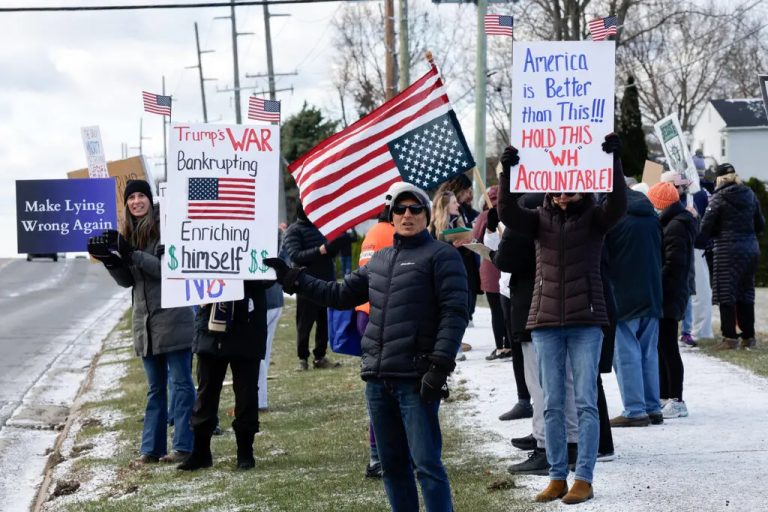
More than 3,000 events across the United States and around the world are taking place on Saturday under the banner of the No Kings movement — the largest coordinated demonstration against the Trump administration since it took office fourteen months ago. From Queens to Atlanta, from London to Paris, the protests are drawing people animated by a range of grievances: the war in Iran, immigration enforcement operations, a partial government shutdown straining airport security, and what organizers describe as a systematic assault on democratic institutions. The breadth of the agenda is intentional. This is a movement defined not by a single demand but by accumulated anger.
The No Kings coalition debuted in February 2025 on Presidents’ Day. It grew in June when Trump ordered a military parade in Washington on his birthday. It grew again in October. Saturday’s mobilization is the largest yet, and its timing is not coincidental — it comes as Brent crude trades above $100 a barrel, as thousands of additional U.S. troops prepare to deploy to the Middle East, and as midterm election forecasts show Republicans increasingly at risk of losing one or both chambers of Congress in November. The political pressure the movement is attempting to generate has a specific target date.
A Coalition Held Together by Grievance, Not Ideology
The movement’s deliberate lack of a single unifying demand has drawn criticism from organizers who prefer focused campaigns. But it has also enabled a breadth of participation that more targeted protests rarely achieve. In Atlanta, demonstrators shifted emphasis from immigration — the focus of earlier No Kings events there — toward the Iran war, the shutdown’s impact on air travel, and Republican-backed voting restrictions. In Queens, a march stretching multiple city blocks shut down traffic for an hour. In London, crowds carried caricatures of Trump, Vance, and Elon Musk, alongside posters referencing the Minab school strike that killed at least 175 people — most of them children — on the war’s opening day.
That image — a strike on an elementary school on February 28 — has become one of the conflict’s most politically resonant facts, appearing in protest signs from New Jersey to London. One demonstrator in Britain, a New Yorker who has lived in London for a decade, described the war as part of “a domestic political climate that includes the erosion of democratic institutions, democratic guardrails and unaccountable violence.” That framing — connecting foreign policy to domestic authoritarianism — reflects a deliberate organizing strategy: treating the Iran war not as a separate issue but as an expression of the same executive overreach that produced the immigration raids, the government shutdown, and the attacks on independent media.
What the Movement Is Actually Demanding
The No Kings website lists the Iran conflict and immigration operations as its two headline issues, describing the former as “an illegal, catastrophic war putting us in danger and driving up our costs” and the latter as “masked secret police terrorizing our communities.” The framing is deliberately populist — connecting the abstract costs of a foreign war to the tangible experience of $4-a-gallon gasoline and $200 grocery bills. Whether that connection lands with the persuadable voters who will determine November’s outcome is a different question, but the strategy is clear: make the war personal.
Veterans organizations including About Face and Common Defense have been visible participants in the movement, lending a credibility that purely activist-led campaigns often lack. Their presence addresses the class-coalition problem that has historically limited anti-war movements — the gap between the largely urban, educated demographics that dominate street protests and the working-class military communities whose children are most likely to be deployed. Whether Saturday’s turnout translates into durable cross-class organizing is the question that will determine whether No Kings becomes a political force or remains a recurring media event.
The White House dismissed the protests on Thursday as “Trump derangement therapy sessions.” That characterization reflects a calculation that the demonstrations will not move the needle with Trump’s core supporters — a bet that may prove correct. But it also misreads what sustained, visible public opposition does to the political environment over time. Public opinion on the Iran war has been running against the administration for weeks. Congressional Republicans in competitive districts are watching the street numbers alongside the polling numbers. The midterms are seven months away. The No Kings movement did not begin with enough political infrastructure to force a policy reversal. Whether it develops that infrastructure between now and November is the real story of Saturday’s marches.