When Iranian missiles and drones began slamming into Gulf capitals within hours of the first US-Israeli strikes on February 28, 2026, they shattered something more durable than glass and concrete. They destroyed the carefully constructed fiction that the Persian Gulf’s wealthy monarchies could host American military bases, pursue diplomatic engagement with Tehran, and remain insulated from the consequences of a regional war — all at the same time.
For the first time in history, a single actor struck all six Gulf Cooperation Council (GCC) states simultaneously within a 24-hour window. The UAE alone has absorbed more than 1,700 missiles and drones over ten days. Strikes sparked fires near luxury hotels in Dubai, caused panic at Kuwait’s international airport, and put Saudi Arabia’s largest oil refinery out of commission. Qatar’s emir had personally lobbied Washington not to use Gulf bases for operations against Iran. Oman’s foreign minister had been mediating the nuclear talks and appeared on American television days before the war to say a deal was “within reach.” Neither plea mattered. Iran’s response repaid years of Gulf good faith with a barrage more ferocious than anything directed at the countries that launched the war — in the early days, Iran fired more than twice as many ballistic missiles and approximately 20 times more drones at Gulf states than at Israel.
Caught Between Protector and Aggressor
The Gulf states now confront a dilemma with no clean exit. The United States’ Gulf partners were not given advanced notice of Operation Epic Fury, even though it was clear they would become one of Iran’s main targets in retaliatory strikes. Gulf leaders have expressed anger over the absence of prior warning, with one anonymous official telling reporters they were “angry that the US military has not defended them enough.”
In an interview with CNN, Trump called the attacks on the Gulf “probably the biggest surprise” of the war so far. It shouldn’t have been surprising. During Trump’s first-term “maximum pressure” campaign, Iran backed attacks on Saudi oil infrastructure in 2019 — and Washington’s response was tepid enough to convince Riyadh that diplomacy with Tehran was safer than reliance on American protection. In 2023, Saudi Arabia and Iran restored diplomatic relations under ostensible Chinese auspices, part of a broader regional trend toward de-escalation.
That rapprochement is now in ruins. Gulf states told CNBC that Iran’s attacks have created a “huge trust gap” that will last for years to come. Qatar’s prime minister described the strikes as a “big sense of betrayal” by Iran’s leadership. Anwar Gargash, adviser to UAE President Mohammed bin Zayed and an architect of the Gulf-Iran rapprochement, warned of “damage that extends beyond the war” in our relationship with Iran.
Yet the anger is not directed solely at Tehran. Prince Turki al-Faisal, the former chief of Saudi intelligence, told CNN that this was “Netanyahu’s war,” echoing growing allegations that Israel had convinced the US to launch the operation. Gulf states long believed that hosting US military bases would translate into American security support. But the US response to Iran-backed attacks in 2019 reinforced concerns that Washington would not come to their defense. Iran’s attacks on the Gulf — combined with the prospect of sustained instability — have increased the perceived risks of housing US military bases at a time when Gulf states are also questioning the benefits.
The Economic Wreckage
The damage to the Gulf’s brand as a safe haven for global capital may outlast the war itself. For years, the GCC states presented themselves as havens of stability and opportunity for mobile talent and capital. But attracting tourists, building data centers, and sustaining complex logistical hubs is difficult in the middle of an active war zone. Shooting down most drones and missiles is good in the short term, but likely not good enough when global firms are deciding where to invest.
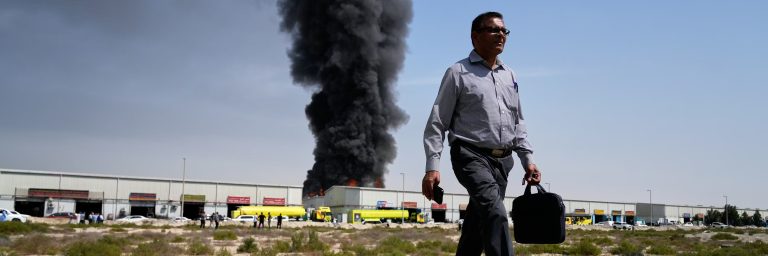
The numbers are grim. A fire broke out at the Ruwais Industrial Complex in Abu Dhabi after an Iranian drone strike, forcing ADNOC to shut down a refinery producing 922,000 barrels of oil per day. Qatar shut down its LNG exports — 20 percent of the global LNG market — after Iranian drones targeted key facilities at Ras Laffan. Bahrain’s state oil company declared force majeure on all shipments after its refinery was struck. Some expats have attempted to flee the country, with private jet evacuation costs reaching $250,000. Iranian drone strikes on UAE-based Amazon data centers speak directly to US concerns about placing critical AI infrastructure in the Gulf.
What Comes After
The former Australian ambassador Bob Bowker, writing for The Conversation, identifies the central tension Gulf leaders will face once the bombs stop: how to maintain a security relationship with a United States that is simultaneously indispensable and intolerable. The Gulf states hold $315 billion in US Treasury securities — leverage they have never seriously deployed. Their populations, particularly younger generations, are more educated, globally connected, and skeptical of American hegemony than any previous cohort. And Israel, despite the Abraham Accords, remains deeply unpopular across the region.
Iran’s bombardment of its Gulf neighbors has inexorably dragged them into a war they had desperately hoped to avoid. The potential entry of the UAE, Qatar, and Saudi Arabia into direct war alongside Israel and the United States represents the first full-scale manifestation of America’s ambitions for the Middle Eastern order it has overseen for decades. Washington has always dreamed of Arab-Israeli cooperation against Iran without resolving the Palestinian issue. Here it is. It would be no small irony if America’s Middle East reached its apotheosis just as the entire region collapsed into the abyss.
The Carnegie Endowment captured the paradox most sharply: Iran is counting on these reputation costs — and the threat of worse — to force Gulf rulers to lobby Trump for a ceasefire. The Gulf states, meanwhile, are discovering that the US security umbrella they paid for with base-hosting agreements, arms purchases, and Treasury holdings does not extend to protecting them from the consequences of wars they begged Washington not to start. Whether they emerge from this war as closer American allies or as nations shopping for alternatives — from European defense pacts to Chinese diplomatic umbrellas — may be the most consequential geopolitical question of the post-war Middle East.
Original analysis inspired by Bob Bowker from The Conversation. Additional research and verification conducted through multiple sources.