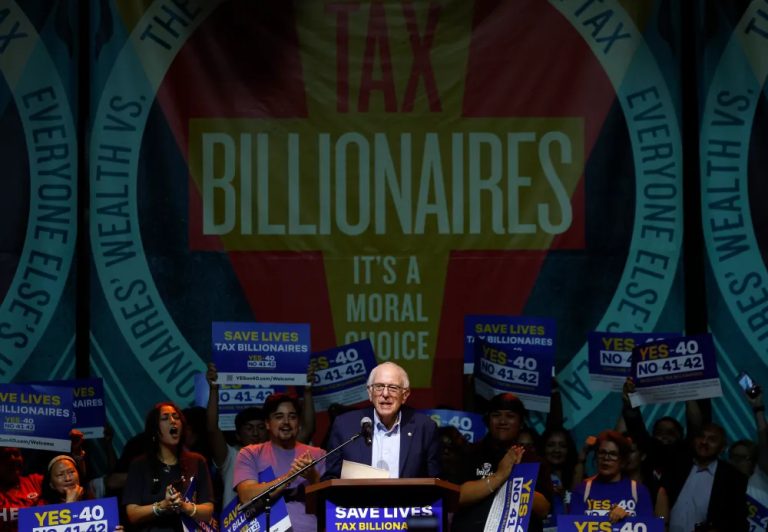
America’s 2026 midterms have turned growing public anger at billionaire influence into an election funded heavily by the very class voters increasingly distrust. Political advertising is projected to reach a record $11.6 billion this cycle, surpassing even spending during the 2024 presidential election. AdImpact projects that congressional, state and local contests are all contributing to the surge. The result is an election in which arguments about concentrated wealth are competing with unprecedented concentrations of political money.
Public attitudes have shifted significantly. A 2025 Harris Poll found that 53 percent of Americans believed billionaires threatened democracy, up seven points in a year, while 69 percent wanted them to play a smaller role in politics. Those concerns cross party lines, even if Democrats express them more strongly. Billionaire influence has consequently moved from a progressive talking point associated with Bernie Sanders into a broader debate over who exercises power in American democracy.
Unlimited Money Changes the Political Contest
The structure of campaign finance helps explain the scale of the spending. Federal rules limit how much an individual can contribute directly to a candidate, but the Federal Election Commission allows unlimited contributions to independent expenditure committees known as super PACs. That distinction has created a political system in which wealthy donors can spend enormous sums supporting candidates while remaining formally separate from their campaigns.
Money flowing through the wider political system is already immense. Federal Election Commission records show PACs raised more than $8.3 billion through June 30, while congressional candidates collected almost $2.8 billion. By October, AdImpact reported that congressional advertising alone had already reached $3.8 billion, with Republicans holding the spending advantage in most closely contested Senate races and many competitive House contests.
Elon Musk illustrates how much influence a single fortune can exert. Reuters reported in October that Musk had already spent roughly $366 million during the cycle to help Republicans retain control of Congress. Newsweek later calculated his total involvement at approximately $446 million. His spending is unusually large, but he is part of a wider donor ecosystem that includes major fortunes financing Republicans, Democrats, cryptocurrency interests and technology focused political groups.
This creates an awkward political reality for both parties. Republicans currently benefit from a particularly strong network of wealthy donors, but Democrats also rely on figures such as George Soros, Michael Bloomberg and Reid Hoffman. Candidates can condemn the political power of billionaires while accepting help from super PACs financed by them. That contradiction makes it difficult for either party to claim complete independence from the system it criticizes.
California Turns the Argument Into a Ballot Fight
California’s Proposition 40 brings the conflict directly to voters. The measure would impose a tax equal to 5 percent of the wealth of California residents with assets exceeding $1 billion. State analysis says 90 percent of the revenue would fund health care, while the remainder would support education, food assistance and administration. Officials estimate the proposal could generate tens of billions of dollars over several years.
Yet the campaign surrounding the measure demonstrates the political power its supporters want to reduce. California records show opponents raised about $130.3 million by October 22, compared with roughly $33.4 million for supporters. The fight has therefore become more than a tax debate. It is a live experiment in whether extraordinary private wealth can shape public decisions about extraordinary private wealth itself.
The political backlash is unlikely to disappear after November. Billionaire money now influences elections, technology regulation, taxation, cryptocurrency policy and debates over artificial intelligence. Crypto executives alone have spent tens of millions of dollars this cycle, Reuters found recently, often backing candidates from both parties depending on their policy positions.
The deeper issue is therefore not whether Democrats or Republicans have richer supporters. Both depend on concentrated private wealth to compete. The more consequential question is whether a political system financed this way can meaningfully restrict the influence of the people providing the money. The 2026 midterms suggest that voter resentment toward billionaire power is rising faster than Washington’s willingness to reduce its dependence on it.
Original analysis inspired by Jesus Mesa from Newsweek. Additional research and verification conducted through multiple sources.
By ThinkTanksMonitor