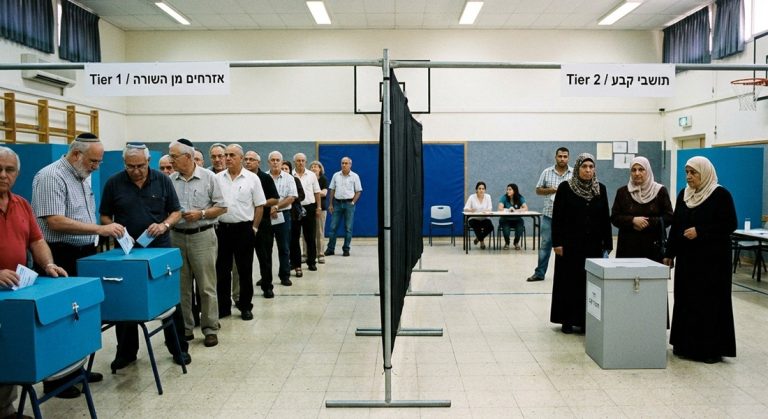
Public life inside Israel often presents an image of effortless diversity along coastal boardwalks and busy city streets. Defenders of the state regularly point to Palestinian citizens casting ballots or holding parliamentary seats as proof of an inclusive society. Yet the administrative machinery governing the October 2026 legislative vote reveals how quickly those democratic privileges can vanish. Democratic institutions do not automatically guarantee equal rights when the underlying constitutional order exists to preserve ethnic dominance.
In late September, the Central Elections Committee voted to ban the main Palestinian parliamentary slates, Raam and the Joint List, from competing in the national ballot. During the same session, committee members disqualified Balad party leader Sami Abu Shehadeh while clearing Jewish supremacist factions like Otzma Yehudit to run unimpeded. Although the Supreme Court later overturned the party bans on October 2, the ritualistic attempt to purge Arab representatives exposes a deep structural flaw. Even Mansour Abbas, who broke decades of Arab political taboo by joining an Israeli governing coalition in 2021, found his party fighting merely to appear on the ballot.
Constitutional Hierarchy and the Limits of Suffrage
This recurring electoral drama stems from a legal framework engineered during the earliest days of the state. Roughly 150,000 Palestinians who survived the 1948 expulsions inside the new borders received voting rights, yet they lived under strict military administration until 1966. State planners separated individual citizenship from collective nationality, reserving the latter exclusively for Jewish people worldwide. Consequently, a Jewish immigrant from New York or Paris enjoys immediate national rights and land access, while indigenous Palestinian citizens remain barred from reclaiming their ancestral villages.
For decades, secular Labor Zionism managed this contradiction through quiet institutional containment. Palestinian citizens could cast ballots and sit in the Knesset, provided they never challenged the ethnic character of the state. That delicate facade fractured after the 1967 territorial conquests energized religious nationalist movements that gradually moved from the ideological fringes into the heart of government. Modern right wing coalitions no longer hide behind liberal rhetoric, choosing instead to codify ethnic supremacy into explicit law.
When Arab lawmakers attempted to challenge this hierarchy in 2018 by introducing a bill defining Israel as a state for all its citizens, parliamentary leaders blocked the measure from even reaching the floor. weeks later, the Knesset approved the Nation State Basic Law, which formally declared that national self determination belongs solely to the Jewish people and elevated Jewish settlement to a constitutional value. Even failed legislative proposals against minority rights serve a clear purpose inside parliament, shifting public boundaries and making overt discrimination routine.
Public Sentiment and the Illusion of Reform
Years of exclusionary lawmaking and aggressive campaign rhetoric have steadily reshaped attitudes across the broader electorate. A landmark Pew Research Center survey previously found that 48 percent of Jewish Israelis favored expelling or transferring Arab citizens out of the country. That hostility has only grown more pronounced amid recent regional conflict. Data from the 2025 Israeli Democracy Index shows that 53 percent of Jewish respondents now support government policies encouraging Arab emigration, up from 36 percent in 2019, while just 16 percent believe Palestinian national identity can coexist with loyalty to the state.
These numbers highlight the central paradox facing Palestinian voters ahead of the late October polls. Decades of working within the parliamentary system have failed to halt the steady rise of political forces dedicated to their marginalization. Rather than offering a pathway to equality, this two tier electoral model allows the state to maintain a democratic veneer abroad while enforcing an entrenched ethnic hierarchy at home.
Original analysis inspired by Emad Moussa from The New Arab. Additional research and verification conducted through multiple sources.