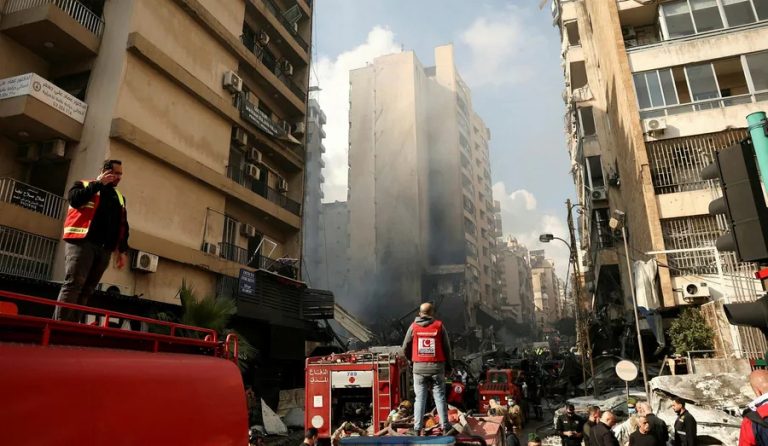
Less than twelve hours after the US-Iran ceasefire was announced, Israel launched “Operation Eternal Darkness.” In the span of ten minutes, 100 airstrikes were launched across Lebanon by Israel during the operation — targeting Hezbollah assets including headquarters, intelligence centers, missile infrastructure, sites related to the Radwan Force, and aerial and naval units. Lebanon’s Health Ministry said at least 303 people were killed and more than 1,000 wounded on Wednesday in Israeli strikes in central Beirut and other areas of Lebanon, with Prime Minister Salam declaring Thursday a “national day of mourning.” The ceasefire that took weeks to broker almost collapsed before the ink was dry — and the decision that nearly destroyed it was made in Jerusalem, not Tehran.
Netanyahu’s position is stark: after announcing that Israel wants direct negotiations with Lebanon on disarming Hezbollah and establishing peaceful relations, he said there is no ceasefire in place as he pursues the talks. That is not a paradox — it is a strategy. The Lebanese government, supported by France, has been proposing holding direct peace talks with Israel for several weeks, in an initiative meant to help de-escalate the war in Lebanon, prevent a prolonged Israeli occupation of southern Lebanon, increase international pressure to disarm Hezbollah, and open the door to a historic peace deal. The French gave the proposal to both Israel and the Trump administration — and the Israelis rejected the proposal and refused to negotiate, with Israeli officials saying Netanyahu and his Cabinet preferred to escalate their war against Hezbollah.
That changed only when Washington intervened. On Wednesday, after pressure from the White House — which is concerned the crisis in Lebanon will lead to the collapse of the ceasefire with Iran — Netanyahu changed course. Trump told NBC News in an interview that he asked Netanyahu to be “a little more low-key” in operations in Lebanon as the US seeks to negotiate an agreement to end the war with Iran, with sources confirming that Netanyahu’s decision to seek direct negotiations with Lebanon came at Trump’s request.
The Ceasefire’s Central Tripwire
Iran has made its position unambiguous. Foreign Minister Araghchi wrote on X that the terms of the ceasefire are “clear and explicit: the US must choose — ceasefire or continued war via Israel. It cannot have both.” He added: “The world sees the massacres in Lebanon. The ball is in the US court, and the world is watching whether it will act on its commitments.” The consequences are not theoretical. Iran was clear in its 10-point proposal that Israel and Washington must halt attacks on all of its allies — including Hezbollah — for the two-week ceasefire to hold and for negotiations to begin. Israel’s continued bombardment of Lebanon is now violating Tehran’s red lines, analysts point out, and could derail the fragile truce between the US and Iran.
Lebanon’s government, for its part, has responded to Netanyahu’s negotiation offer with a condition that makes the sequencing problem plain: an official source told Al Jazeera that there will be no talks before a ceasefire is secured. A senior Israeli official told Channel 12 that Israel is open to negotiations, but they will take place without a ceasefire. Two positions that cannot both be satisfied simultaneously are now the basis on which all parties are being asked to proceed.
Hezbollah’s own stance leaves even less room for optimism. Hezbollah lawmaker Ali Fayyad stated that the group rejects direct negotiations with Israel and said that the Lebanese government should demand a ceasefire as a precondition before further steps. Hezbollah’s leadership rejected US proposals, calling them a form of “surrender,” and said disarmament would only be possible after Israel fully withdraws from southern Lebanon.
The Disarmament Question Nobody Can Answer
At the center of the Lebanon crisis is a demand — Hezbollah’s full disarmament — that has been on the table for two decades and has never been achieved. Hezbollah is widely described as comparable to or stronger than the Lebanese Armed Forces in military power, with its better discipline, experience, and weaponry giving it “clearly” better military and combat capacity than the LAF. The Lebanese Armed Forces teeter on the brink of collapse, with Qatar funding their payroll and the US supplying rudimentary equipment, while soldiers often have to moonlight as nightclub bouncers and Uber drivers to survive — with logistics that verge on the farcical.
Lebanon’s externally driven push to disarm Hezbollah reveals a deeper crisis of sovereignty, as the state lacks the legitimacy, institutional capacity, and public trust necessary to reclaim monopoly over force without risking deeper instability and communal backlash. Even Lebanon’s own information minister admitted the army’s limited capacity when the disarmament plan was announced. Attempts to disarm Hezbollah without political, economic and institutional transformation will likely provoke communal backlash and further weaken the state.
The UNIFIL precedent reinforces the concern. The UN Interim Force in Lebanon has documented more than 10,000 ceasefire violations from Israel — 7,500 in the country’s airspace and 2,500 on the ground. That accumulated record of Israeli disregard for existing UN resolutions is precisely why Hezbollah’s support base rejects disarmament as a security risk. Although Hezbollah’s autonomous military posture is incompatible with a sovereign national defense policy, its support base — shaped by state failure, insecurity, historical marginalization and repeated external attacks — cannot be dismissed. Many Shia view its arms not simply as leverage but as a security guarantee in an inequitable system.
A Political Exit That Requires Honesty
Lebanon’s President Aoun has shown more strategic clarity than Netanyahu on this question. Earlier on Thursday, Lebanon’s President Joseph Aoun said that a ceasefire with Israel, followed by “direct negotiations,” was the “only solution” to the conflict. Lebanon’s cabinet also instructed security forces to restrict weapons in Beirut exclusively to state institutions, with Prime Minister Nawaf Salam directing that “the army and security forces are requested to immediately begin reinforcing the full imposition of state authority over Beirut governorate and to monopolise weapons in the hands of legitimate authorities alone.”
That is precisely the direction that credible analysts recommend. Disarmament should be the culmination of state rebuilding, not its precondition — if the state can defend its borders, uphold citizens’ rights, deliver services, and integrate all communities in a national framework, the rationale for having arms outside state control will erode. Lebanon’s recent assertion of state sovereignty will only be realized if state capacity and legitimacy are rebuilt first.
The battle to disarm Hezbollah has been shaping up to be a main focus of Israelis, renewing the debate: can force alone deliver security, or does the absence of a political strategy risk open-ended conflict? Israel’s own history in Lebanon answers that question. Its 1982 invasion lasted eighteen years and ended without achieving its stated objectives. The UN Security Council’s Resolution 1701, agreed after the 2006 war, required the same Hezbollah disarmament Israel is now demanding by force — and was never implemented, in part because Israel never fulfilled its own obligations under the agreement. The pattern is not incidental. It is structural. Bombing Hezbollah infrastructure while simultaneously blocking the diplomatic track that might actually produce a political settlement is not a strategy. It is the maintenance of a permanent conflict whose costs are now threatening to sink the only negotiated exit from the wider Iran war that Washington has managed to produce.
Original analysis inspired by Haaretz Editorial Board from Haaretz. Additional research and verification conducted through multiple sources.