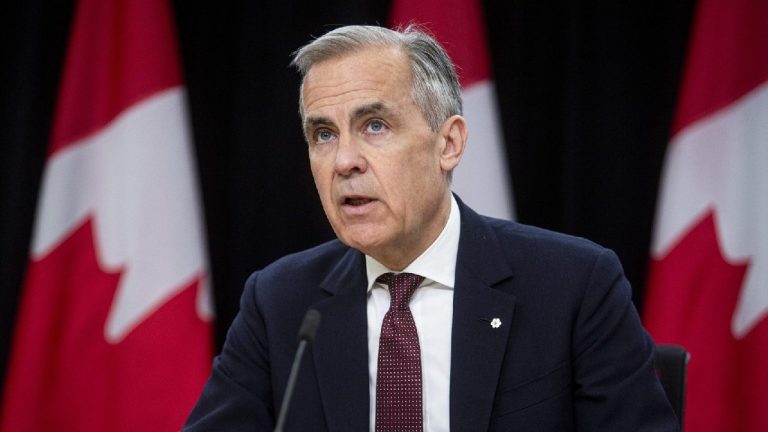
Canadian Prime Minister Mark Carney captivated global audiences at Davos with a bold declaration that the rules-based international order had collapsed. Yet as Palestinian civilians continue to die under a nominal ceasefire, Ottawa’s refusal to translate rhetorical clarity into concrete action exposes the central contradiction facing middle powers that champion international law in the abstract while ignoring its most urgent test case.
The Davos Moment and Its Discontents
When Mark Carney took the stage at the World Economic Forum on January 20, he delivered what many commentators described as the most consequential speech of the annual summit. The Canadian leader declared that the old international order “is not coming back,” acknowledged that powerful states had always exempted themselves from the rules they claimed to uphold, and positioned Canada as a nation prepared to “stop pretending” and “name reality.” The address earned widespread praise for its frankness about the selective application of international law, with Carney noting that legal accountability had always varied depending on the identity of the accused or the victim.
Days later, Carney reinforced this moral framing in his International Holocaust Remembrance Day statement, marking the liberation of Auschwitz-Birkenau. In language that seemed deliberately chosen for its breadth of application, the Prime Minister cautioned that “looking away is not a passive act, but an active betrayal.” These two interventions — one analytical, one moral — established an unusually high standard against which Canadian foreign policy would inevitably be measured.
That measurement came almost immediately. On January 31, a series of deadly Israeli military operations across Gaza killed at least 31 Palestinians in a single day, including multiple children and elderly civilians, during what is nominally a ceasefire period. Ottawa issued no condemnation and took no visible diplomatic action, leaving a conspicuous silence where Carney’s stated principles demanded speech.
A Ceasefire in Name Only
The gap between the formal truce that took effect on October 10, 2025, and conditions on the ground represents one of the most glaring failures of international diplomatic machinery in recent memory. Documentation compiled by Al Jazeera based on Gaza government records shows that by late January 2026, over 1,450 ceasefire violations had been recorded. These include hundreds of incidents involving direct fire at civilians, raids on residential areas, demolitions of homes, and sustained bombing and shelling campaigns.
The Palestinian Centre for Human Rights has documented a steady drumbeat of lethal incidents throughout the supposed truce period. On January 31 alone, predawn airstrikes struck a residential building in western Gaza City, killing five members of one family — three children aged seven, five, and three, along with their aunt and grandmother. Simultaneously, a missile hit a tent encampment in the al-Mawasi area, killing seven members of the Abu Hadayed family spanning three generations. In total, approximately 60 Palestinians were killed between January 31 and February 4, a rate of roughly one death every two hours.
The UN Office for Human Rights has confirmed that civilian killings have continued unabated after the ceasefire’s formal commencement, raising fundamental questions about the legal and diplomatic status of an agreement that one party systematically violates while the international community looks on. These are not isolated incidents but part of a documented pattern that makes the use of the word “ceasefire” increasingly difficult to sustain.
Ottawa’s Arms Pipeline Undercuts Its Own Principles
Beyond silence, Canada’s material contribution to the ongoing violence presents an even more damaging contradiction. Despite official claims that no new arms export permits for use in the Gaza conflict have been approved since January 2024, a comprehensive November 2025 investigation by Arms Embargo Now revealed that Canadian military components — including parts for F-35 fighter jets — continue to reach Israel through an indirect route via American weapons manufacturers. The report documented how a regulatory loophole allows Canadian defence firms to ship components to US facilities, which then integrate them into weapons systems ultimately delivered to the Israeli military.
This finding was corroborated by CBC reporting that Canadian Crown corporations reviewed US-bound arms exports over concerns about their potential end use in Israel. A SIPRI backgrounder on arms exporters’ responses to the Gaza war placed Canada within a broader pattern of Western nations that have adjusted formal export policies while maintaining substantive military supply relationships. Former Amnesty International Canada Secretary General Alex Neve has characterised the situation as a “constant pipeline of weapons systems, components, and military technology originating in Canada” that directly supports ongoing operations in Gaza.
The humanitarian dimension compounds the moral weight of these arms transfers. Despite commitments in the Trump administration’s 20-point ceasefire framework that full aid would immediately flow into the Gaza Strip, UNRWA has confirmed that Israel continues to block agreed-upon quantities of humanitarian supplies. Local government officials report that only approximately 25,000 of the 60,000 required aid trucks have entered the territory since the ceasefire began, leaving 2.4 million people in increasingly desperate conditions.
The Credibility Test for Middle Power Diplomacy
Carney’s Davos address was not merely a comment on global affairs but a strategic positioning statement for a new era of middle power diplomacy. He explicitly claimed for Canada “the capacity to stop pretending, to name reality, to build our strength at home, and to act together.” This framing resonated widely precisely because it acknowledged what many smaller and mid-sized nations have long known: that the rules-based order functions selectively, and that powerful states treat international law as optional when their interests or allies are implicated.
Yet the very insight that made Carney’s speech compelling also establishes the standard by which his government’s actions must be judged. The International Court of Justice’s October 2025 advisory opinion on Israel’s obligations in the Occupied Palestinian Territory reinforced the legal framework that binds not only the occupying power but all states with knowledge of violations. The ruling built upon the Court’s landmark July 2024 advisory opinion, which found Israel’s presence in the Palestinian territories inconsistent with international law, and outlined obligations for third-party states — obligations that Canada, as a self-declared champion of rules-based governance, cannot plausibly claim ignorance of.
An analysis by the French Institute of International Relations has identified a growing trend of middle powers using international legal mechanisms to assert influence amid global polarization. South Africa’s ongoing genocide case before the ICJ exemplifies one model of middle power engagement. Canada, however, has chosen a different path — articulating the diagnosis without administering the remedy, a posture that risks undermining the very credibility Carney sought to build at Davos.
What Naming Reality Would Actually Require
If Canada’s declared path is to confront uncomfortable truths rather than perpetuate diplomatic fictions, several concrete steps would demonstrate that commitment. Closing the regulatory loophole that permits Canadian military components to reach Israel via third-country transfers would align policy with stated principle. Supporting enforcement mechanisms at the International Criminal Court, endorsing arms embargo resolutions at the United Nations Security Council, and conditioning diplomatic relationships on compliance with ceasefire terms would transform rhetoric into action.
Middle powers do not forfeit influence by insisting on consistent application of international law. On the contrary, their legitimacy derives precisely from their willingness to apply principles universally rather than selectively. The nations and peoples who have suffered most from the old order’s hypocrisy — in Gaza, in Sudan, in Lebanon — understand better than anyone that international law was never equally applied. What they seek from states like Canada is not the acknowledgment of that failure, which Carney provided eloquently at Davos, but the commitment to build something different, which Ottawa has yet to demonstrate.
The test of whether Carney’s vision represents a genuine reorientation of Canadian foreign policy or a well-crafted rhetorical exercise will not be settled at future summits or in carefully worded statements. It will be settled by whether Canada acts on the implications of its own analysis — beginning with the conflict where international law’s collapse is most visible, most documented, and most lethal.
Original analysis inspired by Ghada Ageel from Middle East Eye. Additional research and verification conducted through multiple sources.