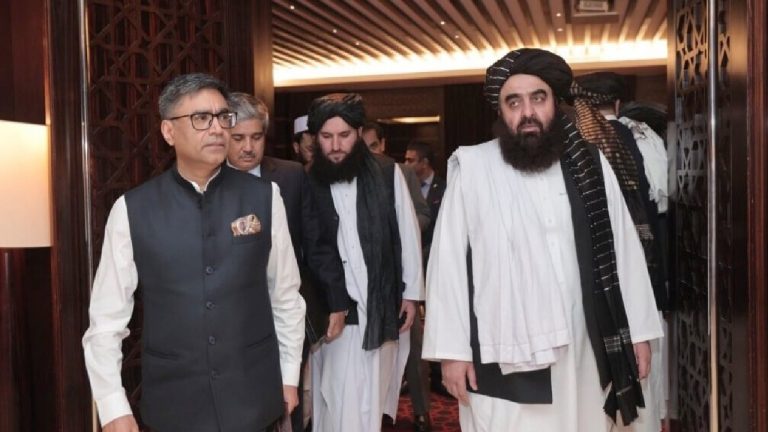
Strategic calculations rather than ideological alignment drive India’s cautious diplomatic expansion into Taliban-controlled Afghanistan. As regional power dynamics shift with Pakistan’s declining influence and China’s growing presence, New Delhi faces competing pressures: maintaining connectivity to Central Asia while avoiding formal legitimization of a regime whose governance contradicts India’s democratic values.
Pakistan’s Border Conflict Opens Diplomatic Space for India
The deteriorating security relationship between Islamabad and Kabul created unexpected opportunities for Indian diplomacy. Pakistan launched airstrikes on October 9, 2025, targeting multiple Afghan provinces in operations aimed at Tehrik-e-Taliban Pakistan (TTP) militants allegedly operating from Afghan territory. These strikes resulted in 37 civilian deaths and 425 injuries according to UN assessments, triggering retaliatory Taliban attacks on Pakistani border posts.
This escalation coincided precisely with New Delhi’s most significant diplomatic initiative toward the Taliban administration. While Pakistani warplanes struck Kabul, India hosted Afghan Foreign Minister Amir Khan Muttaqi for the first high-level Taliban visit since the 2021 power transition. The timing highlighted shifting regional alignments—Pakistan conducting military operations against its former protégés while India pursued diplomatic normalization.
Peace negotiations in Istanbul throughout November achieved minimal progress, leaving bilateral tensions elevated. This sustained friction between traditional allies Pakistan and Afghanistan fundamentally alters South Asian geopolitics, creating space for competitors to expand influence that Islamabad once considered its exclusive domain.
The strategic implications extend beyond immediate diplomatic gains. Pakistan’s inability to manage its relationship with the Taliban administration undermines decades of investment in Afghan proxies, while demonstrating the limits of military force in dictating outcomes across the Durand Line.
Embassy Reopening Signals Pragmatic Engagement Over Ideological Consistency
New Delhi announced embassy restoration on October 10, 2025, upgrading the limited technical mission maintained since 2022 to full diplomatic representation. External Affairs Minister Subrahmanyam Jaishankar framed the decision as supporting Afghanistan’s development while strengthening regional stability—carefully avoiding language suggesting political recognition.
This distinction carries significance. Only Russia among nations with Kabul embassies has formally recognized Taliban governance, while approximately twelve countries including China, Iran, Pakistan and Turkey maintain diplomatic presence without conferring legitimacy. India joins this intermediate category—operational engagement without normalization.
The embassy reopening followed extensive deliberations about reputational risks. Female journalists were excluded from Muttaqi’s initial New Delhi press conference, generating immediate domestic criticism and requiring a subsequent media event with women present. Such incidents underscore the contradictions inherent in cooperating with an administration whose policies fundamentally oppose Indian democratic values.
Chatham House analysts characterize India’s approach as realist rather than endorsing, noting that maintaining diplomatic presence serves national interests regardless of governing regime palatability. This calculation prioritizes strategic positioning over moral consistency—a shift reflecting regional security imperatives and economic connectivity requirements.
The embassy functions as intelligence gathering platform, commercial liaison, and political signal simultaneously. It demonstrates Indian commitment to Afghan engagement while hedging against Chinese and Pakistani influence expansion, all without the constraints formal recognition would impose.
Economic Connectivity Through Iran Becomes Strategic Imperative
India’s investment in Iran’s Chabahar Port infrastructure represents more than commercial development—it constitutes geopolitical repositioning designed to bypass Pakistani territory entirely. Trade between India and Afghanistan currently exceeds $1 billion annually, flowing through this Iranian corridor that connects to the Zaranj-Delaram highway India constructed within Afghanistan.
The port’s strategic value intensified following border closures between India and Pakistan in May 2025 after renewed hostilities. With traditional land routes blocked, Chabahar functions as India’s sole reliable access point for Afghan and Central Asian markets. India signed a ten-year management agreement for the Shahid Beheshti terminal in 2024, committing $370 million toward port development.
Western sanctions on Iran complicate this arrangement. The Trump administration provided India with sanctions waivers recognizing Chabahar’s role in Afghan connectivity, though these exemptions require periodic renewal. The October 2025 extension lasted only six months, creating persistent uncertainty about long-term operational viability.
Afghanistan’s Taliban administration recognizes this corridor’s importance. Kabul announced $35 million in Chabahar infrastructure investment despite ongoing tensions with Tehran over water rights and refugee deportations. This commitment reflects Afghanistan’s strategic interest in diversifying trade routes beyond Pakistani control—an objective aligning with Indian priorities.
The port integrates into broader connectivity frameworks including the International North-South Transport Corridor, potentially linking Indian commerce through Iran to Russia and European markets. Such infrastructure investments yield compound returns over decades, establishing physical facts that outlast temporary political tensions.
Human Rights Contradictions Challenge Democratic Credentials
India’s engagement confronts fundamental value conflicts. The International Criminal Court issued arrest warrants in July 2025 for Taliban Supreme Leader Haibatullah Akhundzada and Chief Justice Abdul Hakim Haqqani, charging them with crimes against humanity based on systematic gender persecution.
ICC judges found reasonable grounds that Taliban policies severely deprive women and girls of education, privacy, family life, movement, expression, thought, conscience and religion. The warrants also cite persecution of individuals whose sexuality or gender identity conflicts with Taliban gender ideology. These charges represent unprecedented international judicial action against governance-level gender discrimination.
For India—positioning itself as the world’s largest democracy and fourth-largest economy—such associations carry reputational costs. Domestic constituencies question cooperation with administrators facing international prosecution for systematic human rights violations. Opposition politicians characterize Taliban engagement as betraying democratic principles for transactional advantage.
Yet international responses remain muted. Western nations conduct their own cautious Taliban engagements focused on migration management and counterterrorism coordination. The UN Security Council exempted Muttaqi from travel bans specifically to enable his India visit, signaling growing acceptance of limited diplomatic interaction despite absent formal recognition.
This permissive environment suggests that while democratic values shape rhetoric, strategic imperatives determine behavior. Nations across the political spectrum engage Taliban authorities when interests require it, maintaining public distance while pursuing practical cooperation. India navigates these contradictions no differently than others, though perhaps with greater visibility given its democratic brand.
The moral hazard emerges gradually. Each diplomatic engagement normalizes Taliban governance incrementally, potentially weakening pressure for policy reform. Yet complete isolation achieved nothing during the 1990s beyond ensuring malign actors filled resulting vacuums.
Constrained Cooperation: Transactional Rather Than Transformational
New Delhi’s approach emphasizes limited objectives over comprehensive partnership. Beyond embassy restoration, India committed to maintaining existing development projects while initiating six new programs focused on infrastructure, food security, education and institutional capacity. These initiatives avoid entanglement in governance reform while building goodwill among Afghan populations.
Air connectivity expansion facilitates both diplomatic and commercial interaction. Direct flights between New Delhi and Kabul reduce dependence on third-country transit, lowering transaction costs for bilateral exchange. Streamlined visa procedures for Afghan nationals enable business travel, educational opportunities and familial connections—soft power assets building long-term influence.
Muttaqi invited Indian companies into mining and construction sectors, recognizing India’s historical development partnership role. Prior to 2021, New Delhi invested over $3 billion in Afghan infrastructure including the Salma Dam, Afghan Parliament building, and Indira Gandhi Children’s Hospital. These visible projects generated enduring public goodwill that current cooperation leverages.
However, cooperation faces structural limits. Taliban governance priorities conflict fundamentally with Indian democratic norms, constraining partnership depth. Women’s systematic exclusion from education, employment and public life contradicts principles India promotes internationally. Religious minorities face persecution inconsistent with India’s pluralist self-image.
These ideological gaps ensure engagement remains transactional—exchanging specific benefits rather than building comprehensive alliance. India provides development assistance and market access; Afghanistan offers strategic positioning and counterterrorism assurances. Neither side expects value alignment, only mutual advantage.
Regional Competition Shapes Strategic Calculations
China’s expanding regional footprint motivates Indian positioning. Pakistan, China and Afghanistan held trilateral foreign minister meetings in July 2025 discussing China-Pakistan Economic Corridor extension into Afghan territory. Such initiatives could reestablish economic integration between Islamabad and Kabul despite current tensions, potentially marginalizing Indian influence.
Beijing pursues systematic Central Asian engagement through Belt and Road infrastructure investments, creating economic dependencies that translate into political leverage. Afghanistan’s mineral resources—including lithium deposits critical for battery production—attract Chinese commercial interest. Without competitive positioning, India risks exclusion from economic opportunities and strategic influence in territories it considers vital security periphery.
Western foreign aid to Afghanistan declined by more than 65% since 2021, creating funding gaps that regional powers can exploit. Nations providing economic assistance gain corresponding policy influence, shaping Taliban administration decisions through resource allocation. India’s development programs serve both humanitarian and strategic functions—addressing Afghan needs while securing political access.
Pakistan’s capacity to rebuild Taliban relations depends partly on resolving TTP sanctuary issues, but also on demonstrating economic value. If Islamabad successfully integrates Afghanistan into CPEC frameworks despite current friction, India’s emerging influence could prove ephemeral. Conversely, sustained Pakistan-Afghanistan tensions create extended windows for Indian engagement without Pakistani competition.
Russia maintains its own Afghan interests, balancing security concerns about Islamic extremism with opposition to Western influence. Moscow’s formal Taliban recognition and arms sales discussions indicate priorities distinct from Indian calculations, though both nations share interests in stability and connectivity.
These overlapping competitions create complex diplomatic terrain where temporary alignments shift based on immediate advantages rather than enduring partnerships. India navigates these dynamics pragmatically, cooperating with Iran despite US pressure, engaging Taliban despite ideological conflicts, and maintaining Pakistan competition despite periodic dialogue initiatives.
Future Scenarios: Peripheral Player or Western Hinge?
India’s ultimate position within Afghan geopolitics remains contingent on variables beyond its control. If Pakistan successfully reconciles with the Taliban administration and implements CPEC extension, India’s influence could stagnate at current levels—providing aid and maintaining presence without shaping major decisions. Alternative outcomes where sustained Pakistan-Afghanistan tensions persist would enable expanded Indian engagement across multiple sectors.
Afghanistan’s economic needs create opportunities for any nation offering development resources without demanding political reforms. Taliban authorities prioritize legitimacy through economic performance, making them receptive to investment partnerships that generate employment and infrastructure regardless of donor ideology. This pragmatism benefits India if it scales humanitarian assistance into comprehensive development programs.
Western aid reduction and economic isolation increase Afghanistan’s regional dependence, potentially advantaging whoever fills funding gaps. However, India’s capacity to provide large-scale economic assistance remains limited compared to China’s resources or historical Western commitments. New Delhi can offer targeted programs in education, agriculture and small infrastructure, but lacks resources for transformative investment.
The Chabahar corridor’s viability depends significantly on US sanctions policy toward Iran. Sustained waivers enable continued Indian operations; waiver termination would severely constrain Afghan connectivity while potentially forcing renewed reliance on Pakistani routes. This external dependency limits India’s autonomous action regardless of bilateral agreements with Taliban authorities.
Broader regional realignments including US-India relations and India-China dynamics will shape possibilities. Recent reports indicate both cooling US-India ties and warming India-China connections, though these remain preliminary assessments requiring verification. Significant shifts in major power relationships could fundamentally alter incentive structures guiding Indian policy toward Afghanistan and neighboring states.
Conclusion: Strategic Hedging Amid Uncertainty
India’s Taliban engagement represents calculated risk management rather than confident strategy. New Delhi expands presence opportunistically when Pakistani weakness creates openings, while maintaining deniability through absent formal recognition. This intermediate position allows flexible response to evolving circumstances without irreversible commitments.
The approach acknowledges Afghanistan’s centrality to Indian interests—as potential terrorism safe haven, trade corridor to Central Asia, and arena for great power competition. Complete disengagement would cede influence to rivals; comprehensive partnership would compromise democratic credibility and expose India to governance failures it cannot control.
Transactional cooperation offers middle ground: sufficient engagement to protect interests and maintain options, limited enough to preserve distance from Taliban policies and minimize exposure to regime instability. Whether this threading of needles proves sustainable depends on factors largely beyond Indian control—Pakistan’s relationship trajectory, China’s investment levels, Western sanctions persistence, and Taliban governance evolution.
The ultimate test will be whether India can translate current access into enduring influence, or whether today’s opportunities represent temporary windows that close once regional alignments stabilize along different axes. For now, New Delhi pursues incremental gains while hedging against multiple futures—hardly inspiring strategy, but perhaps realistic given surrounding volatility.
Original analysis inspired by Bethlehem Eshetu from Newlines Institute. Additional research and verification conducted through multiple sources.